

Mid-ocean ridge basalt (MORB) is one of Earth’s most
common and most intensely studied rock types. Murray
and Renard (1891) published an early account of the composition of MORB, demonstrating that it was similar in
major element composition to basalts erupted on land.
Major progress in understanding the range of compositions of volcanic rocks erupted on mid-ocean ridges began
roughly 75 years later, with the exploration and sampling
of ridges during the early years of testing and acceptance
of the theory of plate tectonics. Initially, samples were collected mostly by dredging, although by the 1970s, scientists had also begun to deploy both human-occupied
submersibles, such as Alvin, to directly observe and sample the seafloor (e.g., Ballard and Van Andel, 1977), and
to use drilling, via the Deep Sea Drilling Project (DSDP)
and its successor programs to recover intrusive rocks from
beneath the seafloor. Evidence that these mid-ocean ridge
volcanoes were underlain by active magmatic systems
came via the discovery of warm springs on the Galápagos
Spreading Center in 1977 (Corliss et al., 1979) and hot
springs on the East Pacific Rise in 1979 (Spiess et al.,
1980). Soon thereafter, ever-improving observational
technologies paved the way for discoveries of specific
eruptions (e.g., Embley et al., 1991; Haymon et al.,
1993; see also reviews in Baker et al., 2012; Rubin et al.,
2012). Exploration and monitoring of mid-ocean
ridges continue to this day as we expand our understanding of magmatism and volcanism there. Current understanding of the recent volcanic history of several
submarine mid-ocean ridge volcanoes now rivals
that at volcanoes on land (Rubin et al., 2012; Clague
et al., 2013).
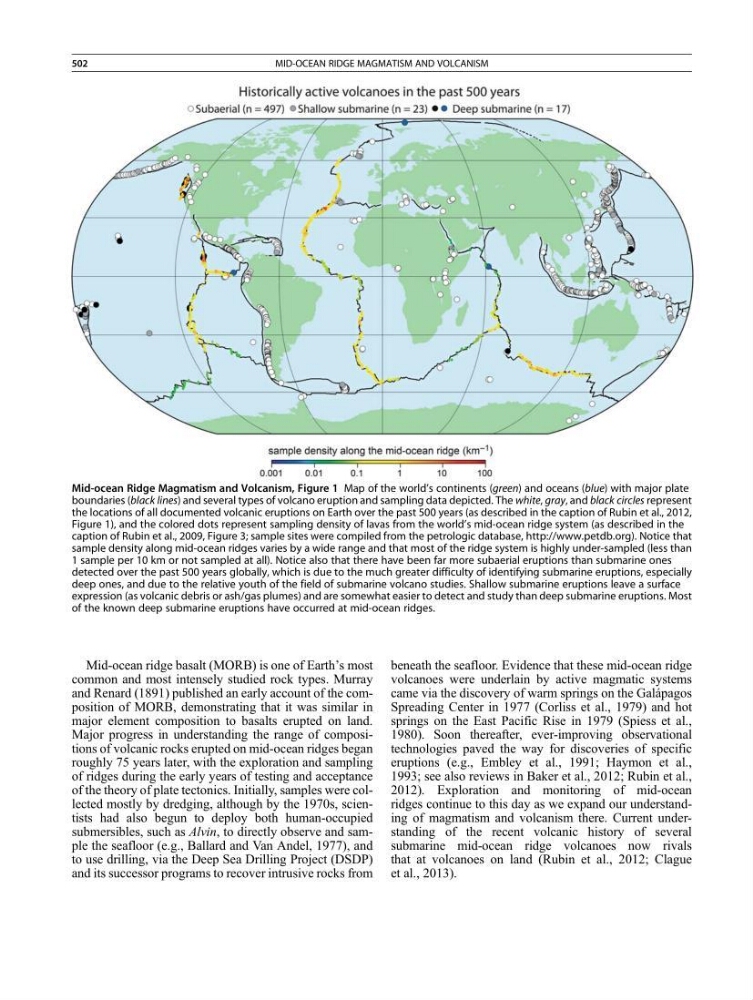
Mid-ocean Ridge Magmatism and Volcanism, Figure 1 Map of the world’s continents (green) and oceans (blue) with major plate
boundaries (black lines) and several types of volcano eruption and sampling data depicted. The white, gray, and black circles represent
the locations of all documented volcanic eruptions on Earth over the past 500 years (as described in the caption of Rubin et al., 2012,
Figure 1), and the colored dots represent sampling density of lavas from the world’s mid-ocean ridge system (as described in the
caption of Rubin et al., 2009, Figure 3; sample sites were compiled from the petrologic database, http://www.petdb.org). Notice that
sample density along mid-ocean ridges varies by a wide range and that most of the ridge system is highly under-sampled (less than
1 sample per 10 km or not sampled at all). Notice also that there have been far more subaerial eruptions than submarine ones
detected over the past 500 years globally, which is due to the much greater difficulty of identifying submarine eruptions, especially
deep ones, and due to the relative youth of the field of submarine volcano studies. Shallow submarine eruptions leave a surface
expression (as volcanic debris or ash/gas plumes) and are somewhat easier to detect and study than deep submarine eruptions. Most
of the known deep submarine eruptions have occurred at mid-ocean ridges.
502
MID-OCEAN RIDGE MAGMATISM AND VOLCANISM