

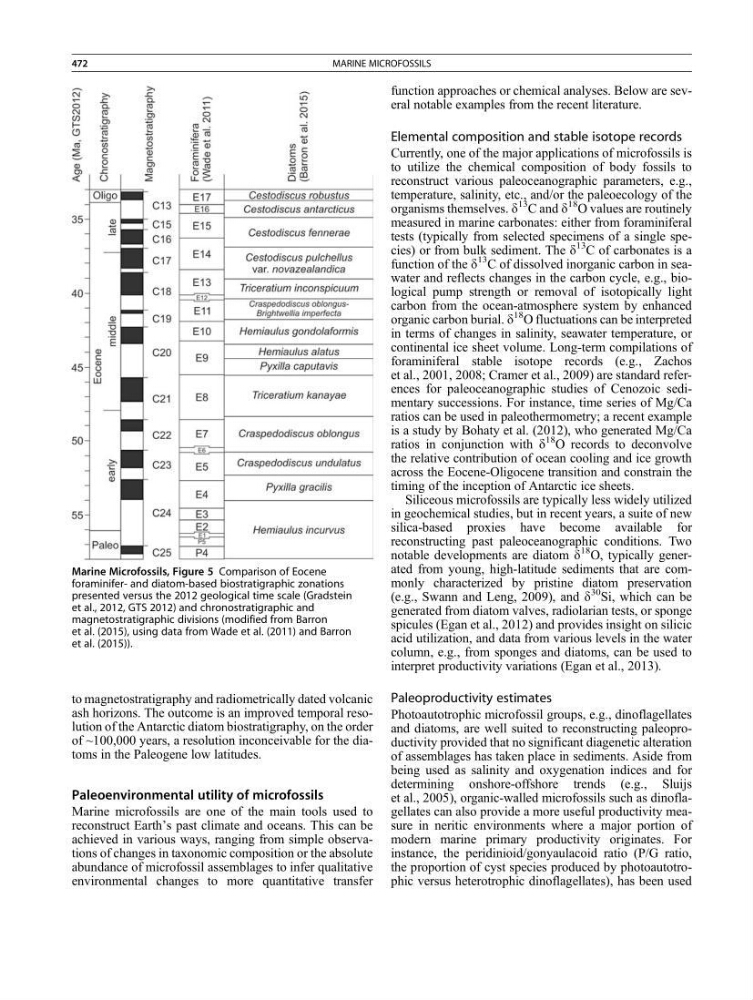
to magnetostratigraphy and radiometrically dated volcanic
ash horizons. The outcome is an improved temporal resolution of the Antarctic diatom biostratigraphy, on the order
of ~100,000 years, a resolution inconceivable for the diatoms in the Paleogene low latitudes.
Paleoenvironmental utility of microfossils
Marine microfossils are one of the main tools used to
reconstruct Earth’s past climate and oceans. This can be
achieved in various ways, ranging from simple observations of changes in taxonomic composition or the absolute
abundance of microfossil assemblages to infer qualitative
environmental changes to more quantitative transfer
function approaches or chemical analyses. Below are several notable examples from the recent literature.
Elemental composition and stable isotope records
Currently, one of the major applications of microfossils is
to utilize the chemical composition of body fossils to
reconstruct various paleoceanographic parameters, e.g.,
temperature, salinity, etc., and/or the paleoecology of the
organisms themselves. d
13
C and d
18
O values are routinely
measured in marine carbonates: either from foraminiferal
tests (typically from selected specimens of a single species) or from bulk sediment. The d
13
C of carbonates is a
function of the d
13 C of dissolved inorganic carbon in seawater and reflects changes in the carbon cycle, e.g., biological pump strength or removal of isotopically light
carbon from the ocean-atmosphere system by enhanced
organic carbon burial. d
18
O fluctuations can be interpreted
in terms of changes in salinity, seawater temperature, or
continental ice sheet volume. Long-term compilations of
foraminiferal stable isotope records (e.g., Zachos
et al., 2001, 2008; Cramer et al., 2009) are standard references for paleoceanographic studies of Cenozoic sedimentary successions. For instance, time series of Mg/Ca
ratios can be used in paleothermometry; a recent example
is a study by Bohaty et al. (2012), who generated Mg/Ca
ratios in conjunction with d
18
O records to deconvolve
the relative contribution of ocean cooling and ice growth
across the Eocene-Oligocene transition and constrain the
timing of the inception of Antarctic ice sheets.
Siliceous microfossils are typically less widely utilized
in geochemical studies, but in recent years, a suite of new
silica-based proxies have become available for
reconstructing past paleoceanographic conditions. Two
notable developments are diatom d
18 O, typically generated from young, high-latitude sediments that are commonly characterized by pristine diatom preservation
(e.g., Swann and Leng, 2009), and d
30
Si, which can be
generated from diatom valves, radiolarian tests, or sponge
spicules (Egan et al., 2012) and provides insight on silicic
acid utilization, and data from various levels in the water
column, e.g., from sponges and diatoms, can be used to
interpret productivity variations (Egan et al., 2013).
Paleoproductivity estimates
Photoautotrophic microfossil groups, e.g., dinoflagellates
and diatoms, are well suited to reconstructing paleoproductivity provided that no significant diagenetic alteration
of assemblages has taken place in sediments. Aside from
being used as salinity and oxygenation indices and for
determining onshore-offshore trends (e.g., Sluijs
et al., 2005), organic-walled microfossils such as dinoflagellates can also provide a more useful productivity measure in neritic environments where a major portion of
modern marine primary productivity originates. For
instance, the peridinioid/gonyaulacoid ratio (P/G ratio,
the proportion of cyst species produced by photoautotrophic versus heterotrophic dinoflagellates), has been used
Marine Microfossils, Figure 5 Comparison of Eocene
foraminifer- and diatom-based biostratigraphic zonations
presented versus the 2012 geological time scale (Gradstein
et al., 2012, GTS 2012) and chronostratigraphic and
magnetostratigraphic divisions (modified from Barron
et al. (2015), using data from Wade et al. (2011) and Barron
et al. (2015)).
472
MARINE MICROFOSSILS