

foraminifera, radiolarians, and silicoflagellates) publishing nearly 400 scientific papers on fossil and recent microorganisms during his career (Tanimura et al., 2009). Other
prominent early workers in the field of marine micropaleontology include Ernst Heinrich Haeckel (1834–1919), a
pioneering radiolarian worker and creator of the famous
illustrative work “Art Forms in Nature” (see Tanimura
et al., 2009), and Georges Deflandre (1897–1973), whose
remarkably rich publication record includes papers on
nearly every known microfossil group (Evitt, 1975).
Early marine micropaleontologists tended to have a
descriptive, taxonomic approach to their study. However,
with the realization that fossils have great utility in
constraining the relative age of sediments came an
increased awareness of possible microfossil applications
in biostratigraphy, paleoceanography, geochemistry, and
even nanotechnology (e.g., Gebeshuber and Crawford,
2006).
The study of microfossils shifted from the occupation
of a narrow group of scholars into one of the basic
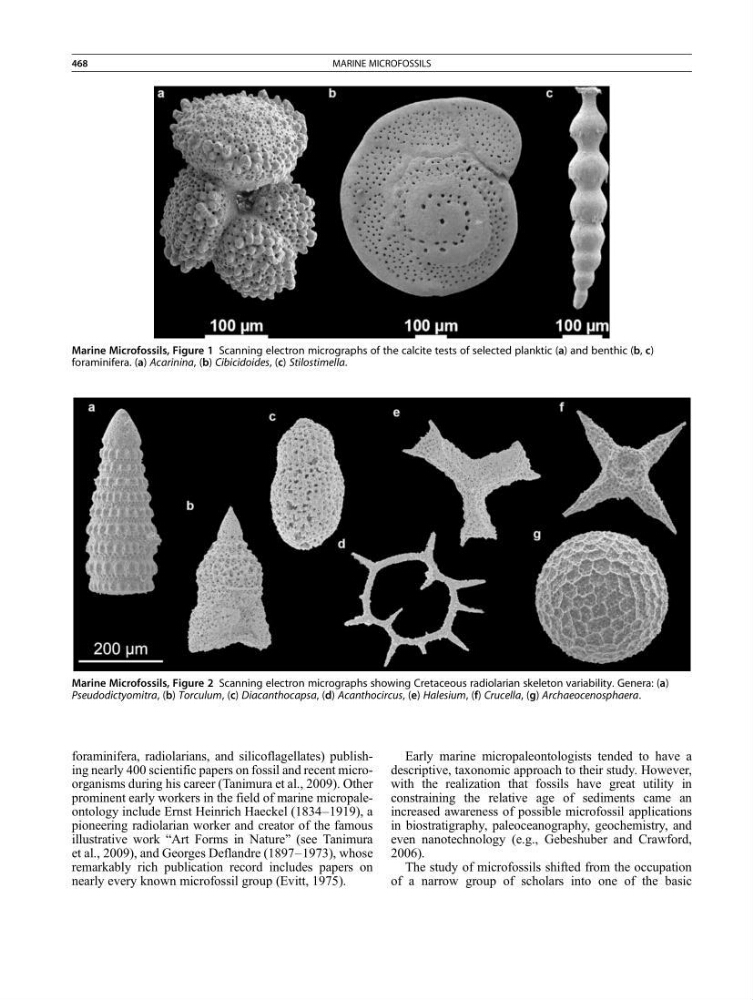
Marine Microfossils, Figure 1 Scanning electron micrographs of the calcite tests of selected planktic (a) and benthic (b, c)
foraminifera. (a) Acarinina, (b) Cibicidoides, (c) Stilostimella.
Marine Microfossils, Figure 2 Scanning electron micrographs showing Cretaceous radiolarian skeleton variability. Genera: (a)
Pseudodictyomitra, (b) Torculum, (c) Diacanthocapsa, (d) Acanthocircus, (e) Halesium, (f) Crucella, (g) Archaeocenosphaera.
468
MARINE MICROFOSSILS