

that act to move the plates are (1) the drag caused by partial coupling of the asthenosphere to the lithospheric plates
above it, so that the plates follow the convection movements; (2) phase transformations in the subducting crust
and lithosphere, which increase the density of the rocks
and therefore cause them to sink through the mantle
(known as “slab pull”); and (3) a lateral “ridge push” force
imparted by the mountains of the mid ocean ridges where
ocean crust is formed; new crust is formed at the top of the
ridge and so causes a gravitational force pushing the
slightly older crust to both sides. The slab pull force is
due mainly to two reactions; the conversion of basalt and
gabbro to eclogite (about 20 % denser) in the upper
30–40 km and the transformation of olivine to a highpressure spinel structure at around 400 km depth (12 %
density increase).
For the discussion of whether plate tectonics operated
earlier in Earth history, mantle convection will certainly
have occurred and volcanism may have been more abundant at any particular time, but the second-phase transformation of the slab pull force will only have functioned if
subduction to depths of more than 400 km occurred.
The evolution of temperature in the Earth:
the background to global tectonic regimes
Since mantle convection is an essential prerequisite for
plate tectonics, and convection will occur once a given
threshold is reached (a Rayleigh number of more than
2,380), the state of internal heat of the Earth as
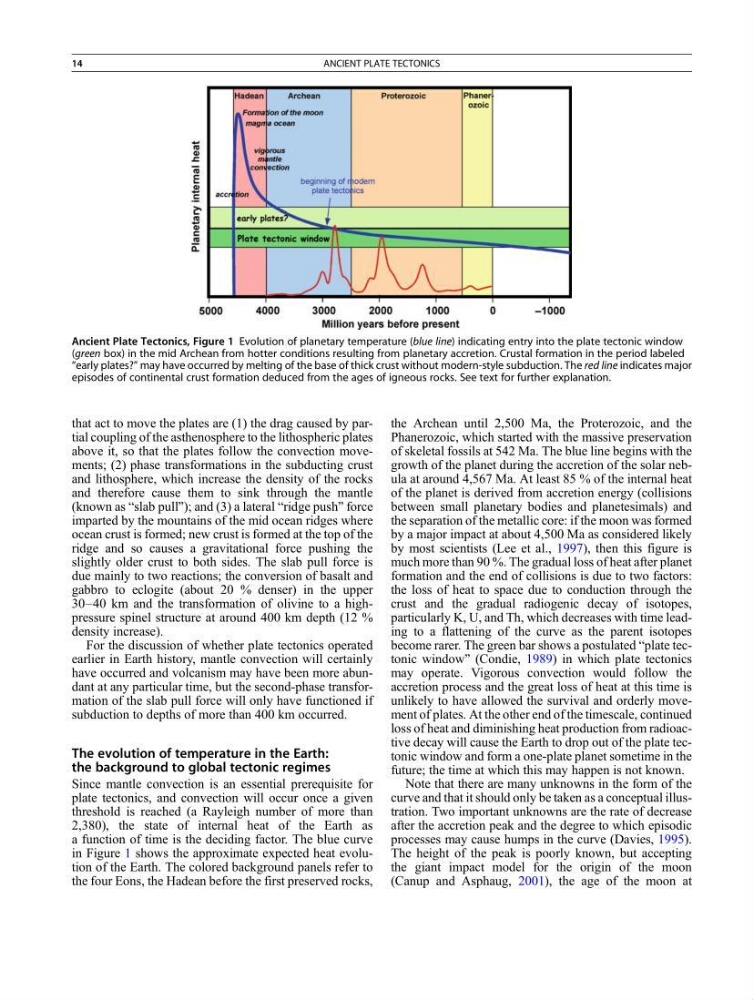
a function of time is the deciding factor. The blue curve
in Figure 1 shows the approximate expected heat evolution of the Earth. The colored background panels refer to
the four Eons, the Hadean before the first preserved rocks,
the Archean until 2,500 Ma, the Proterozoic, and the
Phanerozoic, which started with the massive preservation
of skeletal fossils at 542 Ma. The blue line begins with the
growth of the planet during the accretion of the solar nebula at around 4,567 Ma. At least 85 % of the internal heat
of the planet is derived from accretion energy (collisions
between small planetary bodies and planetesimals) and
the separation of the metallic core: if the moon was formed
by a major impact at about 4,500 Ma as considered likely
by most scientists (Lee et al., 1997), then this figure is
much more than 90 %. The gradual loss of heat after planet
formation and the end of collisions is due to two factors:
the loss of heat to space due to conduction through the
crust and the gradual radiogenic decay of isotopes,
particularly K, U, and Th, which decreases with time leading to a flattening of the curve as the parent isotopes
become rarer. The green bar shows a postulated “plate tectonic window” (Condie, 1989) in which plate tectonics
may operate. Vigorous convection would follow the
accretion process and the great loss of heat at this time is
unlikely to have allowed the survival and orderly movement of plates. At the other end of the timescale, continued
loss of heat and diminishing heat production from radioactive decay will cause the Earth to drop out of the plate tectonic window and form a one-plate planet sometime in the
future; the time at which this may happen is not known.
Note that there are many unknowns in the form of the
curve and that it should only be taken as a conceptual illustration. Two important unknowns are the rate of decrease
after the accretion peak and the degree to which episodic
processes may cause humps in the curve (Davies, 1995).
The height of the peak is poorly known, but accepting
the giant impact model for the origin of the moon
(Canup and Asphaug, 2001), the age of the moon at
Ancient Plate Tectonics, Figure 1 Evolution of planetary temperature (blue line) indicating entry into the plate tectonic window
(green box) in the mid Archean from hotter conditions resulting from planetary accretion. Crustal formation in the period labeled
“early plates?” may have occurred by melting of the base of thick crust without modern-style subduction. The red line indicates major
episodes of continental crust formation deduced from the ages of igneous rocks. See text for further explanation.
14
ANCIENT PLATE TECTONICS
above it, so that the plates follow the convection movements; (2) phase transformations in the subducting crust
and lithosphere, which increase the density of the rocks
and therefore cause them to sink through the mantle
(known as “slab pull”); and (3) a lateral “ridge push” force
imparted by the mountains of the mid ocean ridges where
ocean crust is formed; new crust is formed at the top of the
ridge and so causes a gravitational force pushing the
slightly older crust to both sides. The slab pull force is
due mainly to two reactions; the conversion of basalt and
gabbro to eclogite (about 20 % denser) in the upper
30–40 km and the transformation of olivine to a highpressure spinel structure at around 400 km depth (12 %
density increase).
For the discussion of whether plate tectonics operated
earlier in Earth history, mantle convection will certainly
have occurred and volcanism may have been more abundant at any particular time, but the second-phase transformation of the slab pull force will only have functioned if
subduction to depths of more than 400 km occurred.
The evolution of temperature in the Earth:
the background to global tectonic regimes
Since mantle convection is an essential prerequisite for
plate tectonics, and convection will occur once a given
threshold is reached (a Rayleigh number of more than
2,380), the state of internal heat of the Earth as
a function of time is the deciding factor. The blue curve
in Figure 1 shows the approximate expected heat evolution of the Earth. The colored background panels refer to
the four Eons, the Hadean before the first preserved rocks,
the Archean until 2,500 Ma, the Proterozoic, and the
Phanerozoic, which started with the massive preservation
of skeletal fossils at 542 Ma. The blue line begins with the
growth of the planet during the accretion of the solar nebula at around 4,567 Ma. At least 85 % of the internal heat
of the planet is derived from accretion energy (collisions
between small planetary bodies and planetesimals) and
the separation of the metallic core: if the moon was formed
by a major impact at about 4,500 Ma as considered likely
by most scientists (Lee et al., 1997), then this figure is
much more than 90 %. The gradual loss of heat after planet
formation and the end of collisions is due to two factors:
the loss of heat to space due to conduction through the
crust and the gradual radiogenic decay of isotopes,
particularly K, U, and Th, which decreases with time leading to a flattening of the curve as the parent isotopes
become rarer. The green bar shows a postulated “plate tectonic window” (Condie, 1989) in which plate tectonics
may operate. Vigorous convection would follow the
accretion process and the great loss of heat at this time is
unlikely to have allowed the survival and orderly movement of plates. At the other end of the timescale, continued
loss of heat and diminishing heat production from radioactive decay will cause the Earth to drop out of the plate tectonic window and form a one-plate planet sometime in the
future; the time at which this may happen is not known.
Note that there are many unknowns in the form of the
curve and that it should only be taken as a conceptual illustration. Two important unknowns are the rate of decrease
after the accretion peak and the degree to which episodic
processes may cause humps in the curve (Davies, 1995).
The height of the peak is poorly known, but accepting
the giant impact model for the origin of the moon
(Canup and Asphaug, 2001), the age of the moon at
Ancient Plate Tectonics, Figure 1 Evolution of planetary temperature (blue line) indicating entry into the plate tectonic window
(green box) in the mid Archean from hotter conditions resulting from planetary accretion. Crustal formation in the period labeled
“early plates?” may have occurred by melting of the base of thick crust without modern-style subduction. The red line indicates major
episodes of continental crust formation deduced from the ages of igneous rocks. See text for further explanation.
14
ANCIENT PLATE TECTONICS