

in the oceans. Like almost all other geophysical measurements, the results from the first observations yielded the
most startling results and helped change our view of the
thermal properties of the Earth.
Bullard (1939) started in this field, before WWII, by
measuring the heat flow on land in South Africa. His work
there established the standards and techniques that are still
currently in use in the global heat flow field. In 1945, he
showed that the heat flow through the stable continents
is remarkably uniform at ~60 mWm
À2 (Bullard, 1945).
He speculated that the heat was caused by the radioactivity
of granite and, since that was missing on the ocean floor, it
would be lower. He concluded “it would be of great interest to verify this by heat flow measurements under the
oceans.”
Hans Pettersson, a Swedish radiochemist, attempted the
earliest marine temperature gradient measurements. He
reported two measurements from the Pacific in his report
on the 1947–1948 Swedish Deep-Sea Expedition
(Pettersson, 1949). The temperature gradients were low
and implied a heat flow (20–30 mWm
À2
) much below
that through the continents. As this was as expected, if
radioactivity were the cause, the incentive to make
more measurements evaporated, and little effort was
made to continue them (Gustaf Arrhenius, Personal
Communication, 2010).
Bullard had questions regarding both the method of
measurement and the conclusions of Pettersson. In 1949,
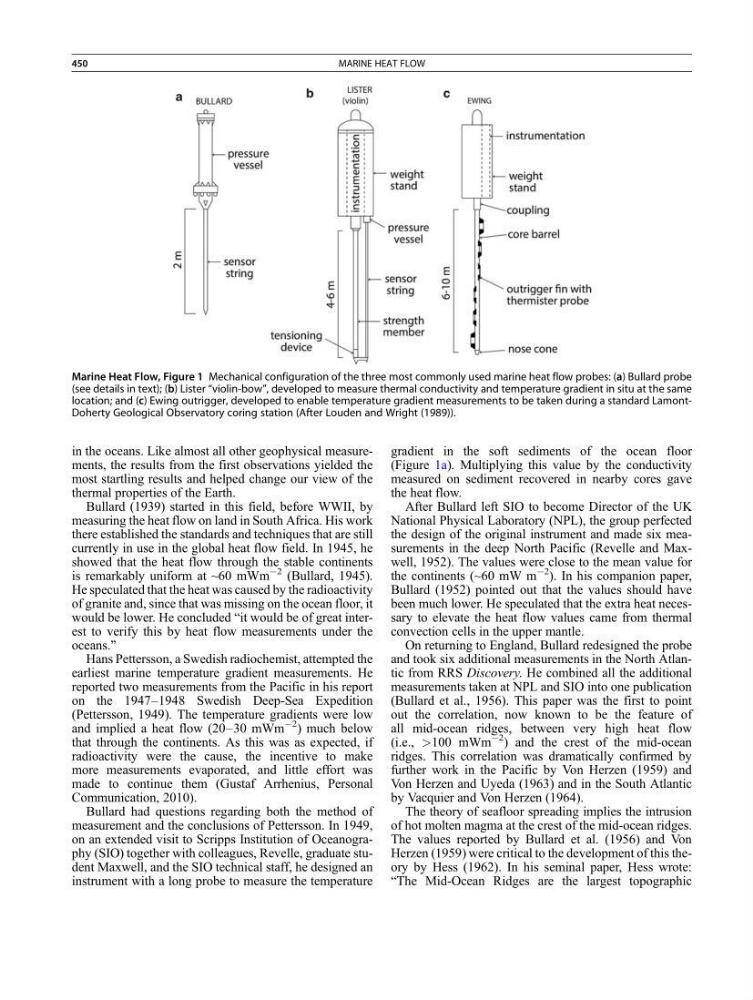
on an extended visit to Scripps Institution of Oceanography (SIO) together with colleagues, Revelle, graduate student Maxwell, and the SIO technical staff, he designed an
instrument with a long probe to measure the temperature
gradient in the soft sediments of the ocean floor
(Figure 1a). Multiplying this value by the conductivity
measured on sediment recovered in nearby cores gave
the heat flow.
After Bullard left SIO to become Director of the UK
National Physical Laboratory (NPL), the group perfected
the design of the original instrument and made six measurements in the deep North Pacific (Revelle and Maxwell, 1952). The values were close to the mean value for
the continents (~60 mW m
À2
). In his companion paper,
Bullard (1952) pointed out that the values should have
been much lower. He speculated that the extra heat necessary to elevate the heat flow values came from thermal
convection cells in the upper mantle.
On returning to England, Bullard redesigned the probe
and took six additional measurements in the North Atlantic from RRS Discovery. He combined all the additional
measurements taken at NPL and SIO into one publication
(Bullard et al., 1956). This paper was the first to point
out the correlation, now known to be the feature of
all mid-ocean ridges, between very high heat flow
(i.e., >100 mWm
À2
) and the crest of the mid-ocean
ridges. This correlation was dramatically confirmed by
further work in the Pacific by Von Herzen (1959) and
Von Herzen and Uyeda (1963) and in the South Atlantic
by Vacquier and Von Herzen (1964).
The theory of seafloor spreading implies the intrusion
of hot molten magma at the crest of the mid-ocean ridges.
The values reported by Bullard et al. (1956) and Von
Herzen (1959) were critical to the development of this theory by Hess (1962). In his seminal paper, Hess wrote:
“The Mid-Ocean Ridges are the largest topographic
Marine Heat Flow, Figure 1 Mechanical configuration of the three most commonly used marine heat flow probes: (a) Bullard probe
(see details in text); (b) Lister “violin-bow”, developed to measure thermal conductivity and temperature gradient in situ at the same
location; and (c) Ewing outrigger, developed to enable temperature gradient measurements to be taken during a standard LamontDoherty Geological Observatory coring station (After Louden and Wright (1989)).
450
MARINE HEAT FLOW
most startling results and helped change our view of the
thermal properties of the Earth.
Bullard (1939) started in this field, before WWII, by
measuring the heat flow on land in South Africa. His work
there established the standards and techniques that are still
currently in use in the global heat flow field. In 1945, he
showed that the heat flow through the stable continents
is remarkably uniform at ~60 mWm
À2 (Bullard, 1945).
He speculated that the heat was caused by the radioactivity
of granite and, since that was missing on the ocean floor, it
would be lower. He concluded “it would be of great interest to verify this by heat flow measurements under the
oceans.”
Hans Pettersson, a Swedish radiochemist, attempted the
earliest marine temperature gradient measurements. He
reported two measurements from the Pacific in his report
on the 1947–1948 Swedish Deep-Sea Expedition
(Pettersson, 1949). The temperature gradients were low
and implied a heat flow (20–30 mWm
À2
) much below
that through the continents. As this was as expected, if
radioactivity were the cause, the incentive to make
more measurements evaporated, and little effort was
made to continue them (Gustaf Arrhenius, Personal
Communication, 2010).
Bullard had questions regarding both the method of
measurement and the conclusions of Pettersson. In 1949,
on an extended visit to Scripps Institution of Oceanography (SIO) together with colleagues, Revelle, graduate student Maxwell, and the SIO technical staff, he designed an
instrument with a long probe to measure the temperature
gradient in the soft sediments of the ocean floor
(Figure 1a). Multiplying this value by the conductivity
measured on sediment recovered in nearby cores gave
the heat flow.
After Bullard left SIO to become Director of the UK
National Physical Laboratory (NPL), the group perfected
the design of the original instrument and made six measurements in the deep North Pacific (Revelle and Maxwell, 1952). The values were close to the mean value for
the continents (~60 mW m
À2
). In his companion paper,
Bullard (1952) pointed out that the values should have
been much lower. He speculated that the extra heat necessary to elevate the heat flow values came from thermal
convection cells in the upper mantle.
On returning to England, Bullard redesigned the probe
and took six additional measurements in the North Atlantic from RRS Discovery. He combined all the additional
measurements taken at NPL and SIO into one publication
(Bullard et al., 1956). This paper was the first to point
out the correlation, now known to be the feature of
all mid-ocean ridges, between very high heat flow
(i.e., >100 mWm
À2
) and the crest of the mid-ocean
ridges. This correlation was dramatically confirmed by
further work in the Pacific by Von Herzen (1959) and
Von Herzen and Uyeda (1963) and in the South Atlantic
by Vacquier and Von Herzen (1964).
The theory of seafloor spreading implies the intrusion
of hot molten magma at the crest of the mid-ocean ridges.
The values reported by Bullard et al. (1956) and Von
Herzen (1959) were critical to the development of this theory by Hess (1962). In his seminal paper, Hess wrote:
“The Mid-Ocean Ridges are the largest topographic
Marine Heat Flow, Figure 1 Mechanical configuration of the three most commonly used marine heat flow probes: (a) Bullard probe
(see details in text); (b) Lister “violin-bow”, developed to measure thermal conductivity and temperature gradient in situ at the same
location; and (c) Ewing outrigger, developed to enable temperature gradient measurements to be taken during a standard LamontDoherty Geological Observatory coring station (After Louden and Wright (1989)).
450
MARINE HEAT FLOW