

The mantle convection around a subduction mainly results
from the dynamics of the plate subduction, not the opposite
(Kincaid and Sacks, 1997). Once the subduction process is
launched, it becomes stable over millions of years unless
an oceanic plateau, an island arc, or a continental block
reaches the subduction zone. If this occurs, subduction
may stop in the collision zone and jump to another place
where a new oceanic subduction may develop (Taiwan,
New Guinea, Philippines, Indonesia, etc.). In a few cases,
continental subduction prevails for tens of millions of years
before plate reorganization (Himalaya, Weissel et al., 1980;
Shemenda, 1992).
Tectonic activity
Earthquakes
The subduction process generates large stresses within
both converging plates as well as along the subduction
interface. Part of the stress is intermittently released seismically (seismic cycle). The largest earthquakes are produced by the so-called subduction earthquakes, i.e., the
seismic expression of mega-ruptures along the frictional
part of the plate interface, also called “seismogenic zone”
(M9.0 2011 Tohoku earthquake, M9.2 2004 Sumatra
earthquake, etc.). These particular earthquakes dissipate
at least 85 % of the total seismic energy released in the
world (Scholz, 1990). The reason is that the subduction
interfaces are the largest faults on Earth (up to several hundred km, even 1,000 + km long) accommodating the largest slips (up to several tens of meters). Kanamori (1977)
has shown that the seismic moment for great earthquakes
is proportional to the faulted area and the slip on the fault.
In addition to the subduction earthquakes, intraplate earthquakes may also occur either in the overriding plate, especially if compressive or extensive stress is transmitted
from the subduction zone, or the downgoing plate
(commonly called slab when it subducts into the mantle).
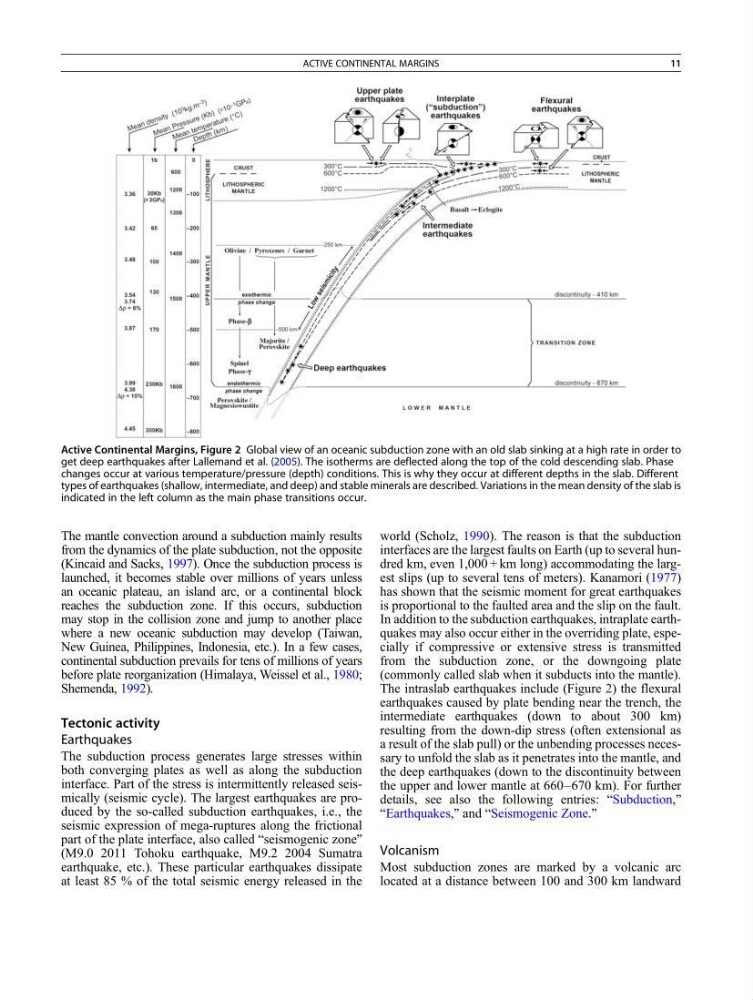
The intraslab earthquakes include (Figure 2) the flexural
earthquakes caused by plate bending near the trench, the
intermediate earthquakes (down to about 300 km)
resulting from the down-dip stress (often extensional as
a result of the slab pull) or the unbending processes necessary to unfold the slab as it penetrates into the mantle, and
the deep earthquakes (down to the discontinuity between
the upper and lower mantle at 660–670 km). For further
details, see also the following entries: “Subduction,”
“Earthquakes,” and “Seismogenic Zone.”
Volcanism
Most subduction zones are marked by a volcanic arc
located at a distance between 100 and 300 km landward
Active Continental Margins, Figure 2 Global view of an oceanic subduction zone with an old slab sinking at a high rate in order to
get deep earthquakes after Lallemand et al. (2005). The isotherms are deflected along the top of the cold descending slab. Phase
changes occur at various temperature/pressure (depth) conditions. This is why they occur at different depths in the slab. Different
types of earthquakes (shallow, intermediate, and deep) and stable minerals are described. Variations in the mean density of the slab is
indicated in the left column as the main phase transitions occur.
ACTIVE CONTINENTAL MARGINS
11
from the dynamics of the plate subduction, not the opposite
(Kincaid and Sacks, 1997). Once the subduction process is
launched, it becomes stable over millions of years unless
an oceanic plateau, an island arc, or a continental block
reaches the subduction zone. If this occurs, subduction
may stop in the collision zone and jump to another place
where a new oceanic subduction may develop (Taiwan,
New Guinea, Philippines, Indonesia, etc.). In a few cases,
continental subduction prevails for tens of millions of years
before plate reorganization (Himalaya, Weissel et al., 1980;
Shemenda, 1992).
Tectonic activity
Earthquakes
The subduction process generates large stresses within
both converging plates as well as along the subduction
interface. Part of the stress is intermittently released seismically (seismic cycle). The largest earthquakes are produced by the so-called subduction earthquakes, i.e., the
seismic expression of mega-ruptures along the frictional
part of the plate interface, also called “seismogenic zone”
(M9.0 2011 Tohoku earthquake, M9.2 2004 Sumatra
earthquake, etc.). These particular earthquakes dissipate
at least 85 % of the total seismic energy released in the
world (Scholz, 1990). The reason is that the subduction
interfaces are the largest faults on Earth (up to several hundred km, even 1,000 + km long) accommodating the largest slips (up to several tens of meters). Kanamori (1977)
has shown that the seismic moment for great earthquakes
is proportional to the faulted area and the slip on the fault.
In addition to the subduction earthquakes, intraplate earthquakes may also occur either in the overriding plate, especially if compressive or extensive stress is transmitted
from the subduction zone, or the downgoing plate
(commonly called slab when it subducts into the mantle).
The intraslab earthquakes include (Figure 2) the flexural
earthquakes caused by plate bending near the trench, the
intermediate earthquakes (down to about 300 km)
resulting from the down-dip stress (often extensional as
a result of the slab pull) or the unbending processes necessary to unfold the slab as it penetrates into the mantle, and
the deep earthquakes (down to the discontinuity between
the upper and lower mantle at 660–670 km). For further
details, see also the following entries: “Subduction,”
“Earthquakes,” and “Seismogenic Zone.”
Volcanism
Most subduction zones are marked by a volcanic arc
located at a distance between 100 and 300 km landward
Active Continental Margins, Figure 2 Global view of an oceanic subduction zone with an old slab sinking at a high rate in order to
get deep earthquakes after Lallemand et al. (2005). The isotherms are deflected along the top of the cold descending slab. Phase
changes occur at various temperature/pressure (depth) conditions. This is why they occur at different depths in the slab. Different
types of earthquakes (shallow, intermediate, and deep) and stable minerals are described. Variations in the mean density of the slab is
indicated in the left column as the main phase transitions occur.
ACTIVE CONTINENTAL MARGINS
11