

Tidal Salt Marsh: Shrubbery often associated with
mangroves. Tidal salt marsh consists of shrubbery, sedges,
and grasses, generally less than one-half meter in height,
that normally grow above mean sea-level and below
highest tidal levels in soft sediments along the intertidal
zone of less exposed marine coastal environments and
estuarine margins.
Tidal Salt Pan: Often associated with mangroves and
tidal salt marsh, tidal salt pans consist of carpeted surface
layers of microphyte vegetation covering flat-pan areas
above mean sea-level and below highest tidal levels along
the intertidal zone of less exposed marine coastal environments and estuarine margins.
Tidal Wetlands: Tidal wetland habitats are the combination of the three intertidal vegetation assemblages as mangroves, tidal salt marsh, and tidal salt pan. These
characteristically occur between mean sea-level and the
highest tidal levels. Mangroves dominate in wet tropical
conditions. In arid and cooler latitudes, the proportion of
mangroves is notably diminished to nonexistent, replaced
by the corresponding dominance of tidal salt marsh shrubbery and flat expanses of tidal salt pan.
Introduction
Mangrove coasts are shorelines fringed by mangrove and
salt marsh vegetation. They form a significant part of
coastal tidal wetlands as distinctive habitats of tropic and
temperate shorelines. Tidal wetlands have vegetation of
varying complexities from forested mangrove woodlands,
thick mangrove and salt marsh shrubbery, and low dense
samphire plains to microalgal covered salt pans
(Tomlinson, 1994). In the tropics, mangroves are often
the dominant shoreline ecosystem comprised chiefly of
flowering trees and shrubs uniquely adapted to coastal
and estuarine tidal conditions (Duke, 2011). They form
distinctly vegetated and often densely structured habitat
of verdant closed canopies cloaking coastal margins and
tidal waterways of equatorial, tropical, and subtropical
regions of the world. Normally, but not exclusively, these
vegetation assemblages grow in soft sediments above
mean sea-level in the intertidal zone of sheltered coastal
environments and estuarine margins (Figure 1).
The plants of mangrove coasts are well known for their
morphological and physiological adaptations coping with
salt, saturated anoxic soils, and regular tidal
inundation; notably with specialized attributes like:
exposed air-breathing roots above ground; extra, aboveground stem support structures; salt-excreting leaves;
low water potentials and high intracellular salt concentrations to maintain favorable water relations in saline environments; and viviparous water-dispersed propagules.
With such attributes, these habitats have essential roles
in coastal productivity and connectivity, often supporting
high biodiversity and biomass not possible in upland vegetation, especially in more arid regions.
Mangrove coasts are key sources of primary production
with highly dependent trophic linkages between plants
and animals, as nursery and breeding sites of benthic and
arboreal life, as well as physical shelter and protection
from severe storms, river flows, and large tsunami waves.
Within tropical latitudes, mangrove coasts nestle mostly
between two other iconic ecosystems of coral reefs and
tropical rainforests. All three are intimately
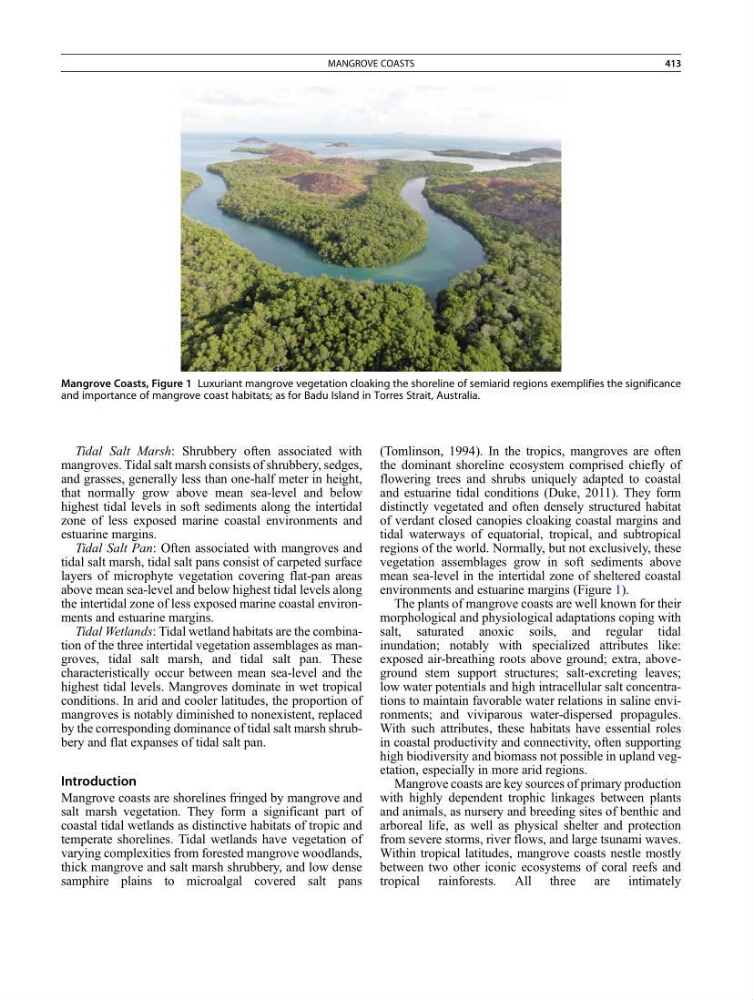
Mangrove Coasts, Figure 1 Luxuriant mangrove vegetation cloaking the shoreline of semiarid regions exemplifies the significance
and importance of mangrove coast habitats; as for Badu Island in Torres Strait, Australia.
MANGROVE COASTS
413
mangroves. Tidal salt marsh consists of shrubbery, sedges,
and grasses, generally less than one-half meter in height,
that normally grow above mean sea-level and below
highest tidal levels in soft sediments along the intertidal
zone of less exposed marine coastal environments and
estuarine margins.
Tidal Salt Pan: Often associated with mangroves and
tidal salt marsh, tidal salt pans consist of carpeted surface
layers of microphyte vegetation covering flat-pan areas
above mean sea-level and below highest tidal levels along
the intertidal zone of less exposed marine coastal environments and estuarine margins.
Tidal Wetlands: Tidal wetland habitats are the combination of the three intertidal vegetation assemblages as mangroves, tidal salt marsh, and tidal salt pan. These
characteristically occur between mean sea-level and the
highest tidal levels. Mangroves dominate in wet tropical
conditions. In arid and cooler latitudes, the proportion of
mangroves is notably diminished to nonexistent, replaced
by the corresponding dominance of tidal salt marsh shrubbery and flat expanses of tidal salt pan.
Introduction
Mangrove coasts are shorelines fringed by mangrove and
salt marsh vegetation. They form a significant part of
coastal tidal wetlands as distinctive habitats of tropic and
temperate shorelines. Tidal wetlands have vegetation of
varying complexities from forested mangrove woodlands,
thick mangrove and salt marsh shrubbery, and low dense
samphire plains to microalgal covered salt pans
(Tomlinson, 1994). In the tropics, mangroves are often
the dominant shoreline ecosystem comprised chiefly of
flowering trees and shrubs uniquely adapted to coastal
and estuarine tidal conditions (Duke, 2011). They form
distinctly vegetated and often densely structured habitat
of verdant closed canopies cloaking coastal margins and
tidal waterways of equatorial, tropical, and subtropical
regions of the world. Normally, but not exclusively, these
vegetation assemblages grow in soft sediments above
mean sea-level in the intertidal zone of sheltered coastal
environments and estuarine margins (Figure 1).
The plants of mangrove coasts are well known for their
morphological and physiological adaptations coping with
salt, saturated anoxic soils, and regular tidal
inundation; notably with specialized attributes like:
exposed air-breathing roots above ground; extra, aboveground stem support structures; salt-excreting leaves;
low water potentials and high intracellular salt concentrations to maintain favorable water relations in saline environments; and viviparous water-dispersed propagules.
With such attributes, these habitats have essential roles
in coastal productivity and connectivity, often supporting
high biodiversity and biomass not possible in upland vegetation, especially in more arid regions.
Mangrove coasts are key sources of primary production
with highly dependent trophic linkages between plants
and animals, as nursery and breeding sites of benthic and
arboreal life, as well as physical shelter and protection
from severe storms, river flows, and large tsunami waves.
Within tropical latitudes, mangrove coasts nestle mostly
between two other iconic ecosystems of coral reefs and
tropical rainforests. All three are intimately
Mangrove Coasts, Figure 1 Luxuriant mangrove vegetation cloaking the shoreline of semiarid regions exemplifies the significance
and importance of mangrove coast habitats; as for Badu Island in Torres Strait, Australia.
MANGROVE COASTS
413