

the NE Lau Basin (Resing et al., 2011; https://www.
youtube.com/watch?v¼xRaEcGHHsVY), NW Rota in
the Mariana Arc (Chadwick et al., 2008; https://www.
youtube.com/watch?v¼Cz4niudHwMs); Havre volcano
in the Kermadec arc, NZ (Carey et al., 2014; Figure 2).
Such events have dramatically increased our knowledge
of submarine eruption and pyroclast transport processes,
and challenged existing paradigms in volcanology.
Sulfur
Consonant with their volatile-rich nature, convergent margin magmas generally contain more S than those from
other tectonic settings (Sharma et al., 2004). This is
manifested in several ways. One is that lakes of molten
sulfur are sometimes found on convergent margin volcanoes, both above and below sealevel. Sulfur pools at the
bottoms of crater lakes exist on subaerial volcanoes in
Central America, Indonesia, Andes, and Japan (Kim
et al., 2011). Molten sulfur forms as a result of the disproportionation of magmatic sulfur dioxide (SO 2 ), released
from degassing magma, according to the reaction SO 2 +
H 2 O¼H 2 SO 4 + S. Pools of molten sulfur in equilibrium
with acid water is the result. Examples of active disproportionation associated with a submarine eruption has
been investigated at NW Rota-1 in the Mariana arc, where
yellowish clouds of newly-formed sulfur billowed out
of the eruption pit http://www.youtube.com/watch?
v¼RY3a7rIFlEs. Pools of molten sulfur are also found
in craters of some submarine volcanoes, for example the
summits of Nikko and Daikoku in the Mariana Arc
(Embley et al., 2007) and in Volcano O in the Lau Basin
(Kim et al., 2011; Figure 2).
The combined effects of magmatic sulfur and explosive
arc volcanism can affect climate. During Plinian eruptions, magmatic SO 2 is converted to small (0.1-1 mm
diameter) droplets of sulfuric acid and, if injected into
the stratosphere, can remain suspended for many months,
encircling the globe. These droplets reflect incoming sunlight, cooling the Earth below and modifying climate. As
an example of this, the 1991 eruption of Pinatubo in the
Philippines resulted in Northern Hemisphere were lower
than normal by up to 3
C in the winters of 1991–1992
and 1992–1993 (Robock, 2000).
Mineral deposits
Sulfide mineral deposits are another important manifestation of magmatic sulfur in convergent margin magmas.
Important mineral deposits are associated with modern
and ancient island arcs, including interarc rifts and backarc
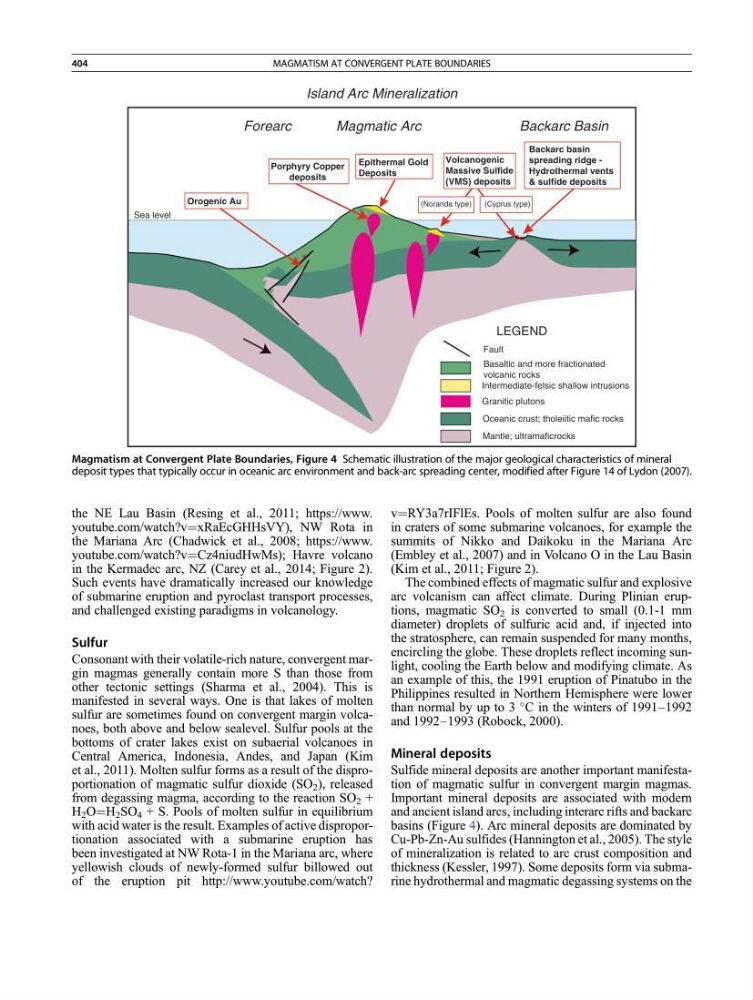
basins (Figure 4). Arc mineral deposits are dominated by
Cu-Pb-Zn-Au sulfides (Hannington et al., 2005). The style
of mineralization is related to arc crust composition and
thickness (Kessler, 1997). Some deposits form via submarine hydrothermal and magmatic degassing systems on the
Granitic plutons
Intermediate-felsic shallow intrusions
Basaltic and more fractionated
volcanic rocks
Mantle; ultramaficrocks
Backarc basin
spreading ridge -
Hydrothermal vents
& sulfide deposits
Volcanogenic
Massive Sulfide
(VMS) deposits
Epithermal Gold
Deposits
Porphyry Copper
deposits
Orogenic Au
(Cyprus type)
(Noranda type)
Sea level
LEGEND
Magmatic Arc
Forearc
Backarc Basin
Fault
Island Arc Mineralization
Oceanic crust; tholeiitic mafic rocks
Magmatism at Convergent Plate Boundaries, Figure 4 Schematic illustration of the major geological characteristics of mineral
deposit types that typically occur in oceanic arc environment and back-arc spreading center, modified after Figure 14 of Lydon (2007).
404
MAGMATISM AT CONVERGENT PLATE BOUNDARIES
youtube.com/watch?v¼xRaEcGHHsVY), NW Rota in
the Mariana Arc (Chadwick et al., 2008; https://www.
youtube.com/watch?v¼Cz4niudHwMs); Havre volcano
in the Kermadec arc, NZ (Carey et al., 2014; Figure 2).
Such events have dramatically increased our knowledge
of submarine eruption and pyroclast transport processes,
and challenged existing paradigms in volcanology.
Sulfur
Consonant with their volatile-rich nature, convergent margin magmas generally contain more S than those from
other tectonic settings (Sharma et al., 2004). This is
manifested in several ways. One is that lakes of molten
sulfur are sometimes found on convergent margin volcanoes, both above and below sealevel. Sulfur pools at the
bottoms of crater lakes exist on subaerial volcanoes in
Central America, Indonesia, Andes, and Japan (Kim
et al., 2011). Molten sulfur forms as a result of the disproportionation of magmatic sulfur dioxide (SO 2 ), released
from degassing magma, according to the reaction SO 2 +
H 2 O¼H 2 SO 4 + S. Pools of molten sulfur in equilibrium
with acid water is the result. Examples of active disproportionation associated with a submarine eruption has
been investigated at NW Rota-1 in the Mariana arc, where
yellowish clouds of newly-formed sulfur billowed out
of the eruption pit http://www.youtube.com/watch?
v¼RY3a7rIFlEs. Pools of molten sulfur are also found
in craters of some submarine volcanoes, for example the
summits of Nikko and Daikoku in the Mariana Arc
(Embley et al., 2007) and in Volcano O in the Lau Basin
(Kim et al., 2011; Figure 2).
The combined effects of magmatic sulfur and explosive
arc volcanism can affect climate. During Plinian eruptions, magmatic SO 2 is converted to small (0.1-1 mm
diameter) droplets of sulfuric acid and, if injected into
the stratosphere, can remain suspended for many months,
encircling the globe. These droplets reflect incoming sunlight, cooling the Earth below and modifying climate. As
an example of this, the 1991 eruption of Pinatubo in the
Philippines resulted in Northern Hemisphere were lower
than normal by up to 3
C in the winters of 1991–1992
and 1992–1993 (Robock, 2000).
Mineral deposits
Sulfide mineral deposits are another important manifestation of magmatic sulfur in convergent margin magmas.
Important mineral deposits are associated with modern
and ancient island arcs, including interarc rifts and backarc
basins (Figure 4). Arc mineral deposits are dominated by
Cu-Pb-Zn-Au sulfides (Hannington et al., 2005). The style
of mineralization is related to arc crust composition and
thickness (Kessler, 1997). Some deposits form via submarine hydrothermal and magmatic degassing systems on the
Granitic plutons
Intermediate-felsic shallow intrusions
Basaltic and more fractionated
volcanic rocks
Mantle; ultramaficrocks
Backarc basin
spreading ridge -
Hydrothermal vents
& sulfide deposits
Volcanogenic
Massive Sulfide
(VMS) deposits
Epithermal Gold
Deposits
Porphyry Copper
deposits
Orogenic Au
(Cyprus type)
(Noranda type)
Sea level
LEGEND
Magmatic Arc
Forearc
Backarc Basin
Fault
Island Arc Mineralization
Oceanic crust; tholeiitic mafic rocks
Magmatism at Convergent Plate Boundaries, Figure 4 Schematic illustration of the major geological characteristics of mineral
deposit types that typically occur in oceanic arc environment and back-arc spreading center, modified after Figure 14 of Lydon (2007).
404
MAGMATISM AT CONVERGENT PLATE BOUNDARIES