

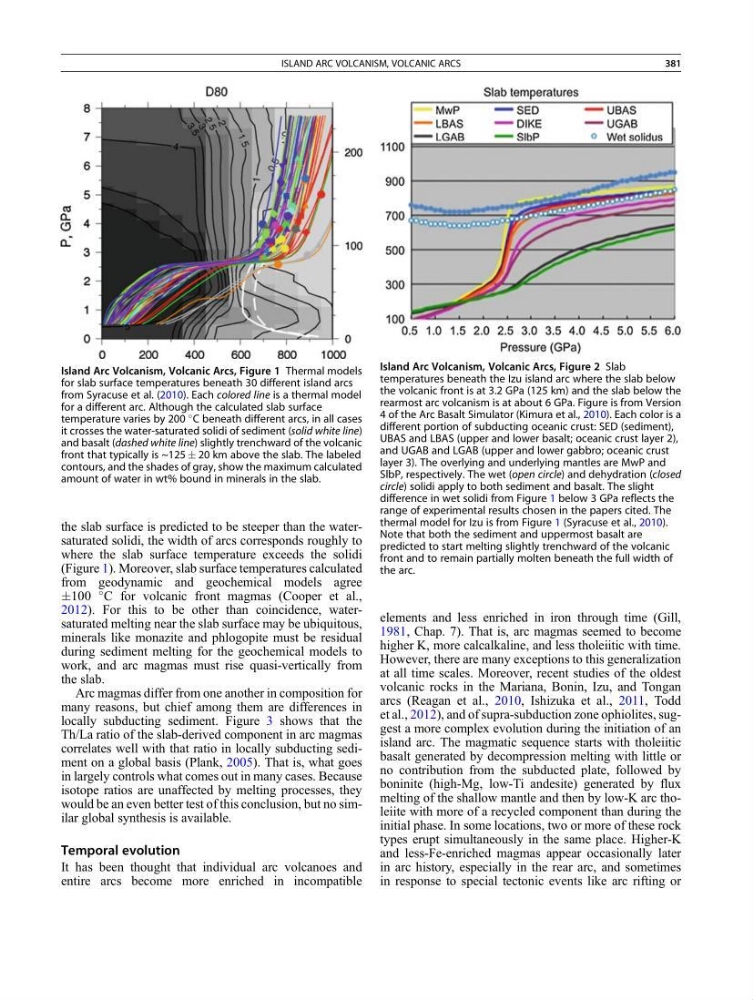
the slab surface is predicted to be steeper than the watersaturated solidi, the width of arcs corresponds roughly to
where the slab surface temperature exceeds the solidi
(Figure 1). Moreover, slab surface temperatures calculated
from geodynamic and geochemical models agree
Æ100
C for volcanic front magmas (Cooper et al.,
2012). For this to be other than coincidence, watersaturated melting near the slab surface may be ubiquitous,
minerals like monazite and phlogopite must be residual
during sediment melting for the geochemical models to
work, and arc magmas must rise quasi-vertically from
the slab.
Arc magmas differ from one another in composition for
many reasons, but chief among them are differences in
locally subducting sediment. Figure 3 shows that the
Th/La ratio of the slab-derived component in arc magmas
correlates well with that ratio in locally subducting sediment on a global basis (Plank, 2005). That is, what goes
in largely controls what comes out in many cases. Because
isotope ratios are unaffected by melting processes, they
would be an even better test of this conclusion, but no similar global synthesis is available.
Temporal evolution
It has been thought that individual arc volcanoes and
entire arcs become more enriched in incompatible
elements and less enriched in iron through time (Gill,
1981, Chap. 7). That is, arc magmas seemed to become
higher K, more calcalkaline, and less tholeiitic with time.
However, there are many exceptions to this generalization
at all time scales. Moreover, recent studies of the oldest
volcanic rocks in the Mariana, Bonin, Izu, and Tongan
arcs (Reagan et al., 2010, Ishizuka et al., 2011, Todd
et al., 2012), and of supra-subduction zone ophiolites, suggest a more complex evolution during the initiation of an
island arc. The magmatic sequence starts with tholeiitic
basalt generated by decompression melting with little or
no contribution from the subducted plate, followed by
boninite (high-Mg, low-Ti andesite) generated by flux
melting of the shallow mantle and then by low-K arc tholeiite with more of a recycled component than during the
initial phase. In some locations, two or more of these rock
types erupt simultaneously in the same place. Higher-K
and less-Fe-enriched magmas appear occasionally later
in arc history, especially in the rear arc, and sometimes
in response to special tectonic events like arc rifting or
Island Arc Volcanism, Volcanic Arcs, Figure 1 Thermal models
for slab surface temperatures beneath 30 different island arcs
from Syracuse et al. (2010). Each colored line is a thermal model
for a different arc. Although the calculated slab surface
temperature varies by 200
C beneath different arcs, in all cases
it crosses the water-saturated solidi of sediment (solid white line)
and basalt (dashed white line) slightly trenchward of the volcanic
front that typically is ~125 Æ 20 km above the slab. The labeled
contours, and the shades of gray, show the maximum calculated
amount of water in wt% bound in minerals in the slab.
Island Arc Volcanism, Volcanic Arcs, Figure 2 Slab
temperatures beneath the Izu island arc where the slab below
the volcanic front is at 3.2 GPa (125 km) and the slab below the
rearmost arc volcanism is at about 6 GPa. Figure is from Version
4 of the Arc Basalt Simulator (Kimura et al., 2010). Each color is a
different portion of subducting oceanic crust: SED (sediment),
UBAS and LBAS (upper and lower basalt; oceanic crust layer 2),
and UGAB and LGAB (upper and lower gabbro; oceanic crust
layer 3). The overlying and underlying mantles are MwP and
SlbP, respectively. The wet (open circle) and dehydration (closed
circle) solidi apply to both sediment and basalt. The slight
difference in wet solidi from Figure 1 below 3 GPa reflects the
range of experimental results chosen in the papers cited. The
thermal model for Izu is from Figure 1 (Syracuse et al., 2010).
Note that both the sediment and uppermost basalt are
predicted to start melting slightly trenchward of the volcanic
front and to remain partially molten beneath the full width of
the arc.
ISLAND ARC VOLCANISM, VOLCANIC ARCS
381
where the slab surface temperature exceeds the solidi
(Figure 1). Moreover, slab surface temperatures calculated
from geodynamic and geochemical models agree
Æ100
C for volcanic front magmas (Cooper et al.,
2012). For this to be other than coincidence, watersaturated melting near the slab surface may be ubiquitous,
minerals like monazite and phlogopite must be residual
during sediment melting for the geochemical models to
work, and arc magmas must rise quasi-vertically from
the slab.
Arc magmas differ from one another in composition for
many reasons, but chief among them are differences in
locally subducting sediment. Figure 3 shows that the
Th/La ratio of the slab-derived component in arc magmas
correlates well with that ratio in locally subducting sediment on a global basis (Plank, 2005). That is, what goes
in largely controls what comes out in many cases. Because
isotope ratios are unaffected by melting processes, they
would be an even better test of this conclusion, but no similar global synthesis is available.
Temporal evolution
It has been thought that individual arc volcanoes and
entire arcs become more enriched in incompatible
elements and less enriched in iron through time (Gill,
1981, Chap. 7). That is, arc magmas seemed to become
higher K, more calcalkaline, and less tholeiitic with time.
However, there are many exceptions to this generalization
at all time scales. Moreover, recent studies of the oldest
volcanic rocks in the Mariana, Bonin, Izu, and Tongan
arcs (Reagan et al., 2010, Ishizuka et al., 2011, Todd
et al., 2012), and of supra-subduction zone ophiolites, suggest a more complex evolution during the initiation of an
island arc. The magmatic sequence starts with tholeiitic
basalt generated by decompression melting with little or
no contribution from the subducted plate, followed by
boninite (high-Mg, low-Ti andesite) generated by flux
melting of the shallow mantle and then by low-K arc tholeiite with more of a recycled component than during the
initial phase. In some locations, two or more of these rock
types erupt simultaneously in the same place. Higher-K
and less-Fe-enriched magmas appear occasionally later
in arc history, especially in the rear arc, and sometimes
in response to special tectonic events like arc rifting or
Island Arc Volcanism, Volcanic Arcs, Figure 1 Thermal models
for slab surface temperatures beneath 30 different island arcs
from Syracuse et al. (2010). Each colored line is a thermal model
for a different arc. Although the calculated slab surface
temperature varies by 200
C beneath different arcs, in all cases
it crosses the water-saturated solidi of sediment (solid white line)
and basalt (dashed white line) slightly trenchward of the volcanic
front that typically is ~125 Æ 20 km above the slab. The labeled
contours, and the shades of gray, show the maximum calculated
amount of water in wt% bound in minerals in the slab.
Island Arc Volcanism, Volcanic Arcs, Figure 2 Slab
temperatures beneath the Izu island arc where the slab below
the volcanic front is at 3.2 GPa (125 km) and the slab below the
rearmost arc volcanism is at about 6 GPa. Figure is from Version
4 of the Arc Basalt Simulator (Kimura et al., 2010). Each color is a
different portion of subducting oceanic crust: SED (sediment),
UBAS and LBAS (upper and lower basalt; oceanic crust layer 2),
and UGAB and LGAB (upper and lower gabbro; oceanic crust
layer 3). The overlying and underlying mantles are MwP and
SlbP, respectively. The wet (open circle) and dehydration (closed
circle) solidi apply to both sediment and basalt. The slight
difference in wet solidi from Figure 1 below 3 GPa reflects the
range of experimental results chosen in the papers cited. The
thermal model for Izu is from Figure 1 (Syracuse et al., 2010).
Note that both the sediment and uppermost basalt are
predicted to start melting slightly trenchward of the volcanic
front and to remain partially molten beneath the full width of
the arc.
ISLAND ARC VOLCANISM, VOLCANIC ARCS
381