

Age-progressive volcanism along the Hawaiian island
chain (McDougall, 1964) provided the first insights into
potential causes of intraplate magmatism. The age of volcanism systematically increases to the northwest from the
island of Hawaii, a “hot spot” generating significant
magmatism that is distal from any current plate boundary
(Wilson, 1963, 1965). Another explanation for intraplate
magmatism is mantle ascending and partially melting via
fissures and faults where the lithosphere is extending
(e.g., Turcotte and Oxburgh, 1973; Anderson, 1995).
The trend of the Hawaiian-Emperor seamount chain, however, is oblique to preexisting fracture zones, which show
no evidence for extension.
Observations of multiple age-progressive volcanic
island chains led to the interpretation that hot spots are surface expressions of deep mantle plumes (Morgan, 1971,
1972), to which large igneous provinces have also been
attributed, both on the continents (e.g., Richards et al.,
1989) and in the oceans (e.g., Coffin and Eldholm,
1994). Subsequently, other interpretations of hot spot
islands arose, e.g., channeled asthenospheric flow from a
hot spot to a seafloor spreading center (Morgan, 1978;
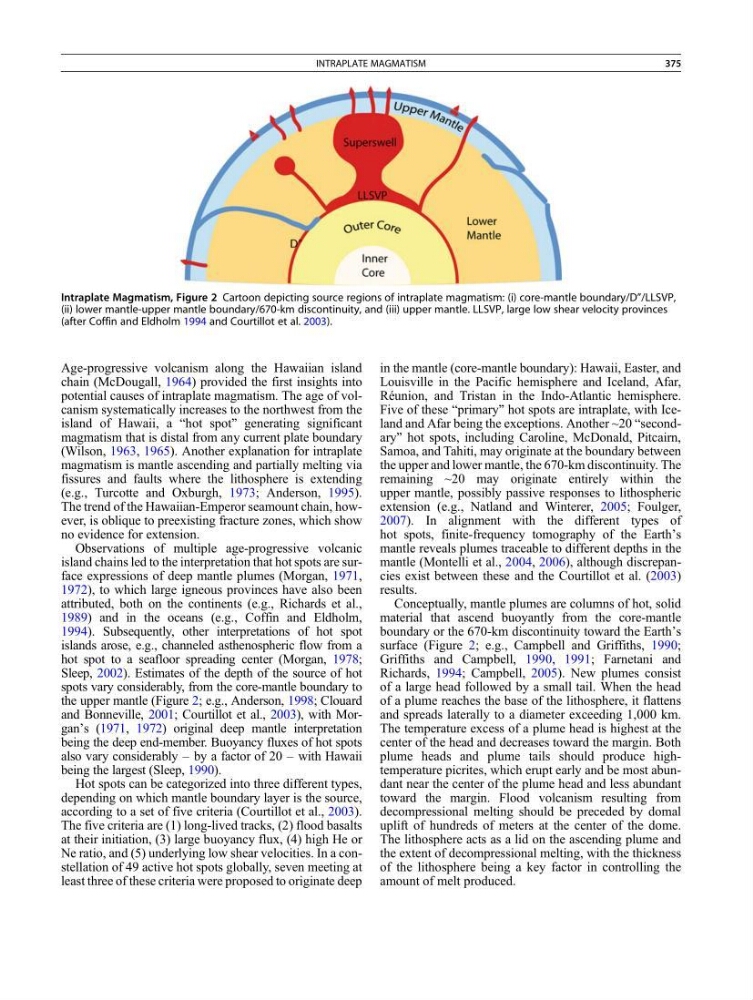
Sleep, 2002). Estimates of the depth of the source of hot
spots vary considerably, from the core-mantle boundary to
the upper mantle (Figure 2; e.g., Anderson, 1998; Clouard
and Bonneville, 2001; Courtillot et al., 2003), with Morgan’s (1971, 1972) original deep mantle interpretation
being the deep end-member. Buoyancy fluxes of hot spots
also vary considerably – by a factor of 20 – with Hawaii
being the largest (Sleep, 1990).
Hot spots can be categorized into three different types,
depending on which mantle boundary layer is the source,
according to a set of five criteria (Courtillot et al., 2003).
The five criteria are (1) long-lived tracks, (2) flood basalts
at their initiation, (3) large buoyancy flux, (4) high He or
Ne ratio, and (5) underlying low shear velocities. In a constellation of 49 active hot spots globally, seven meeting at
least three of these criteria were proposed to originate deep
in the mantle (core-mantle boundary): Hawaii, Easter, and
Louisville in the Pacific hemisphere and Iceland, Afar,
Réunion, and Tristan in the Indo-Atlantic hemisphere.
Five of these “primary” hot spots are intraplate, with Iceland and Afar being the exceptions. Another ~20 “secondary” hot spots, including Caroline, McDonald, Pitcairn,
Samoa, and Tahiti, may originate at the boundary between
the upper and lower mantle, the 670-km discontinuity. The
remaining ~20 may originate entirely within the
upper mantle, possibly passive responses to lithospheric
extension (e.g., Natland and Winterer, 2005; Foulger,
2007). In alignment with the different types of
hot spots, finite-frequency tomography of the Earth’s
mantle reveals plumes traceable to different depths in the
mantle (Montelli et al., 2004, 2006), although discrepancies exist between these and the Courtillot et al. (2003)
results.
Conceptually, mantle plumes are columns of hot, solid
material that ascend buoyantly from the core-mantle
boundary or the 670-km discontinuity toward the Earth’s
surface (Figure 2; e.g., Campbell and Griffiths, 1990;
Griffiths and Campbell, 1990, 1991; Farnetani and
Richards, 1994; Campbell, 2005). New plumes consist
of a large head followed by a small tail. When the head
of a plume reaches the base of the lithosphere, it flattens
and spreads laterally to a diameter exceeding 1,000 km.
The temperature excess of a plume head is highest at the
center of the head and decreases toward the margin. Both
plume heads and plume tails should produce hightemperature picrites, which erupt early and be most abundant near the center of the plume head and less abundant
toward the margin. Flood volcanism resulting from
decompressional melting should be preceded by domal
uplift of hundreds of meters at the center of the dome.
The lithosphere acts as a lid on the ascending plume and
the extent of decompressional melting, with the thickness
of the lithosphere being a key factor in controlling the
amount of melt produced.
Intraplate Magmatism, Figure 2 Cartoon depicting source regions of intraplate magmatism: (i) core-mantle boundary/D”/LLSVP,
(ii) lower mantle-upper mantle boundary/670-km discontinuity, and (iii) upper mantle. LLSVP, large low shear velocity provinces
(after Coffin and Eldholm 1994 and Courtillot et al. 2003).
INTRAPLATE MAGMATISM
375
chain (McDougall, 1964) provided the first insights into
potential causes of intraplate magmatism. The age of volcanism systematically increases to the northwest from the
island of Hawaii, a “hot spot” generating significant
magmatism that is distal from any current plate boundary
(Wilson, 1963, 1965). Another explanation for intraplate
magmatism is mantle ascending and partially melting via
fissures and faults where the lithosphere is extending
(e.g., Turcotte and Oxburgh, 1973; Anderson, 1995).
The trend of the Hawaiian-Emperor seamount chain, however, is oblique to preexisting fracture zones, which show
no evidence for extension.
Observations of multiple age-progressive volcanic
island chains led to the interpretation that hot spots are surface expressions of deep mantle plumes (Morgan, 1971,
1972), to which large igneous provinces have also been
attributed, both on the continents (e.g., Richards et al.,
1989) and in the oceans (e.g., Coffin and Eldholm,
1994). Subsequently, other interpretations of hot spot
islands arose, e.g., channeled asthenospheric flow from a
hot spot to a seafloor spreading center (Morgan, 1978;
Sleep, 2002). Estimates of the depth of the source of hot
spots vary considerably, from the core-mantle boundary to
the upper mantle (Figure 2; e.g., Anderson, 1998; Clouard
and Bonneville, 2001; Courtillot et al., 2003), with Morgan’s (1971, 1972) original deep mantle interpretation
being the deep end-member. Buoyancy fluxes of hot spots
also vary considerably – by a factor of 20 – with Hawaii
being the largest (Sleep, 1990).
Hot spots can be categorized into three different types,
depending on which mantle boundary layer is the source,
according to a set of five criteria (Courtillot et al., 2003).
The five criteria are (1) long-lived tracks, (2) flood basalts
at their initiation, (3) large buoyancy flux, (4) high He or
Ne ratio, and (5) underlying low shear velocities. In a constellation of 49 active hot spots globally, seven meeting at
least three of these criteria were proposed to originate deep
in the mantle (core-mantle boundary): Hawaii, Easter, and
Louisville in the Pacific hemisphere and Iceland, Afar,
Réunion, and Tristan in the Indo-Atlantic hemisphere.
Five of these “primary” hot spots are intraplate, with Iceland and Afar being the exceptions. Another ~20 “secondary” hot spots, including Caroline, McDonald, Pitcairn,
Samoa, and Tahiti, may originate at the boundary between
the upper and lower mantle, the 670-km discontinuity. The
remaining ~20 may originate entirely within the
upper mantle, possibly passive responses to lithospheric
extension (e.g., Natland and Winterer, 2005; Foulger,
2007). In alignment with the different types of
hot spots, finite-frequency tomography of the Earth’s
mantle reveals plumes traceable to different depths in the
mantle (Montelli et al., 2004, 2006), although discrepancies exist between these and the Courtillot et al. (2003)
results.
Conceptually, mantle plumes are columns of hot, solid
material that ascend buoyantly from the core-mantle
boundary or the 670-km discontinuity toward the Earth’s
surface (Figure 2; e.g., Campbell and Griffiths, 1990;
Griffiths and Campbell, 1990, 1991; Farnetani and
Richards, 1994; Campbell, 2005). New plumes consist
of a large head followed by a small tail. When the head
of a plume reaches the base of the lithosphere, it flattens
and spreads laterally to a diameter exceeding 1,000 km.
The temperature excess of a plume head is highest at the
center of the head and decreases toward the margin. Both
plume heads and plume tails should produce hightemperature picrites, which erupt early and be most abundant near the center of the plume head and less abundant
toward the margin. Flood volcanism resulting from
decompressional melting should be preceded by domal
uplift of hundreds of meters at the center of the dome.
The lithosphere acts as a lid on the ascending plume and
the extent of decompressional melting, with the thickness
of the lithosphere being a key factor in controlling the
amount of melt produced.
Intraplate Magmatism, Figure 2 Cartoon depicting source regions of intraplate magmatism: (i) core-mantle boundary/D”/LLSVP,
(ii) lower mantle-upper mantle boundary/670-km discontinuity, and (iii) upper mantle. LLSVP, large low shear velocity provinces
(after Coffin and Eldholm 1994 and Courtillot et al. 2003).
INTRAPLATE MAGMATISM
375