

global ocean >1,000 m in height (above surrounding seafloor) to be ~125,000, but it could range from 45,000 to
350,000. For seamounts >100 m in height, they predict
a population of 25,000,000, but it could range from
8,000,000 to 80,000,000. However, only a minuscule fraction of these features have been sampled and dated (e.g.,
the online Seamount Catalog (http://earthref.org/SC/)
includes approximately 1,800 seamounts).
The most comprehensive database of volcanoes active
during the past ~10,000 years (Holocene) includes 1,559
volcanoes, of which 215 are classified as intraplate
(Siebert et al., 2010; http://www.volcano.si.edu/). However, 25 of these are situated on or near plate boundaries
(DeMets et al., 2010). Of the remaining 190 considered
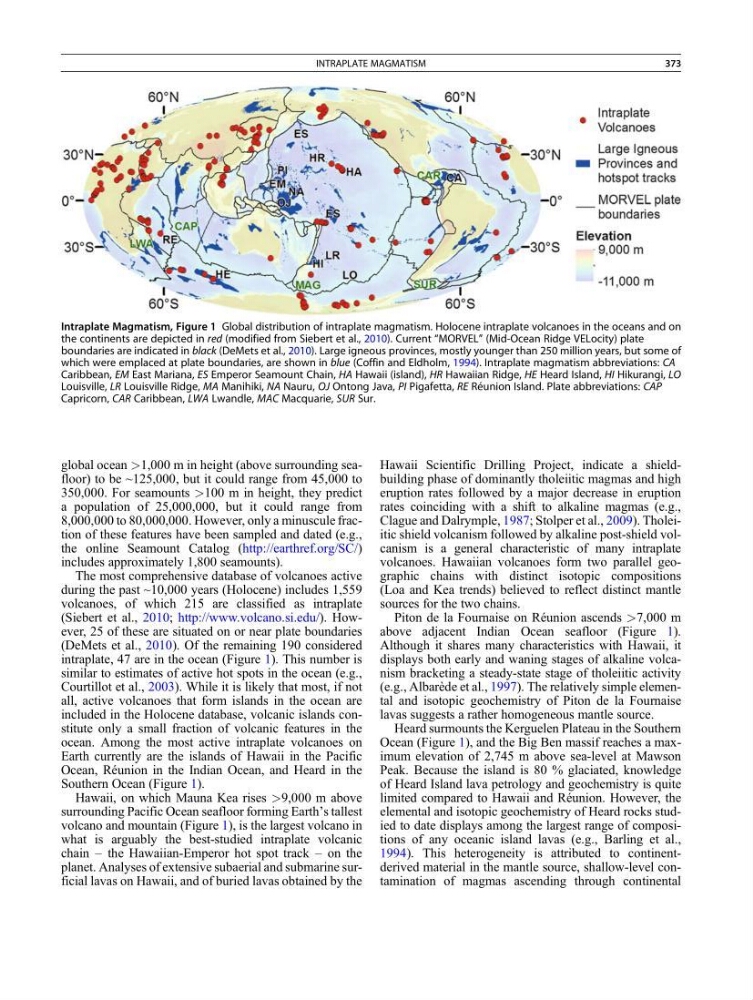
intraplate, 47 are in the ocean (Figure 1). This number is
similar to estimates of active hot spots in the ocean (e.g.,
Courtillot et al., 2003). While it is likely that most, if not
all, active volcanoes that form islands in the ocean are
included in the Holocene database, volcanic islands constitute only a small fraction of volcanic features in the
ocean. Among the most active intraplate volcanoes on
Earth currently are the islands of Hawaii in the Pacific
Ocean, Réunion in the Indian Ocean, and Heard in the
Southern Ocean (Figure 1).
Hawaii, on which Mauna Kea rises >9,000 m above
surrounding Pacific Ocean seafloor forming Earth’s tallest
volcano and mountain (Figure 1), is the largest volcano in
what is arguably the best-studied intraplate volcanic
chain – the Hawaiian-Emperor hot spot track – on the
planet. Analyses of extensive subaerial and submarine surficial lavas on Hawaii, and of buried lavas obtained by the
Hawaii Scientific Drilling Project, indicate a shieldbuilding phase of dominantly tholeiitic magmas and high
eruption rates followed by a major decrease in eruption
rates coinciding with a shift to alkaline magmas (e.g.,
Clague and Dalrymple, 1987; Stolper et al., 2009). Tholeiitic shield volcanism followed by alkaline post-shield volcanism is a general characteristic of many intraplate
volcanoes. Hawaiian volcanoes form two parallel geographic chains with distinct isotopic compositions
(Loa and Kea trends) believed to reflect distinct mantle
sources for the two chains.
Piton de la Fournaise on Réunion ascends >7,000 m
above adjacent Indian Ocean seafloor (Figure 1).
Although it shares many characteristics with Hawaii, it
displays both early and waning stages of alkaline volcanism bracketing a steady-state stage of tholeiitic activity
(e.g., Albarède et al., 1997). The relatively simple elemental and isotopic geochemistry of Piton de la Fournaise
lavas suggests a rather homogeneous mantle source.
Heard surmounts the Kerguelen Plateau in the Southern
Ocean (Figure 1), and the Big Ben massif reaches a maximum elevation of 2,745 m above sea-level at Mawson
Peak. Because the island is 80 % glaciated, knowledge
of Heard Island lava petrology and geochemistry is quite
limited compared to Hawaii and Réunion. However, the
elemental and isotopic geochemistry of Heard rocks studied to date displays among the largest range of compositions of any oceanic island lavas (e.g., Barling et al.,
1994). This heterogeneity is attributed to continentderived material in the mantle source, shallow-level contamination of magmas ascending through continental
Intraplate Magmatism, Figure 1 Global distribution of intraplate magmatism. Holocene intraplate volcanoes in the oceans and on
the continents are depicted in red (modified from Siebert et al., 2010). Current “MORVEL” (Mid-Ocean Ridge VELocity) plate
boundaries are indicated in black (DeMets et al., 2010). Large igneous provinces, mostly younger than 250 million years, but some of
which were emplaced at plate boundaries, are shown in blue (Coffin and Eldholm, 1994). Intraplate magmatism abbreviations: CA
Caribbean, EM East Mariana, ES Emperor Seamount Chain, HA Hawaii (island), HR Hawaiian Ridge, HE Heard Island, HI Hikurangi, LO
Louisville, LR Louisville Ridge, MA Manihiki, NA Nauru, OJ Ontong Java, PI Pigafetta, RE Re ´union Island. Plate abbreviations: CAP
Capricorn, CAR Caribbean, LWA Lwandle, MAC Macquarie, SUR Sur.
INTRAPLATE MAGMATISM
373
350,000. For seamounts >100 m in height, they predict
a population of 25,000,000, but it could range from
8,000,000 to 80,000,000. However, only a minuscule fraction of these features have been sampled and dated (e.g.,
the online Seamount Catalog (http://earthref.org/SC/)
includes approximately 1,800 seamounts).
The most comprehensive database of volcanoes active
during the past ~10,000 years (Holocene) includes 1,559
volcanoes, of which 215 are classified as intraplate
(Siebert et al., 2010; http://www.volcano.si.edu/). However, 25 of these are situated on or near plate boundaries
(DeMets et al., 2010). Of the remaining 190 considered
intraplate, 47 are in the ocean (Figure 1). This number is
similar to estimates of active hot spots in the ocean (e.g.,
Courtillot et al., 2003). While it is likely that most, if not
all, active volcanoes that form islands in the ocean are
included in the Holocene database, volcanic islands constitute only a small fraction of volcanic features in the
ocean. Among the most active intraplate volcanoes on
Earth currently are the islands of Hawaii in the Pacific
Ocean, Réunion in the Indian Ocean, and Heard in the
Southern Ocean (Figure 1).
Hawaii, on which Mauna Kea rises >9,000 m above
surrounding Pacific Ocean seafloor forming Earth’s tallest
volcano and mountain (Figure 1), is the largest volcano in
what is arguably the best-studied intraplate volcanic
chain – the Hawaiian-Emperor hot spot track – on the
planet. Analyses of extensive subaerial and submarine surficial lavas on Hawaii, and of buried lavas obtained by the
Hawaii Scientific Drilling Project, indicate a shieldbuilding phase of dominantly tholeiitic magmas and high
eruption rates followed by a major decrease in eruption
rates coinciding with a shift to alkaline magmas (e.g.,
Clague and Dalrymple, 1987; Stolper et al., 2009). Tholeiitic shield volcanism followed by alkaline post-shield volcanism is a general characteristic of many intraplate
volcanoes. Hawaiian volcanoes form two parallel geographic chains with distinct isotopic compositions
(Loa and Kea trends) believed to reflect distinct mantle
sources for the two chains.
Piton de la Fournaise on Réunion ascends >7,000 m
above adjacent Indian Ocean seafloor (Figure 1).
Although it shares many characteristics with Hawaii, it
displays both early and waning stages of alkaline volcanism bracketing a steady-state stage of tholeiitic activity
(e.g., Albarède et al., 1997). The relatively simple elemental and isotopic geochemistry of Piton de la Fournaise
lavas suggests a rather homogeneous mantle source.
Heard surmounts the Kerguelen Plateau in the Southern
Ocean (Figure 1), and the Big Ben massif reaches a maximum elevation of 2,745 m above sea-level at Mawson
Peak. Because the island is 80 % glaciated, knowledge
of Heard Island lava petrology and geochemistry is quite
limited compared to Hawaii and Réunion. However, the
elemental and isotopic geochemistry of Heard rocks studied to date displays among the largest range of compositions of any oceanic island lavas (e.g., Barling et al.,
1994). This heterogeneity is attributed to continentderived material in the mantle source, shallow-level contamination of magmas ascending through continental
Intraplate Magmatism, Figure 1 Global distribution of intraplate magmatism. Holocene intraplate volcanoes in the oceans and on
the continents are depicted in red (modified from Siebert et al., 2010). Current “MORVEL” (Mid-Ocean Ridge VELocity) plate
boundaries are indicated in black (DeMets et al., 2010). Large igneous provinces, mostly younger than 250 million years, but some of
which were emplaced at plate boundaries, are shown in blue (Coffin and Eldholm, 1994). Intraplate magmatism abbreviations: CA
Caribbean, EM East Mariana, ES Emperor Seamount Chain, HA Hawaii (island), HR Hawaiian Ridge, HE Heard Island, HI Hikurangi, LO
Louisville, LR Louisville Ridge, MA Manihiki, NA Nauru, OJ Ontong Java, PI Pigafetta, RE Re ´union Island. Plate abbreviations: CAP
Capricorn, CAR Caribbean, LWA Lwandle, MAC Macquarie, SUR Sur.
INTRAPLATE MAGMATISM
373