

General architecture
Features of topography and crustal structures resulting
from intraoceanic subduction are illustrated in Figure 2.
The plate boundary on the surface is marked by a trench,
and a volcanic arc with thickened crust is arranged parallel
to the trench. Typical back-arc basins are formed by seafloor spreading, which initiates from intra-arc rift splitting
the volcanic arc. A half of the split and inactivated arc,
referred to as a remnant arc (Karig, 1972), is left behind
the back-arc basin far from the trench comprising a
non-seismic ridge. The counterpart of the remnant arc
may comprise the basement of new volcanic arc after
back-arc spreading (daughter arc) or is occasionally found
as the outer arc, a currently non-volcanic structural high to
the trench side of the active volcanic arc. In a welldeveloped intraoceanic subduction system, there are thus
multiple arrays of arcs.
Intraoceanic trench
Because remote from continental margins, trenches of typical intraoceanic subduction zones are starved with terrigenous clastic sediments except for the trench off Barbados
and Aleutian as shown later. Trench floors are marked by
rough topography with horst and graben resulting from
slab bending and with subducting seamounts (Figure 2)
and are accompanied by thin pelagic sediment covers
and local landslide debris. The subducting plate in the
Western Pacific are dominantly old, cool, and thus dense.
Scarce sediment fill over dense subducting plate created
the Earth’s deepest trenches there. Limited sediment
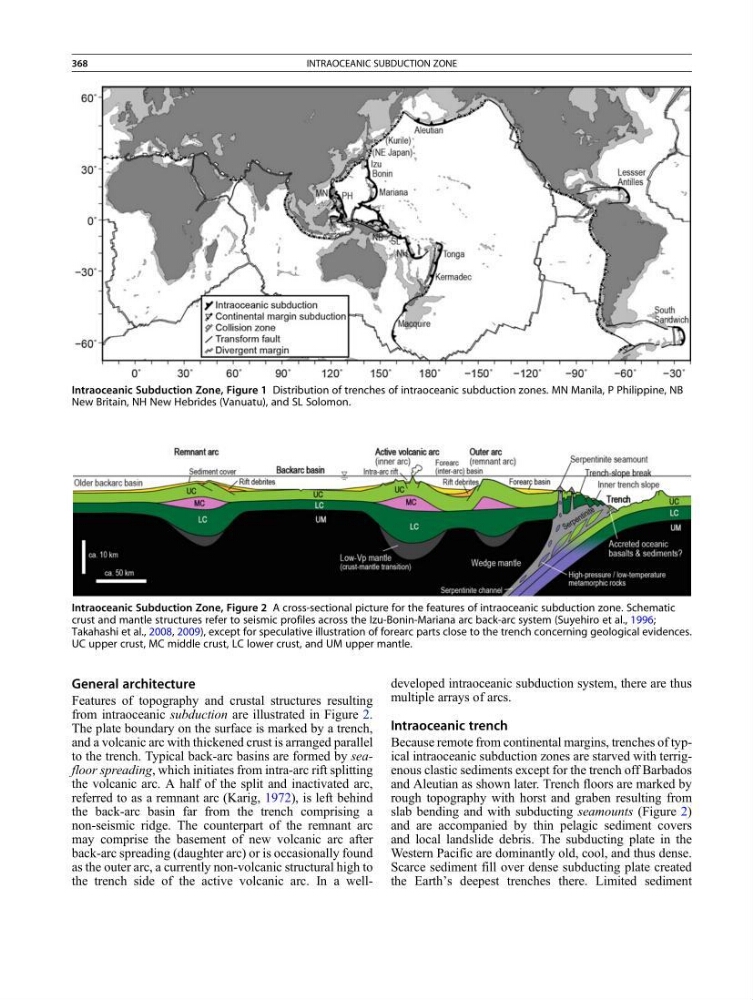
Intraoceanic Subduction Zone, Figure 1 Distribution of trenches of intraoceanic subduction zones. MN Manila, P Philippine, NB
New Britain, NH New Hebrides (Vanuatu), and SL Solomon.
Intraoceanic Subduction Zone, Figure 2 A cross-sectional picture for the features of intraoceanic subduction zone. Schematic
crust and mantle structures refer to seismic profiles across the Izu-Bonin-Mariana arc back-arc system (Suyehiro et al., 1996;
Takahashi et al., 2008, 2009), except for speculative illustration of forearc parts close to the trench concerning geological evidences.
UC upper crust, MC middle crust, LC lower crust, and UM upper mantle.
368
INTRAOCEANIC SUBDUCTION ZONE
Features of topography and crustal structures resulting
from intraoceanic subduction are illustrated in Figure 2.
The plate boundary on the surface is marked by a trench,
and a volcanic arc with thickened crust is arranged parallel
to the trench. Typical back-arc basins are formed by seafloor spreading, which initiates from intra-arc rift splitting
the volcanic arc. A half of the split and inactivated arc,
referred to as a remnant arc (Karig, 1972), is left behind
the back-arc basin far from the trench comprising a
non-seismic ridge. The counterpart of the remnant arc
may comprise the basement of new volcanic arc after
back-arc spreading (daughter arc) or is occasionally found
as the outer arc, a currently non-volcanic structural high to
the trench side of the active volcanic arc. In a welldeveloped intraoceanic subduction system, there are thus
multiple arrays of arcs.
Intraoceanic trench
Because remote from continental margins, trenches of typical intraoceanic subduction zones are starved with terrigenous clastic sediments except for the trench off Barbados
and Aleutian as shown later. Trench floors are marked by
rough topography with horst and graben resulting from
slab bending and with subducting seamounts (Figure 2)
and are accompanied by thin pelagic sediment covers
and local landslide debris. The subducting plate in the
Western Pacific are dominantly old, cool, and thus dense.
Scarce sediment fill over dense subducting plate created
the Earth’s deepest trenches there. Limited sediment
Intraoceanic Subduction Zone, Figure 1 Distribution of trenches of intraoceanic subduction zones. MN Manila, P Philippine, NB
New Britain, NH New Hebrides (Vanuatu), and SL Solomon.
Intraoceanic Subduction Zone, Figure 2 A cross-sectional picture for the features of intraoceanic subduction zone. Schematic
crust and mantle structures refer to seismic profiles across the Izu-Bonin-Mariana arc back-arc system (Suyehiro et al., 1996;
Takahashi et al., 2008, 2009), except for speculative illustration of forearc parts close to the trench concerning geological evidences.
UC upper crust, MC middle crust, LC lower crust, and UM upper mantle.
368
INTRAOCEANIC SUBDUCTION ZONE