

Ice rafting processes and IRD analysis
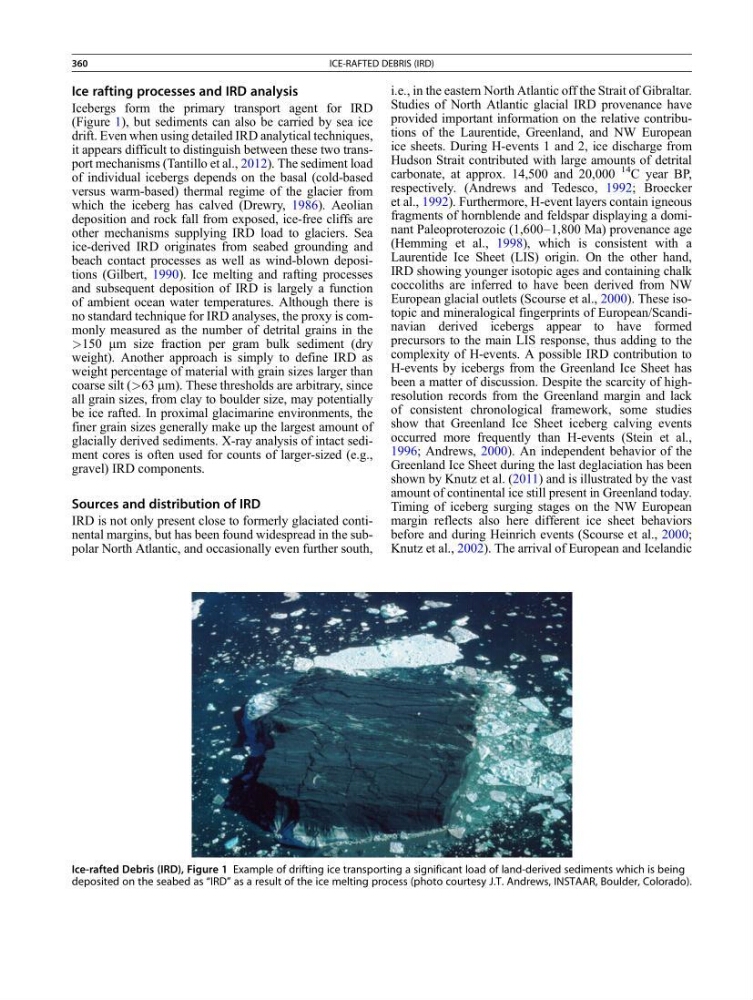
Icebergs form the primary transport agent for IRD
(Figure 1), but sediments can also be carried by sea ice
drift. Even when using detailed IRD analytical techniques,
it appears difficult to distinguish between these two transport mechanisms (Tantillo et al., 2012). The sediment load
of individual icebergs depends on the basal (cold-based
versus warm-based) thermal regime of the glacier from
which the iceberg has calved (Drewry, 1986). Aeolian
deposition and rock fall from exposed, ice-free cliffs are
other mechanisms supplying IRD load to glaciers. Sea
ice-derived IRD originates from seabed grounding and
beach contact processes as well as wind-blown depositions (Gilbert, 1990). Ice melting and rafting processes
and subsequent deposition of IRD is largely a function
of ambient ocean water temperatures. Although there is
no standard technique for IRD analyses, the proxy is commonly measured as the number of detrital grains in the
>150 mm size fraction per gram bulk sediment (dry
weight). Another approach is simply to define IRD as
weight percentage of material with grain sizes larger than
coarse silt (>63 mm). These thresholds are arbitrary, since
all grain sizes, from clay to boulder size, may potentially
be ice rafted. In proximal glacimarine environments, the
finer grain sizes generally make up the largest amount of
glacially derived sediments. X-ray analysis of intact sediment cores is often used for counts of larger-sized (e.g.,
gravel) IRD components.
Sources and distribution of IRD
IRD is not only present close to formerly glaciated continental margins, but has been found widespread in the subpolar North Atlantic, and occasionally even further south,
i.e., in the eastern North Atlantic off the Strait of Gibraltar.
Studies of North Atlantic glacial IRD provenance have
provided important information on the relative contributions of the Laurentide, Greenland, and NW European
ice sheets. During H-events 1 and 2, ice discharge from
Hudson Strait contributed with large amounts of detrital
carbonate, at approx. 14,500 and 20,000
14 C year BP,
respectively. (Andrews and Tedesco, 1992; Broecker
et al., 1992). Furthermore, H-event layers contain igneous
fragments of hornblende and feldspar displaying a dominant Paleoproterozoic (1,600–1,800 Ma) provenance age
(Hemming et al., 1998), which is consistent with a
Laurentide Ice Sheet (LIS) origin. On the other hand,
IRD showing younger isotopic ages and containing chalk
coccoliths are inferred to have been derived from NW
European glacial outlets (Scourse et al., 2000). These isotopic and mineralogical fingerprints of European/Scandinavian derived icebergs appear to have formed
precursors to the main LIS response, thus adding to the
complexity of H-events. A possible IRD contribution to
H-events by icebergs from the Greenland Ice Sheet has
been a matter of discussion. Despite the scarcity of highresolution records from the Greenland margin and lack
of consistent chronological framework, some studies
show that Greenland Ice Sheet iceberg calving events
occurred more frequently than H-events (Stein et al.,
1996; Andrews, 2000). An independent behavior of the
Greenland Ice Sheet during the last deglaciation has been
shown by Knutz et al. (2011) and is illustrated by the vast
amount of continental ice still present in Greenland today.
Timing of iceberg surging stages on the NW European
margin reflects also here different ice sheet behaviors
before and during Heinrich events (Scourse et al., 2000;
Knutz et al., 2002). The arrival of European and Icelandic
Ice-rafted Debris (IRD), Figure 1 Example of drifting ice transporting a significant load of land-derived sediments which is being
deposited on the seabed as “IRD” as a result of the ice melting process (photo courtesy J.T. Andrews, INSTAAR, Boulder, Colorado).
360
ICE-RAFTED DEBRIS (IRD)
Icebergs form the primary transport agent for IRD
(Figure 1), but sediments can also be carried by sea ice
drift. Even when using detailed IRD analytical techniques,
it appears difficult to distinguish between these two transport mechanisms (Tantillo et al., 2012). The sediment load
of individual icebergs depends on the basal (cold-based
versus warm-based) thermal regime of the glacier from
which the iceberg has calved (Drewry, 1986). Aeolian
deposition and rock fall from exposed, ice-free cliffs are
other mechanisms supplying IRD load to glaciers. Sea
ice-derived IRD originates from seabed grounding and
beach contact processes as well as wind-blown depositions (Gilbert, 1990). Ice melting and rafting processes
and subsequent deposition of IRD is largely a function
of ambient ocean water temperatures. Although there is
no standard technique for IRD analyses, the proxy is commonly measured as the number of detrital grains in the
>150 mm size fraction per gram bulk sediment (dry
weight). Another approach is simply to define IRD as
weight percentage of material with grain sizes larger than
coarse silt (>63 mm). These thresholds are arbitrary, since
all grain sizes, from clay to boulder size, may potentially
be ice rafted. In proximal glacimarine environments, the
finer grain sizes generally make up the largest amount of
glacially derived sediments. X-ray analysis of intact sediment cores is often used for counts of larger-sized (e.g.,
gravel) IRD components.
Sources and distribution of IRD
IRD is not only present close to formerly glaciated continental margins, but has been found widespread in the subpolar North Atlantic, and occasionally even further south,
i.e., in the eastern North Atlantic off the Strait of Gibraltar.
Studies of North Atlantic glacial IRD provenance have
provided important information on the relative contributions of the Laurentide, Greenland, and NW European
ice sheets. During H-events 1 and 2, ice discharge from
Hudson Strait contributed with large amounts of detrital
carbonate, at approx. 14,500 and 20,000
14 C year BP,
respectively. (Andrews and Tedesco, 1992; Broecker
et al., 1992). Furthermore, H-event layers contain igneous
fragments of hornblende and feldspar displaying a dominant Paleoproterozoic (1,600–1,800 Ma) provenance age
(Hemming et al., 1998), which is consistent with a
Laurentide Ice Sheet (LIS) origin. On the other hand,
IRD showing younger isotopic ages and containing chalk
coccoliths are inferred to have been derived from NW
European glacial outlets (Scourse et al., 2000). These isotopic and mineralogical fingerprints of European/Scandinavian derived icebergs appear to have formed
precursors to the main LIS response, thus adding to the
complexity of H-events. A possible IRD contribution to
H-events by icebergs from the Greenland Ice Sheet has
been a matter of discussion. Despite the scarcity of highresolution records from the Greenland margin and lack
of consistent chronological framework, some studies
show that Greenland Ice Sheet iceberg calving events
occurred more frequently than H-events (Stein et al.,
1996; Andrews, 2000). An independent behavior of the
Greenland Ice Sheet during the last deglaciation has been
shown by Knutz et al. (2011) and is illustrated by the vast
amount of continental ice still present in Greenland today.
Timing of iceberg surging stages on the NW European
margin reflects also here different ice sheet behaviors
before and during Heinrich events (Scourse et al., 2000;
Knutz et al., 2002). The arrival of European and Icelandic
Ice-rafted Debris (IRD), Figure 1 Example of drifting ice transporting a significant load of land-derived sediments which is being
deposited on the seabed as “IRD” as a result of the ice melting process (photo courtesy J.T. Andrews, INSTAAR, Boulder, Colorado).
360
ICE-RAFTED DEBRIS (IRD)