

adjacent to sulfide veins typically destroys any primary
igneous textures in the volcanic rocks and converts them
to a dominantly quartz-chlorite assemblage. Alteration
temperatures in the cores of the stockwork were likely
close to the exit temperatures of black smoker vents at
the surface, as indicated by fluid inclusion homogenization temperatures in quartz and anhydrite in the veins
(Petersen et al., 2000). In most cases, the alteration also
causes the rocks surrounding the discharge zone to
become insulated, sealing the system against the ingress
of seawater and allowing higher-temperature fluids to
occupy the alteration pipe (Lowell et al., 1993). However,
chloritized pillow rims are also common beyond the main
stockwork zone, indicating fluid flow between pillows
even where sulfide veins are not present. Much of this
chlorite alteration is likely caused by entrainment of seawater into the hydrothermal upflow rather than precipitation from the high-temperature fluids (Janecky and
Shanks, 1988). Abundant anhydrite is also found within
some feeder zones, precipitated from the progressive
heating of seawater that is drawn into the mound beneath
black smoker vents. Lenses of massive sulfide are also
found within permeable zones in the volcanic rocks below
the seafloor, such as interflow breccias, hyaloclastite, or
sediments.
The role of phase separation
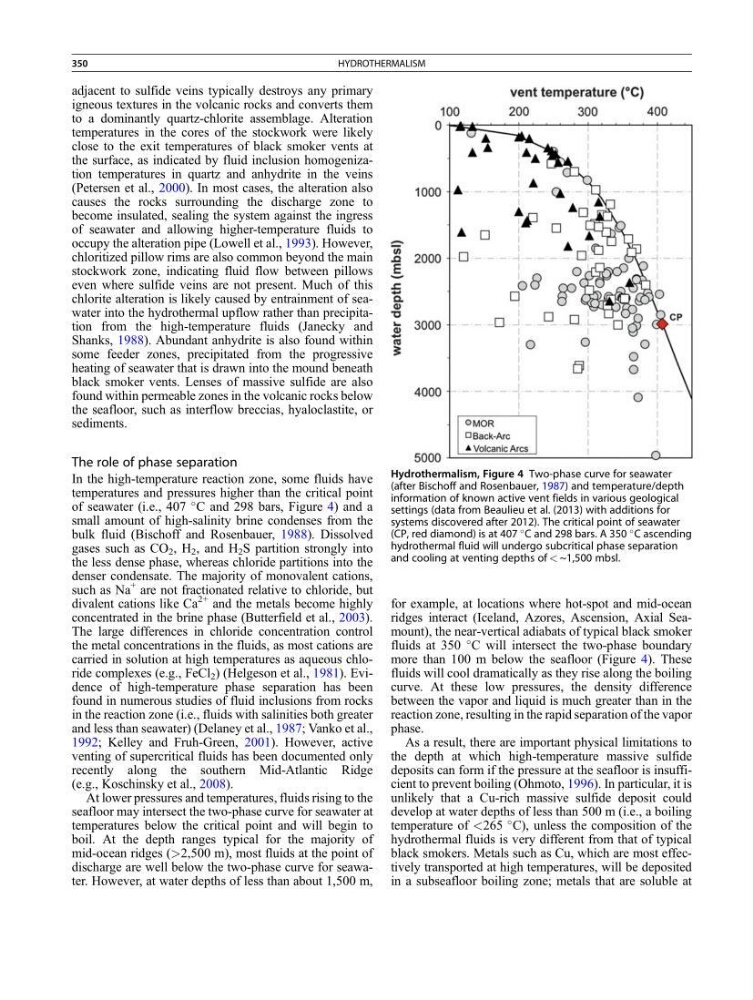
In the high-temperature reaction zone, some fluids have
temperatures and pressures higher than the critical point
of seawater (i.e., 407
C and 298 bars, Figure 4) and a
small amount of high-salinity brine condenses from the
bulk fluid (Bischoff and Rosenbauer, 1988). Dissolved
gases such as CO 2 , H 2 , and H 2 S partition strongly into
the less dense phase, whereas chloride partitions into the
denser condensate. The majority of monovalent cations,
such as Na
+ are not fractionated relative to chloride, but
divalent cations like Ca
2+ and the metals become highly
concentrated in the brine phase (Butterfield et al., 2003).
The large differences in chloride concentration control
the metal concentrations in the fluids, as most cations are
carried in solution at high temperatures as aqueous chloride complexes (e.g., FeCl 2 ) (Helgeson et al., 1981). Evidence of high-temperature phase separation has been
found in numerous studies of fluid inclusions from rocks
in the reaction zone (i.e., fluids with salinities both greater
and less than seawater) (Delaney et al., 1987; Vanko et al.,
1992; Kelley and Fruh-Green, 2001). However, active
venting of supercritical fluids has been documented only
recently along the southern Mid-Atlantic Ridge
(e.g., Koschinsky et al., 2008).
At lower pressures and temperatures, fluids rising to the
seafloor may intersect the two-phase curve for seawater at
temperatures below the critical point and will begin to
boil. At the depth ranges typical for the majority of
mid-ocean ridges (>2,500 m), most fluids at the point of
discharge are well below the two-phase curve for seawater. However, at water depths of less than about 1,500 m,
for example, at locations where hot-spot and mid-ocean
ridges interact (Iceland, Azores, Ascension, Axial Seamount), the near-vertical adiabats of typical black smoker
fluids at 350
C will intersect the two-phase boundary
more than 100 m below the seafloor (Figure 4). These
fluids will cool dramatically as they rise along the boiling
curve. At these low pressures, the density difference
between the vapor and liquid is much greater than in the
reaction zone, resulting in the rapid separation of the vapor
phase.
As a result, there are important physical limitations to
the depth at which high-temperature massive sulfide
deposits can form if the pressure at the seafloor is insufficient to prevent boiling (Ohmoto, 1996). In particular, it is
unlikely that a Cu-rich massive sulfide deposit could
develop at water depths of less than 500 m (i.e., a boiling
temperature of <265
C), unless the composition of the
hydrothermal fluids is very different from that of typical
black smokers. Metals such as Cu, which are most effectively transported at high temperatures, will be deposited
in a subseafloor boiling zone; metals that are soluble at
Hydrothermalism, Figure 4 Two-phase curve for seawater
(after Bischoff and Rosenbauer, 1987) and temperature/depth
information of known active vent fields in various geological
settings (data from Beaulieu et al. (2013) with additions for
systems discovered after 2012). The critical point of seawater
(CP, red diamond) is at 407
C and 298 bars. A 350
C ascending
hydrothermal fluid will undergo subcritical phase separation
and cooling at venting depths of < ~1,500 mbsl.
350
HYDROTHERMALISM
igneous textures in the volcanic rocks and converts them
to a dominantly quartz-chlorite assemblage. Alteration
temperatures in the cores of the stockwork were likely
close to the exit temperatures of black smoker vents at
the surface, as indicated by fluid inclusion homogenization temperatures in quartz and anhydrite in the veins
(Petersen et al., 2000). In most cases, the alteration also
causes the rocks surrounding the discharge zone to
become insulated, sealing the system against the ingress
of seawater and allowing higher-temperature fluids to
occupy the alteration pipe (Lowell et al., 1993). However,
chloritized pillow rims are also common beyond the main
stockwork zone, indicating fluid flow between pillows
even where sulfide veins are not present. Much of this
chlorite alteration is likely caused by entrainment of seawater into the hydrothermal upflow rather than precipitation from the high-temperature fluids (Janecky and
Shanks, 1988). Abundant anhydrite is also found within
some feeder zones, precipitated from the progressive
heating of seawater that is drawn into the mound beneath
black smoker vents. Lenses of massive sulfide are also
found within permeable zones in the volcanic rocks below
the seafloor, such as interflow breccias, hyaloclastite, or
sediments.
The role of phase separation
In the high-temperature reaction zone, some fluids have
temperatures and pressures higher than the critical point
of seawater (i.e., 407
C and 298 bars, Figure 4) and a
small amount of high-salinity brine condenses from the
bulk fluid (Bischoff and Rosenbauer, 1988). Dissolved
gases such as CO 2 , H 2 , and H 2 S partition strongly into
the less dense phase, whereas chloride partitions into the
denser condensate. The majority of monovalent cations,
such as Na
+ are not fractionated relative to chloride, but
divalent cations like Ca
2+ and the metals become highly
concentrated in the brine phase (Butterfield et al., 2003).
The large differences in chloride concentration control
the metal concentrations in the fluids, as most cations are
carried in solution at high temperatures as aqueous chloride complexes (e.g., FeCl 2 ) (Helgeson et al., 1981). Evidence of high-temperature phase separation has been
found in numerous studies of fluid inclusions from rocks
in the reaction zone (i.e., fluids with salinities both greater
and less than seawater) (Delaney et al., 1987; Vanko et al.,
1992; Kelley and Fruh-Green, 2001). However, active
venting of supercritical fluids has been documented only
recently along the southern Mid-Atlantic Ridge
(e.g., Koschinsky et al., 2008).
At lower pressures and temperatures, fluids rising to the
seafloor may intersect the two-phase curve for seawater at
temperatures below the critical point and will begin to
boil. At the depth ranges typical for the majority of
mid-ocean ridges (>2,500 m), most fluids at the point of
discharge are well below the two-phase curve for seawater. However, at water depths of less than about 1,500 m,
for example, at locations where hot-spot and mid-ocean
ridges interact (Iceland, Azores, Ascension, Axial Seamount), the near-vertical adiabats of typical black smoker
fluids at 350
C will intersect the two-phase boundary
more than 100 m below the seafloor (Figure 4). These
fluids will cool dramatically as they rise along the boiling
curve. At these low pressures, the density difference
between the vapor and liquid is much greater than in the
reaction zone, resulting in the rapid separation of the vapor
phase.
As a result, there are important physical limitations to
the depth at which high-temperature massive sulfide
deposits can form if the pressure at the seafloor is insufficient to prevent boiling (Ohmoto, 1996). In particular, it is
unlikely that a Cu-rich massive sulfide deposit could
develop at water depths of less than 500 m (i.e., a boiling
temperature of <265
C), unless the composition of the
hydrothermal fluids is very different from that of typical
black smokers. Metals such as Cu, which are most effectively transported at high temperatures, will be deposited
in a subseafloor boiling zone; metals that are soluble at
Hydrothermalism, Figure 4 Two-phase curve for seawater
(after Bischoff and Rosenbauer, 1987) and temperature/depth
information of known active vent fields in various geological
settings (data from Beaulieu et al. (2013) with additions for
systems discovered after 2012). The critical point of seawater
(CP, red diamond) is at 407
C and 298 bars. A 350
C ascending
hydrothermal fluid will undergo subcritical phase separation
and cooling at venting depths of < ~1,500 mbsl.
350
HYDROTHERMALISM