

fringing to barrier to atoll reefs (Gischler, 2011). During
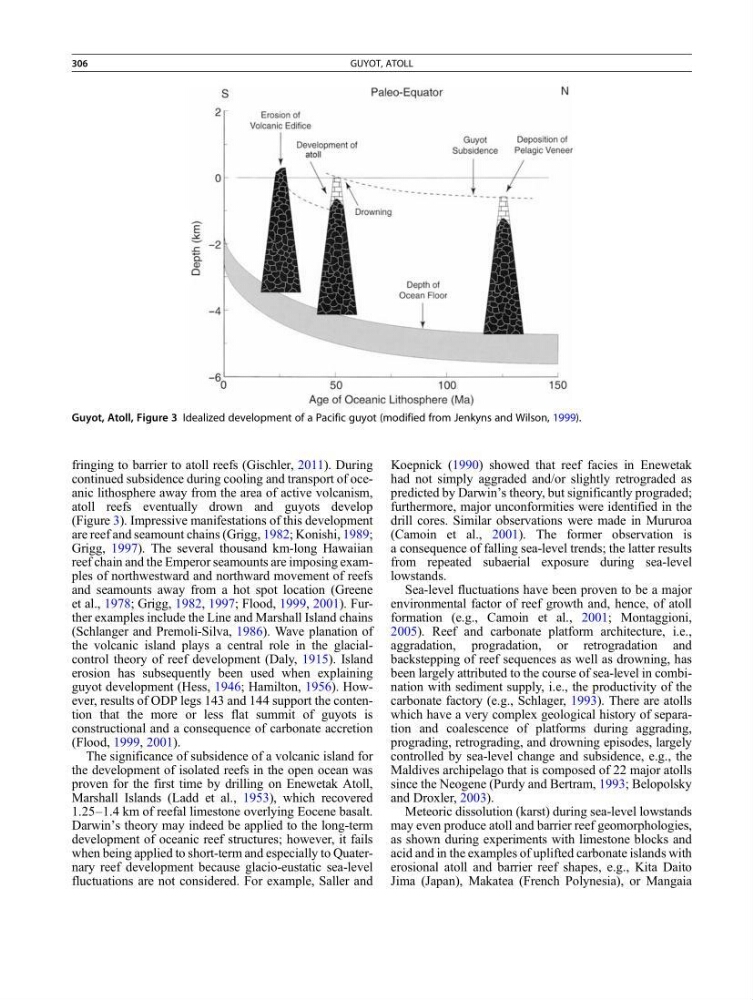
continued subsidence during cooling and transport of oceanic lithosphere away from the area of active volcanism,
atoll reefs eventually drown and guyots develop
(Figure 3). Impressive manifestations of this development
are reef and seamount chains (Grigg, 1982; Konishi, 1989;
Grigg, 1997). The several thousand km-long Hawaiian
reef chain and the Emperor seamounts are imposing examples of northwestward and northward movement of reefs
and seamounts away from a hot spot location (Greene
et al., 1978; Grigg, 1982, 1997; Flood, 1999, 2001). Further examples include the Line and Marshall Island chains
(Schlanger and Premoli-Silva, 1986). Wave planation of
the volcanic island plays a central role in the glacialcontrol theory of reef development (Daly, 1915). Island
erosion has subsequently been used when explaining
guyot development (Hess, 1946; Hamilton, 1956). However, results of ODP legs 143 and 144 support the contention that the more or less flat summit of guyots is
constructional and a consequence of carbonate accretion
(Flood, 1999, 2001).
The significance of subsidence of a volcanic island for
the development of isolated reefs in the open ocean was
proven for the first time by drilling on Enewetak Atoll,
Marshall Islands (Ladd et al., 1953), which recovered
1.25–1.4 km of reefal limestone overlying Eocene basalt.
Darwin’s theory may indeed be applied to the long-term
development of oceanic reef structures; however, it fails
when being applied to short-term and especially to Quaternary reef development because glacio-eustatic sea-level
fluctuations are not considered. For example, Saller and
Koepnick (1990) showed that reef facies in Enewetak
had not simply aggraded and/or slightly retrograded as
predicted by Darwin’s theory, but significantly prograded;
furthermore, major unconformities were identified in the
drill cores. Similar observations were made in Mururoa
(Camoin et al., 2001). The former observation is
a consequence of falling sea-level trends; the latter results
from repeated subaerial exposure during sea-level
lowstands.
Sea-level fluctuations have been proven to be a major
environmental factor of reef growth and, hence, of atoll
formation (e.g., Camoin et al., 2001; Montaggioni,
2005). Reef and carbonate platform architecture, i.e.,
aggradation, progradation, or retrogradation and
backstepping of reef sequences as well as drowning, has
been largely attributed to the course of sea-level in combination with sediment supply, i.e., the productivity of the
carbonate factory (e.g., Schlager, 1993). There are atolls
which have a very complex geological history of separation and coalescence of platforms during aggrading,
prograding, retrograding, and drowning episodes, largely
controlled by sea-level change and subsidence, e.g., the
Maldives archipelago that is composed of 22 major atolls
since the Neogene (Purdy and Bertram, 1993; Belopolsky
and Droxler, 2003).
Meteoric dissolution (karst) during sea-level lowstands
may even produce atoll and barrier reef geomorphologies,
as shown during experiments with limestone blocks and
acid and in the examples of uplifted carbonate islands with
erosional atoll and barrier reef shapes, e.g., Kita Daito
Jima (Japan), Makatea (French Polynesia), or Mangaia
Guyot, Atoll, Figure 3 Idealized development of a Pacific guyot (modified from Jenkyns and Wilson, 1999).
306
GUYOT, ATOLL
continued subsidence during cooling and transport of oceanic lithosphere away from the area of active volcanism,
atoll reefs eventually drown and guyots develop
(Figure 3). Impressive manifestations of this development
are reef and seamount chains (Grigg, 1982; Konishi, 1989;
Grigg, 1997). The several thousand km-long Hawaiian
reef chain and the Emperor seamounts are imposing examples of northwestward and northward movement of reefs
and seamounts away from a hot spot location (Greene
et al., 1978; Grigg, 1982, 1997; Flood, 1999, 2001). Further examples include the Line and Marshall Island chains
(Schlanger and Premoli-Silva, 1986). Wave planation of
the volcanic island plays a central role in the glacialcontrol theory of reef development (Daly, 1915). Island
erosion has subsequently been used when explaining
guyot development (Hess, 1946; Hamilton, 1956). However, results of ODP legs 143 and 144 support the contention that the more or less flat summit of guyots is
constructional and a consequence of carbonate accretion
(Flood, 1999, 2001).
The significance of subsidence of a volcanic island for
the development of isolated reefs in the open ocean was
proven for the first time by drilling on Enewetak Atoll,
Marshall Islands (Ladd et al., 1953), which recovered
1.25–1.4 km of reefal limestone overlying Eocene basalt.
Darwin’s theory may indeed be applied to the long-term
development of oceanic reef structures; however, it fails
when being applied to short-term and especially to Quaternary reef development because glacio-eustatic sea-level
fluctuations are not considered. For example, Saller and
Koepnick (1990) showed that reef facies in Enewetak
had not simply aggraded and/or slightly retrograded as
predicted by Darwin’s theory, but significantly prograded;
furthermore, major unconformities were identified in the
drill cores. Similar observations were made in Mururoa
(Camoin et al., 2001). The former observation is
a consequence of falling sea-level trends; the latter results
from repeated subaerial exposure during sea-level
lowstands.
Sea-level fluctuations have been proven to be a major
environmental factor of reef growth and, hence, of atoll
formation (e.g., Camoin et al., 2001; Montaggioni,
2005). Reef and carbonate platform architecture, i.e.,
aggradation, progradation, or retrogradation and
backstepping of reef sequences as well as drowning, has
been largely attributed to the course of sea-level in combination with sediment supply, i.e., the productivity of the
carbonate factory (e.g., Schlager, 1993). There are atolls
which have a very complex geological history of separation and coalescence of platforms during aggrading,
prograding, retrograding, and drowning episodes, largely
controlled by sea-level change and subsidence, e.g., the
Maldives archipelago that is composed of 22 major atolls
since the Neogene (Purdy and Bertram, 1993; Belopolsky
and Droxler, 2003).
Meteoric dissolution (karst) during sea-level lowstands
may even produce atoll and barrier reef geomorphologies,
as shown during experiments with limestone blocks and
acid and in the examples of uplifted carbonate islands with
erosional atoll and barrier reef shapes, e.g., Kita Daito
Jima (Japan), Makatea (French Polynesia), or Mangaia
Guyot, Atoll, Figure 3 Idealized development of a Pacific guyot (modified from Jenkyns and Wilson, 1999).
306
GUYOT, ATOLL