

usually tens of meters deep. The term atoll derives from
the Divehi (Maldivian) word atolu. Atoll reefs occur in
all oceans; they are most common in the Indo-Pacific
realm.
Guyots, a term coined by Hess (1946), are flat-topped
seamounts located in several hundred to several thousand
meters water depth. They are most common in the northwestern Pacific Ocean. Guyots usually are former volcanoes that are in many cases capped by drowned atoll
reefs and pelagic sediments.
Occurrence, geomorphology, and sediments
Atolls
Atolls are circular to irregular, narrow, shallow-water reef
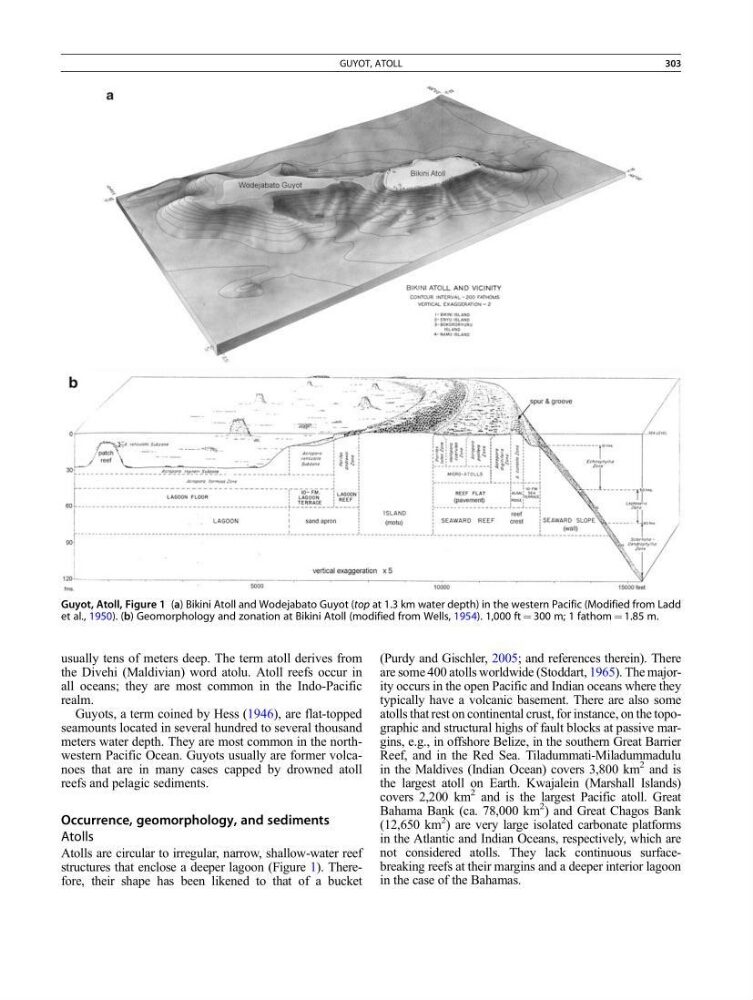
structures that enclose a deeper lagoon (Figure 1). Therefore, their shape has been likened to that of a bucket
(Purdy and Gischler, 2005; and references therein). There
are some 400 atolls worldwide (Stoddart, 1965). The majority occurs in the open Pacific and Indian oceans where they
typically have a volcanic basement. There are also some
atolls that rest on continental crust, for instance, on the topographic and structural highs of fault blocks at passive margins, e.g., in offshore Belize, in the southern Great Barrier
Reef, and in the Red Sea. Tiladummati-Miladummadulu
in the Maldives (Indian Ocean) covers 3,800 km
2 and is
the largest atoll on Earth. Kwajalein (Marshall Islands)
covers 2,200 km
2 and is the largest Pacific atoll. Great
Bahama Bank (ca. 78,000 km
2
) and Great Chagos Bank
(12,650 km
2
) are very large isolated carbonate platforms
in the Atlantic and Indian Oceans, respectively, which are
not considered atolls. They lack continuous surfacebreaking reefs at their margins and a deeper interior lagoon
in the case of the Bahamas.
Guyot, Atoll, Figure 1 (a) Bikini Atoll and Wodejabato Guyot (top at 1.3 km water depth) in the western Pacific (Modified from Ladd
et al., 1950). (b) Geomorphology and zonation at Bikini Atoll (modified from Wells, 1954). 1,000 ft ¼ 300 m; 1 fathom ¼ 1.85 m.
GUYOT, ATOLL
303
the Divehi (Maldivian) word atolu. Atoll reefs occur in
all oceans; they are most common in the Indo-Pacific
realm.
Guyots, a term coined by Hess (1946), are flat-topped
seamounts located in several hundred to several thousand
meters water depth. They are most common in the northwestern Pacific Ocean. Guyots usually are former volcanoes that are in many cases capped by drowned atoll
reefs and pelagic sediments.
Occurrence, geomorphology, and sediments
Atolls
Atolls are circular to irregular, narrow, shallow-water reef
structures that enclose a deeper lagoon (Figure 1). Therefore, their shape has been likened to that of a bucket
(Purdy and Gischler, 2005; and references therein). There
are some 400 atolls worldwide (Stoddart, 1965). The majority occurs in the open Pacific and Indian oceans where they
typically have a volcanic basement. There are also some
atolls that rest on continental crust, for instance, on the topographic and structural highs of fault blocks at passive margins, e.g., in offshore Belize, in the southern Great Barrier
Reef, and in the Red Sea. Tiladummati-Miladummadulu
in the Maldives (Indian Ocean) covers 3,800 km
2 and is
the largest atoll on Earth. Kwajalein (Marshall Islands)
covers 2,200 km
2 and is the largest Pacific atoll. Great
Bahama Bank (ca. 78,000 km
2
) and Great Chagos Bank
(12,650 km
2
) are very large isolated carbonate platforms
in the Atlantic and Indian Oceans, respectively, which are
not considered atolls. They lack continuous surfacebreaking reefs at their margins and a deeper interior lagoon
in the case of the Bahamas.
Guyot, Atoll, Figure 1 (a) Bikini Atoll and Wodejabato Guyot (top at 1.3 km water depth) in the western Pacific (Modified from Ladd
et al., 1950). (b) Geomorphology and zonation at Bikini Atoll (modified from Wells, 1954). 1,000 ft ¼ 300 m; 1 fathom ¼ 1.85 m.
GUYOT, ATOLL
303