

primary correlation markers, respectively, 541 Æ 0.63 Ma,
252.16 Æ 0.5 Ma, and 65.95 Æ 0.05 Ma, and there also are
direct age dates on base Carboniferous, base Permian,
base Jurassic, base Cenomanian, and base Eocene, but
most other period or stage boundaries prior to the Neogene
lack direct age control. No radiometric age dates were
available to GTS2012 for Barremian, Bathonian, Norian,
Kungurian through Wordian, Givetian, Pragian, Pridoli,
Gorstian, Aeronian, Floian, and large parts of Cambrian.
The Callovian through Hauterivian and Upper Triassic
are particularly low in stratigraphically meaningful radiometric dates. Therefore, the third step, linear interpolation,
still plays a key role for most of GTS2012, as it did in
GTS2004. This detailed and high-resolution interpolation
process incorporates several techniques, depending upon
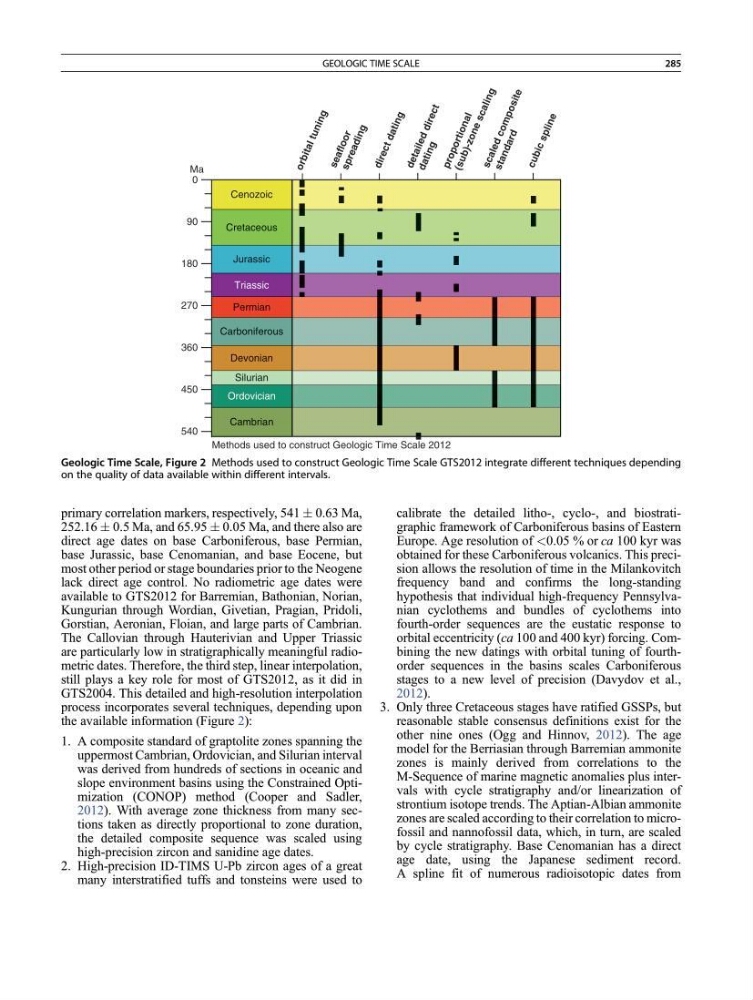
the available information (Figure 2):
1. A composite standard of graptolite zones spanning the
uppermost Cambrian, Ordovician, and Silurian interval
was derived from hundreds of sections in oceanic and
slope environment basins using the Constrained Optimization (CONOP) method (Cooper and Sadler,
2012). With average zone thickness from many sections taken as directly proportional to zone duration,
the detailed composite sequence was scaled using
high-precision zircon and sanidine age dates.
2. High-precision ID-TIMS U-Pb zircon ages of a great
many interstratified tuffs and tonsteins were used to
calibrate the detailed litho-, cyclo-, and biostratigraphic framework of Carboniferous basins of Eastern
Europe. Age resolution of <0.05 % or ca 100 kyr was
obtained for these Carboniferous volcanics. This precision allows the resolution of time in the Milankovitch
frequency band and confirms the long-standing
hypothesis that individual high-frequency Pennsylvanian cyclothems and bundles of cyclothems into
fourth-order sequences are the eustatic response to
orbital eccentricity (ca 100 and 400 kyr) forcing. Combining the new datings with orbital tuning of fourthorder sequences in the basins scales Carboniferous
stages to a new level of precision (Davydov et al.,
2012).
3. Only three Cretaceous stages have ratified GSSPs, but
reasonable stable consensus definitions exist for the
other nine ones (Ogg and Hinnov, 2012). The age
model for the Berriasian through Barremian ammonite
zones is mainly derived from correlations to the
M-Sequence of marine magnetic anomalies plus intervals with cycle stratigraphy and/or linearization of
strontium isotope trends. The Aptian-Albian ammonite
zones are scaled according to their correlation to microfossil and nannofossil data, which, in turn, are scaled
by cycle stratigraphy. Base Cenomanian has a direct
age date, using the Japanese sediment record.
A spline fit of numerous radioisotopic dates from
Cambrian
Ordovician
Silurian
Devonian
Carboniferous
Permian
Triassic
Jurassic
Cretaceous
Cenozoic
0
90
180
270
360
450
540
o r b it a l t u n in g s e a f lo o r
s p r e a d in g
d e t a il e d d ir e c t
d a t in g
d ir e c t d a t in g
s c a le d c o m p o s it e
s t a n d a r d
p r o p o r t io n a l
( s u b ) - z o n e s c a li n g
c u b ic s p li n e
Methods used to construct Geologic Time Scale 2012
Ma
Geologic Time Scale, Figure 2 Methods used to construct Geologic Time Scale GTS2012 integrate different techniques depending
on the quality of data available within different intervals.
GEOLOGIC TIME SCALE
285
252.16 Æ 0.5 Ma, and 65.95 Æ 0.05 Ma, and there also are
direct age dates on base Carboniferous, base Permian,
base Jurassic, base Cenomanian, and base Eocene, but
most other period or stage boundaries prior to the Neogene
lack direct age control. No radiometric age dates were
available to GTS2012 for Barremian, Bathonian, Norian,
Kungurian through Wordian, Givetian, Pragian, Pridoli,
Gorstian, Aeronian, Floian, and large parts of Cambrian.
The Callovian through Hauterivian and Upper Triassic
are particularly low in stratigraphically meaningful radiometric dates. Therefore, the third step, linear interpolation,
still plays a key role for most of GTS2012, as it did in
GTS2004. This detailed and high-resolution interpolation
process incorporates several techniques, depending upon
the available information (Figure 2):
1. A composite standard of graptolite zones spanning the
uppermost Cambrian, Ordovician, and Silurian interval
was derived from hundreds of sections in oceanic and
slope environment basins using the Constrained Optimization (CONOP) method (Cooper and Sadler,
2012). With average zone thickness from many sections taken as directly proportional to zone duration,
the detailed composite sequence was scaled using
high-precision zircon and sanidine age dates.
2. High-precision ID-TIMS U-Pb zircon ages of a great
many interstratified tuffs and tonsteins were used to
calibrate the detailed litho-, cyclo-, and biostratigraphic framework of Carboniferous basins of Eastern
Europe. Age resolution of <0.05 % or ca 100 kyr was
obtained for these Carboniferous volcanics. This precision allows the resolution of time in the Milankovitch
frequency band and confirms the long-standing
hypothesis that individual high-frequency Pennsylvanian cyclothems and bundles of cyclothems into
fourth-order sequences are the eustatic response to
orbital eccentricity (ca 100 and 400 kyr) forcing. Combining the new datings with orbital tuning of fourthorder sequences in the basins scales Carboniferous
stages to a new level of precision (Davydov et al.,
2012).
3. Only three Cretaceous stages have ratified GSSPs, but
reasonable stable consensus definitions exist for the
other nine ones (Ogg and Hinnov, 2012). The age
model for the Berriasian through Barremian ammonite
zones is mainly derived from correlations to the
M-Sequence of marine magnetic anomalies plus intervals with cycle stratigraphy and/or linearization of
strontium isotope trends. The Aptian-Albian ammonite
zones are scaled according to their correlation to microfossil and nannofossil data, which, in turn, are scaled
by cycle stratigraphy. Base Cenomanian has a direct
age date, using the Japanese sediment record.
A spline fit of numerous radioisotopic dates from
Cambrian
Ordovician
Silurian
Devonian
Carboniferous
Permian
Triassic
Jurassic
Cretaceous
Cenozoic
0
90
180
270
360
450
540
o r b it a l t u n in g s e a f lo o r
s p r e a d in g
d e t a il e d d ir e c t
d a t in g
d ir e c t d a t in g
s c a le d c o m p o s it e
s t a n d a r d
p r o p o r t io n a l
( s u b ) - z o n e s c a li n g
c u b ic s p li n e
Methods used to construct Geologic Time Scale 2012
Ma
Geologic Time Scale, Figure 2 Methods used to construct Geologic Time Scale GTS2012 integrate different techniques depending
on the quality of data available within different intervals.
GEOLOGIC TIME SCALE
285