

(precipitated CaCO 3 ), arenaceous (built of sediment particles), or organic (made of tectin).
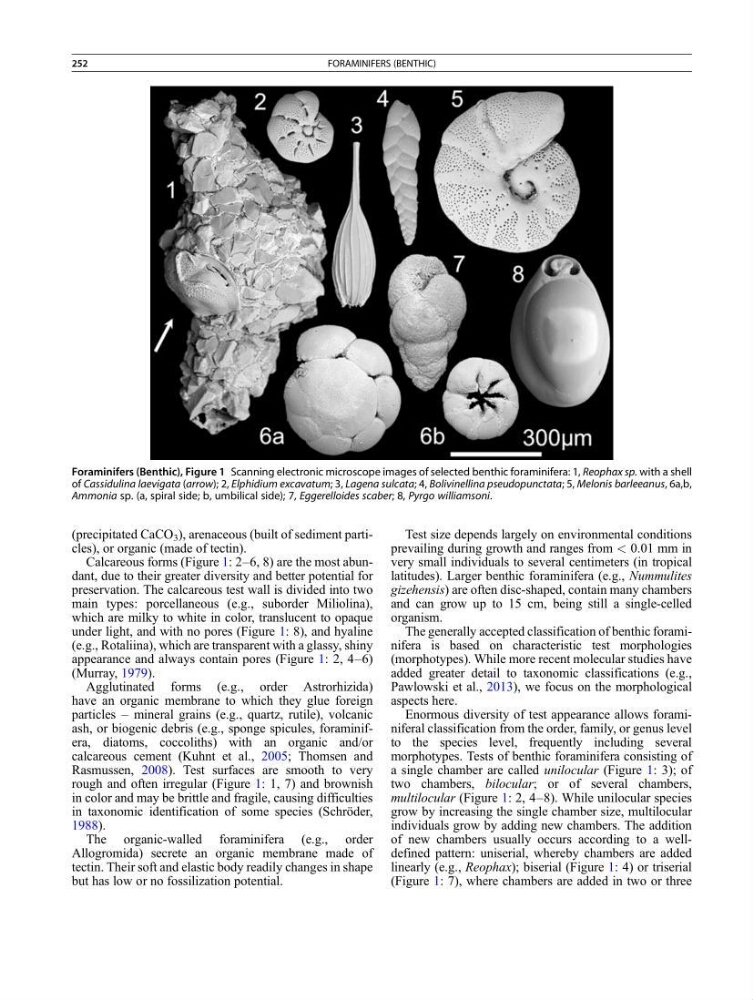
Calcareous forms (Figure 1: 2–6, 8) are the most abundant, due to their greater diversity and better potential for
preservation. The calcareous test wall is divided into two
main types: porcellaneous (e.g., suborder Miliolina),
which are milky to white in color, translucent to opaque
under light, and with no pores (Figure 1: 8), and hyaline
(e.g., Rotaliina), which are transparent with a glassy, shiny
appearance and always contain pores (Figure 1: 2, 4–6)
(Murray, 1979).
Agglutinated forms (e.g., order Astrorhizida)
have an organic membrane to which they glue foreign
particles – mineral grains (e.g., quartz, rutile), volcanic
ash, or biogenic debris (e.g., sponge spicules, foraminifera, diatoms, coccoliths) with an organic and/or
calcareous cement (Kuhnt et al., 2005; Thomsen and
Rasmussen, 2008). Test surfaces are smooth to very
rough and often irregular (Figure 1: 1, 7) and brownish
in color and may be brittle and fragile, causing difficulties
in taxonomic identification of some species (Schröder,
1988).
The organic-walled foraminifera (e.g., order
Allogromida) secrete an organic membrane made of
tectin. Their soft and elastic body readily changes in shape
but has low or no fossilization potential.
Test size depends largely on environmental conditions
prevailing during growth and ranges from < 0.01 mm in
very small individuals to several centimeters (in tropical
latitudes). Larger benthic foraminifera (e.g., Nummulites
gizehensis) are often disc-shaped, contain many chambers
and can grow up to 15 cm, being still a single-celled
organism.
The generally accepted classification of benthic foraminifera is based on characteristic test morphologies
(morphotypes). While more recent molecular studies have
added greater detail to taxonomic classifications (e.g.,
Pawlowski et al., 2013), we focus on the morphological
aspects here.
Enormous diversity of test appearance allows foraminiferal classification from the order, family, or genus level
to the species level, frequently including several
morphotypes. Tests of benthic foraminifera consisting of
a single chamber are called unilocular (Figure 1: 3); of
two chambers, bilocular; or of several chambers,
multilocular (Figure 1: 2, 4–8). While unilocular species
grow by increasing the single chamber size, multilocular
individuals grow by adding new chambers. The addition
of new chambers usually occurs according to a welldefined pattern: uniserial, whereby chambers are added
linearly (e.g., Reophax); biserial (Figure 1: 4) or triserial
(Figure 1: 7), where chambers are added in two or three
Foraminifers (Benthic), Figure 1 Scanning electronic microscope images of selected benthic foraminifera: 1, Reophax sp. with a shell
of Cassidulina laevigata (arrow); 2, Elphidium excavatum; 3, Lagena sulcata; 4, Bolivinellina pseudopunctata; 5, Melonis barleeanus, 6a,b,
Ammonia sp. (a, spiral side; b, umbilical side); 7, Eggerelloides scaber; 8, Pyrgo williamsoni.
252
FORAMINIFERS (BENTHIC)
Calcareous forms (Figure 1: 2–6, 8) are the most abundant, due to their greater diversity and better potential for
preservation. The calcareous test wall is divided into two
main types: porcellaneous (e.g., suborder Miliolina),
which are milky to white in color, translucent to opaque
under light, and with no pores (Figure 1: 8), and hyaline
(e.g., Rotaliina), which are transparent with a glassy, shiny
appearance and always contain pores (Figure 1: 2, 4–6)
(Murray, 1979).
Agglutinated forms (e.g., order Astrorhizida)
have an organic membrane to which they glue foreign
particles – mineral grains (e.g., quartz, rutile), volcanic
ash, or biogenic debris (e.g., sponge spicules, foraminifera, diatoms, coccoliths) with an organic and/or
calcareous cement (Kuhnt et al., 2005; Thomsen and
Rasmussen, 2008). Test surfaces are smooth to very
rough and often irregular (Figure 1: 1, 7) and brownish
in color and may be brittle and fragile, causing difficulties
in taxonomic identification of some species (Schröder,
1988).
The organic-walled foraminifera (e.g., order
Allogromida) secrete an organic membrane made of
tectin. Their soft and elastic body readily changes in shape
but has low or no fossilization potential.
Test size depends largely on environmental conditions
prevailing during growth and ranges from < 0.01 mm in
very small individuals to several centimeters (in tropical
latitudes). Larger benthic foraminifera (e.g., Nummulites
gizehensis) are often disc-shaped, contain many chambers
and can grow up to 15 cm, being still a single-celled
organism.
The generally accepted classification of benthic foraminifera is based on characteristic test morphologies
(morphotypes). While more recent molecular studies have
added greater detail to taxonomic classifications (e.g.,
Pawlowski et al., 2013), we focus on the morphological
aspects here.
Enormous diversity of test appearance allows foraminiferal classification from the order, family, or genus level
to the species level, frequently including several
morphotypes. Tests of benthic foraminifera consisting of
a single chamber are called unilocular (Figure 1: 3); of
two chambers, bilocular; or of several chambers,
multilocular (Figure 1: 2, 4–8). While unilocular species
grow by increasing the single chamber size, multilocular
individuals grow by adding new chambers. The addition
of new chambers usually occurs according to a welldefined pattern: uniserial, whereby chambers are added
linearly (e.g., Reophax); biserial (Figure 1: 4) or triserial
(Figure 1: 7), where chambers are added in two or three
Foraminifers (Benthic), Figure 1 Scanning electronic microscope images of selected benthic foraminifera: 1, Reophax sp. with a shell
of Cassidulina laevigata (arrow); 2, Elphidium excavatum; 3, Lagena sulcata; 4, Bolivinellina pseudopunctata; 5, Melonis barleeanus, 6a,b,
Ammonia sp. (a, spiral side; b, umbilical side); 7, Eggerelloides scaber; 8, Pyrgo williamsoni.
252
FORAMINIFERS (BENTHIC)