

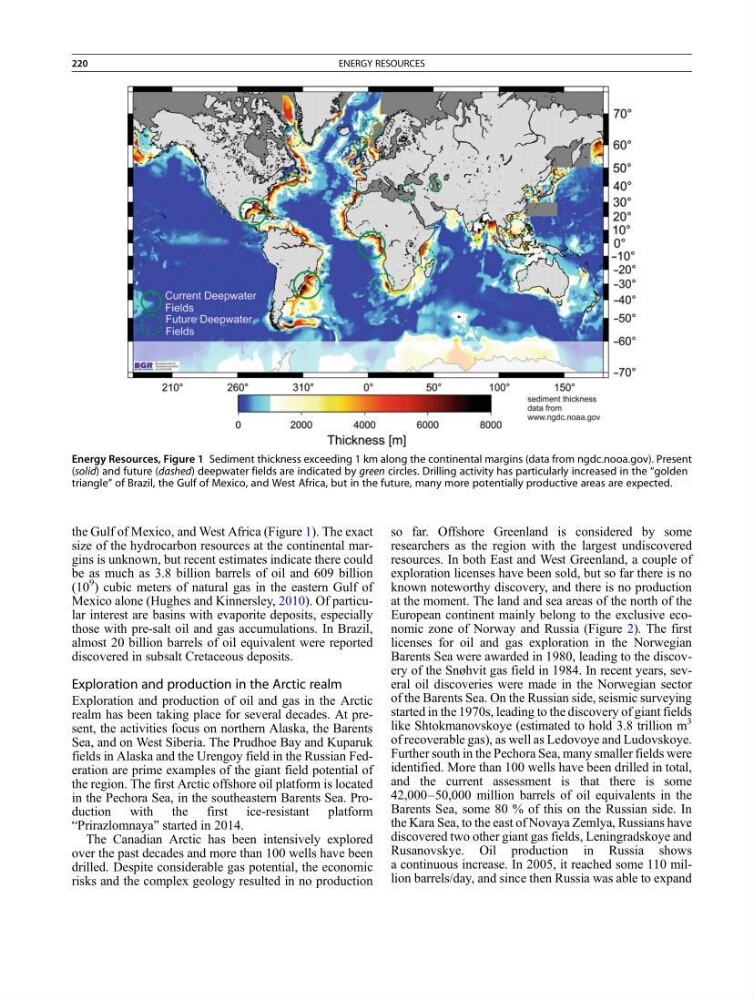
the Gulf of Mexico, and West Africa (Figure 1). The exact
size of the hydrocarbon resources at the continental margins is unknown, but recent estimates indicate there could
be as much as 3.8 billion barrels of oil and 609 billion
(10
9
) cubic meters of natural gas in the eastern Gulf of
Mexico alone (Hughes and Kinnersley, 2010). Of particular interest are basins with evaporite deposits, especially
those with pre-salt oil and gas accumulations. In Brazil,
almost 20 billion barrels of oil equivalent were reported
discovered in subsalt Cretaceous deposits.
Exploration and production in the Arctic realm
Exploration and production of oil and gas in the Arctic
realm has been taking place for several decades. At present, the activities focus on northern Alaska, the Barents
Sea, and on West Siberia. The Prudhoe Bay and Kuparuk
fields in Alaska and the Urengoy field in the Russian Federation are prime examples of the giant field potential of
the region. The first Arctic offshore oil platform is located
in the Pechora Sea, in the southeastern Barents Sea. Production with the first ice-resistant platform
“Prirazlomnaya” started in 2014.
The Canadian Arctic has been intensively explored
over the past decades and more than 100 wells have been
drilled. Despite considerable gas potential, the economic
risks and the complex geology resulted in no production
so far. Offshore Greenland is considered by some
researchers as the region with the largest undiscovered
resources. In both East and West Greenland, a couple of
exploration licenses have been sold, but so far there is no
known noteworthy discovery, and there is no production
at the moment. The land and sea areas of the north of the
European continent mainly belong to the exclusive economic zone of Norway and Russia (Figure 2). The first
licenses for oil and gas exploration in the Norwegian
Barents Sea were awarded in 1980, leading to the discovery of the Snøhvit gas field in 1984. In recent years, several oil discoveries were made in the Norwegian sector
of the Barents Sea. On the Russian side, seismic surveying
started in the 1970s, leading to the discovery of giant fields
like Shtokmanovskoye (estimated to hold 3.8 trillion m
3
of recoverable gas), as well as Ledovoye and Ludovskoye.
Further south in the Pechora Sea, many smaller fields were
identified. More than 100 wells have been drilled in total,
and the current assessment is that there is some
42,000–50,000 million barrels of oil equivalents in the
Barents Sea, some 80 % of this on the Russian side. In
the Kara Sea, to the east of Novaya Zemlya, Russians have
discovered two other giant gas fields, Leningradskoye and
Rusanovskye. Oil production in Russia shows
a continuous increase. In 2005, it reached some 110 million barrels/day, and since then Russia was able to expand
Energy Resources, Figure 1 Sediment thickness exceeding 1 km along the continental margins (data from ngdc.nooa.gov). Present
(solid) and future (dashed) deepwater fields are indicated by green circles. Drilling activity has particularly increased in the “golden
triangle” of Brazil, the Gulf of Mexico, and West Africa, but in the future, many more potentially productive areas are expected.
220
ENERGY RESOURCES
size of the hydrocarbon resources at the continental margins is unknown, but recent estimates indicate there could
be as much as 3.8 billion barrels of oil and 609 billion
(10
9
) cubic meters of natural gas in the eastern Gulf of
Mexico alone (Hughes and Kinnersley, 2010). Of particular interest are basins with evaporite deposits, especially
those with pre-salt oil and gas accumulations. In Brazil,
almost 20 billion barrels of oil equivalent were reported
discovered in subsalt Cretaceous deposits.
Exploration and production in the Arctic realm
Exploration and production of oil and gas in the Arctic
realm has been taking place for several decades. At present, the activities focus on northern Alaska, the Barents
Sea, and on West Siberia. The Prudhoe Bay and Kuparuk
fields in Alaska and the Urengoy field in the Russian Federation are prime examples of the giant field potential of
the region. The first Arctic offshore oil platform is located
in the Pechora Sea, in the southeastern Barents Sea. Production with the first ice-resistant platform
“Prirazlomnaya” started in 2014.
The Canadian Arctic has been intensively explored
over the past decades and more than 100 wells have been
drilled. Despite considerable gas potential, the economic
risks and the complex geology resulted in no production
so far. Offshore Greenland is considered by some
researchers as the region with the largest undiscovered
resources. In both East and West Greenland, a couple of
exploration licenses have been sold, but so far there is no
known noteworthy discovery, and there is no production
at the moment. The land and sea areas of the north of the
European continent mainly belong to the exclusive economic zone of Norway and Russia (Figure 2). The first
licenses for oil and gas exploration in the Norwegian
Barents Sea were awarded in 1980, leading to the discovery of the Snøhvit gas field in 1984. In recent years, several oil discoveries were made in the Norwegian sector
of the Barents Sea. On the Russian side, seismic surveying
started in the 1970s, leading to the discovery of giant fields
like Shtokmanovskoye (estimated to hold 3.8 trillion m
3
of recoverable gas), as well as Ledovoye and Ludovskoye.
Further south in the Pechora Sea, many smaller fields were
identified. More than 100 wells have been drilled in total,
and the current assessment is that there is some
42,000–50,000 million barrels of oil equivalents in the
Barents Sea, some 80 % of this on the Russian side. In
the Kara Sea, to the east of Novaya Zemlya, Russians have
discovered two other giant gas fields, Leningradskoye and
Rusanovskye. Oil production in Russia shows
a continuous increase. In 2005, it reached some 110 million barrels/day, and since then Russia was able to expand
Energy Resources, Figure 1 Sediment thickness exceeding 1 km along the continental margins (data from ngdc.nooa.gov). Present
(solid) and future (dashed) deepwater fields are indicated by green circles. Drilling activity has particularly increased in the “golden
triangle” of Brazil, the Gulf of Mexico, and West Africa, but in the future, many more potentially productive areas are expected.
220
ENERGY RESOURCES