

occurs, due to a change in the beach sedimentary balance,
from prograding to erosive, or to the formation of new seaward embryo dunes (Hesp and Martínez, 2007). Therefore, the frontal dunes will either grow vertically to their
maximum height and then erode moving landwards
(e.g., in beaches with narrow backshore and prevailing
and intense enough winds on the shore) or prograde seawards through the development of new embryo dunes
and foredune ridges (in beaches with broad and high
backshore levels and moderate onshore winds). Under
generally negative balance of beach sediment supply,
embryo dunes will not form and the foredune will undergo
net erosion. In extreme circumstances, the foredune will
become disrupted by blowouts, leading to the development of transgressive sand sheets and dunes (Ranwell,
1972; Hesp, 2002).
Dunes as ecosystems
Coastal dunes support unique and complex ecosystems of
high ecological value. They represent a harsh environment
for the survival of many living beings; hence, species of
sand flora and fauna are specifically adapted to such
stressful conditions, mainly related to sand properties,
sedimentary dynamics, the proximity to the sea, and the
influence of wind (Ranwell, 1972; Chapman, 1976;
Carter, 1988; Maun, 2009). One of the main traits that
make these ecosystems so particular is the nature of the
substrate, i.e., sands, onto which the biocenosis is developed. Apart from its mobility (burial, but also bypassing
and erosion), fine to coarse siliceous sands that commonly
comprise the dunes are characterized by a considerable
pore size, which confers these substrates a free drainage
and a pursuant low capacity to retain water or nutrients,
such as phosphorous, nitrogen, or potassium (Maun,
2009). Severe leaching often occurs, which leads to substantial losses of nutrient and organic matter in the soil.
This leads to a general low vegetation coverage, which is
related to high air and soil temperatures and light intensities in low and medium latitudes. In addition, this characteristic low plant abundance is usually unable to develop a
real soil, and only a partially formed surface horizon
(arenosol), with poor levels of humus, is noticeable in
the more mature stages of the dune development. On the
other hand, the influence of the sea determines a series
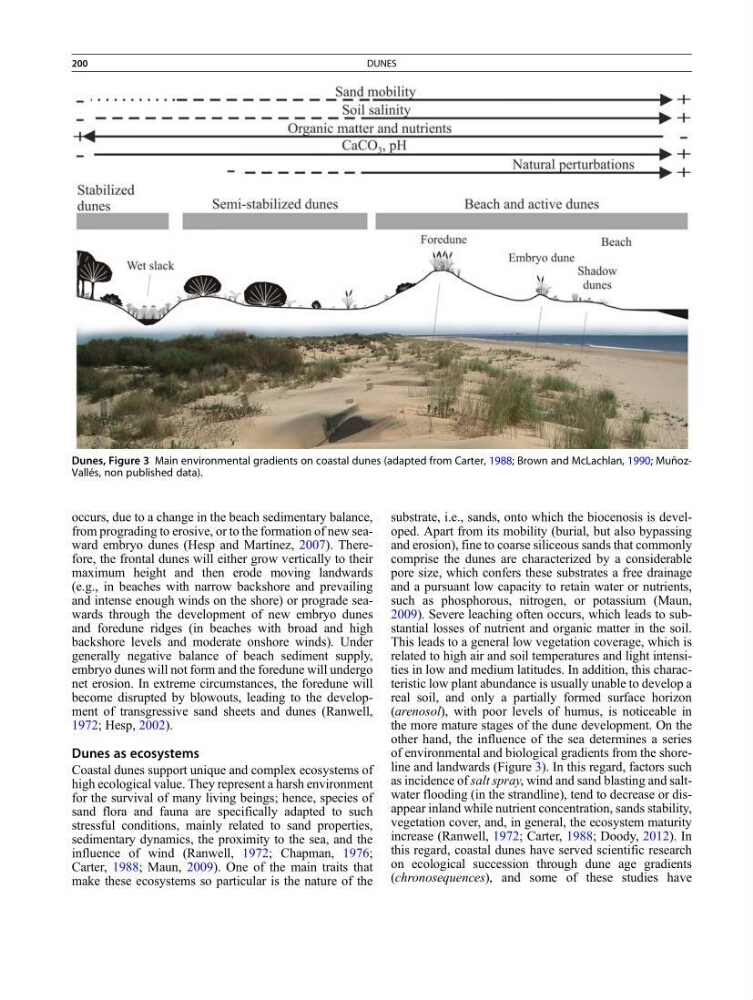
of environmental and biological gradients from the shoreline and landwards (Figure 3). In this regard, factors such
as incidence of salt spray, wind and sand blasting and saltwater flooding (in the strandline), tend to decrease or disappear inland while nutrient concentration, sands stability,
vegetation cover, and, in general, the ecosystem maturity
increase (Ranwell, 1972; Carter, 1988; Doody, 2012). In
this regard, coastal dunes have served scientific research
on ecological succession through dune age gradients
(chronosequences), and some of these studies have
Dunes, Figure 3 Main environmental gradients on coastal dunes (adapted from Carter, 1988; Brown and McLachlan, 1990; Mun ˜ ozValle ´s, non published data).
200
DUNES
from prograding to erosive, or to the formation of new seaward embryo dunes (Hesp and Martínez, 2007). Therefore, the frontal dunes will either grow vertically to their
maximum height and then erode moving landwards
(e.g., in beaches with narrow backshore and prevailing
and intense enough winds on the shore) or prograde seawards through the development of new embryo dunes
and foredune ridges (in beaches with broad and high
backshore levels and moderate onshore winds). Under
generally negative balance of beach sediment supply,
embryo dunes will not form and the foredune will undergo
net erosion. In extreme circumstances, the foredune will
become disrupted by blowouts, leading to the development of transgressive sand sheets and dunes (Ranwell,
1972; Hesp, 2002).
Dunes as ecosystems
Coastal dunes support unique and complex ecosystems of
high ecological value. They represent a harsh environment
for the survival of many living beings; hence, species of
sand flora and fauna are specifically adapted to such
stressful conditions, mainly related to sand properties,
sedimentary dynamics, the proximity to the sea, and the
influence of wind (Ranwell, 1972; Chapman, 1976;
Carter, 1988; Maun, 2009). One of the main traits that
make these ecosystems so particular is the nature of the
substrate, i.e., sands, onto which the biocenosis is developed. Apart from its mobility (burial, but also bypassing
and erosion), fine to coarse siliceous sands that commonly
comprise the dunes are characterized by a considerable
pore size, which confers these substrates a free drainage
and a pursuant low capacity to retain water or nutrients,
such as phosphorous, nitrogen, or potassium (Maun,
2009). Severe leaching often occurs, which leads to substantial losses of nutrient and organic matter in the soil.
This leads to a general low vegetation coverage, which is
related to high air and soil temperatures and light intensities in low and medium latitudes. In addition, this characteristic low plant abundance is usually unable to develop a
real soil, and only a partially formed surface horizon
(arenosol), with poor levels of humus, is noticeable in
the more mature stages of the dune development. On the
other hand, the influence of the sea determines a series
of environmental and biological gradients from the shoreline and landwards (Figure 3). In this regard, factors such
as incidence of salt spray, wind and sand blasting and saltwater flooding (in the strandline), tend to decrease or disappear inland while nutrient concentration, sands stability,
vegetation cover, and, in general, the ecosystem maturity
increase (Ranwell, 1972; Carter, 1988; Doody, 2012). In
this regard, coastal dunes have served scientific research
on ecological succession through dune age gradients
(chronosequences), and some of these studies have
Dunes, Figure 3 Main environmental gradients on coastal dunes (adapted from Carter, 1988; Brown and McLachlan, 1990; Mun ˜ ozValle ´s, non published data).
200
DUNES