

Dunes typology
The different factors involved in the formation and development of coastal dunes result in a wide variety of forms
and dimensions. During the last decades, different authors
have proposed diverse dune classifications based on different criteria (e.g., morphogenetic, geometric,
morphoecological) (see Sanjaume et al., 2011), since the
study of sand dunes is a multidisciplinary matter, carried
out by researchers from different science branches such
as physical (e.g., engineering, physics), life (ecology, botany, zoology), or earth (geomorphology, sedimentology,
hydrology) sciences (Pye and Tsoar, 2009).
In general, the most widely spread and applied coastal
dune classification has been based on morphogenetic
criteria, sometimes considering vegetation traits. Here we
summarize the most common dune types found in coastal
environments (based on the descriptions by Goldsmith,
1985; Hesp, 2002; Pye and Tsoar, 2009; otherwise cited):
• Embryo dunes: also named shadow dunes; they are the
most elementary and small coastal dunes that form in
the wind shadows of clumps of vegetation or other
small obstacles to sand transport by the wind. Sometimes, the term shadow dune is used to name the smaller
forms, with decimetrical or centimetrical lengths.
• Foredunes: dune ridges that run parallel to the shore,
more or less perpendicular to the prevailing wind.
Foredunes are usually developed from several former
embryo dunes that grow and coalesce to form an incipient foredune, corresponding to a higher evolutionary
dune stage (see the subsection “Dune Formation” in this
entry).
• Transverse dunes: alignments or longitudinal ridges
with a gentle slope in the windward face but more pronounced in the slip face, more or less parallel to the
coastline and always arranged perpendicular to the
prevailing wind that originates them. It includes other
types of dunes if they are arranged perpendicular to
the prevailing winds, such as foredunes, barchans, parabolic, or precipitation dunes.
• Barchans: dunes with crescent shape and wings developed downwind.
• Parabolic dunes: relatively stable, U-shaped dunes
with lateral lobes anchored by vegetation and the crest
migrating downwind.
• Reversing dunes: a special type of transverse dune,
showing similar slopes both in the windward and slip
faces due to winds acting in opposite directions.
• Transgressive or precipitation dunes: mobile dunes
with high dynamism and absence of vegetation cover
due to high burial rates, which rush on the existing tree
line and may become a burial hazard for roads and
towns.
• Climbing dunes: dunes originated by a sand-laden
wind or a migratory dune that bump into a topographic
barrier – a hill or a cliff – and climb it totally or partially.
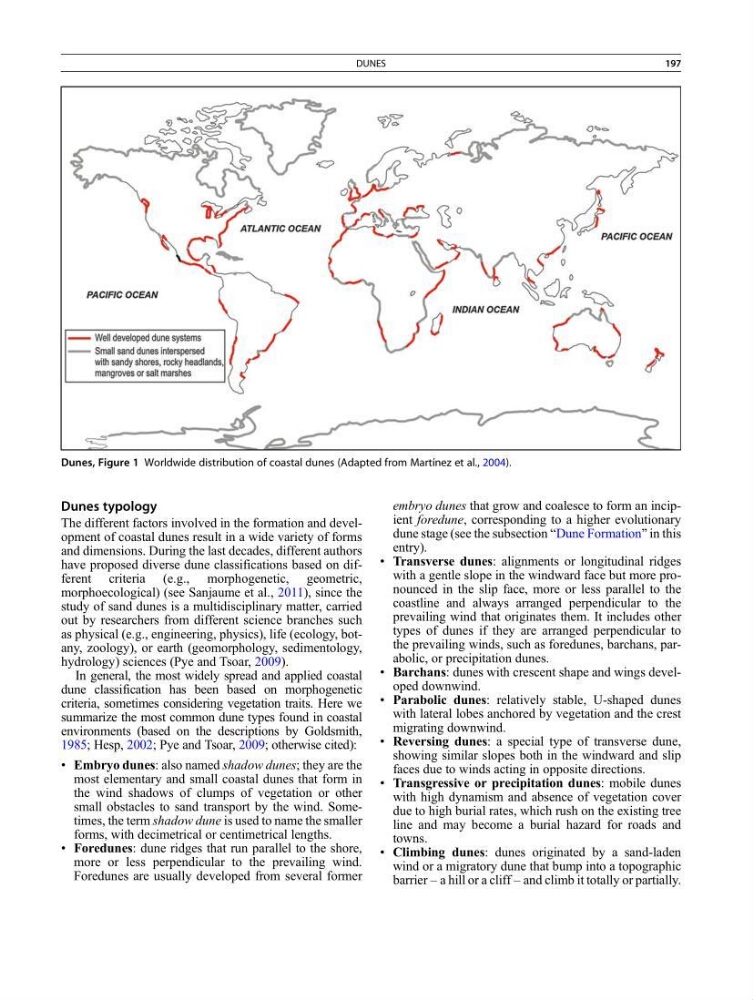
Dunes, Figure 1 Worldwide distribution of coastal dunes (Adapted from Martı ´nez et al., 2004).
DUNES
197
The different factors involved in the formation and development of coastal dunes result in a wide variety of forms
and dimensions. During the last decades, different authors
have proposed diverse dune classifications based on different criteria (e.g., morphogenetic, geometric,
morphoecological) (see Sanjaume et al., 2011), since the
study of sand dunes is a multidisciplinary matter, carried
out by researchers from different science branches such
as physical (e.g., engineering, physics), life (ecology, botany, zoology), or earth (geomorphology, sedimentology,
hydrology) sciences (Pye and Tsoar, 2009).
In general, the most widely spread and applied coastal
dune classification has been based on morphogenetic
criteria, sometimes considering vegetation traits. Here we
summarize the most common dune types found in coastal
environments (based on the descriptions by Goldsmith,
1985; Hesp, 2002; Pye and Tsoar, 2009; otherwise cited):
• Embryo dunes: also named shadow dunes; they are the
most elementary and small coastal dunes that form in
the wind shadows of clumps of vegetation or other
small obstacles to sand transport by the wind. Sometimes, the term shadow dune is used to name the smaller
forms, with decimetrical or centimetrical lengths.
• Foredunes: dune ridges that run parallel to the shore,
more or less perpendicular to the prevailing wind.
Foredunes are usually developed from several former
embryo dunes that grow and coalesce to form an incipient foredune, corresponding to a higher evolutionary
dune stage (see the subsection “Dune Formation” in this
entry).
• Transverse dunes: alignments or longitudinal ridges
with a gentle slope in the windward face but more pronounced in the slip face, more or less parallel to the
coastline and always arranged perpendicular to the
prevailing wind that originates them. It includes other
types of dunes if they are arranged perpendicular to
the prevailing winds, such as foredunes, barchans, parabolic, or precipitation dunes.
• Barchans: dunes with crescent shape and wings developed downwind.
• Parabolic dunes: relatively stable, U-shaped dunes
with lateral lobes anchored by vegetation and the crest
migrating downwind.
• Reversing dunes: a special type of transverse dune,
showing similar slopes both in the windward and slip
faces due to winds acting in opposite directions.
• Transgressive or precipitation dunes: mobile dunes
with high dynamism and absence of vegetation cover
due to high burial rates, which rush on the existing tree
line and may become a burial hazard for roads and
towns.
• Climbing dunes: dunes originated by a sand-laden
wind or a migratory dune that bump into a topographic
barrier – a hill or a cliff – and climb it totally or partially.
Dunes, Figure 1 Worldwide distribution of coastal dunes (Adapted from Martı ´nez et al., 2004).
DUNES
197