

on the plate and is resisted by viscous drag along the interface (F SR ). This definition implies a strong slab capable of
transmitting stresses to the plate and therefore acting as a
stress guide (Elsasser, 1969).
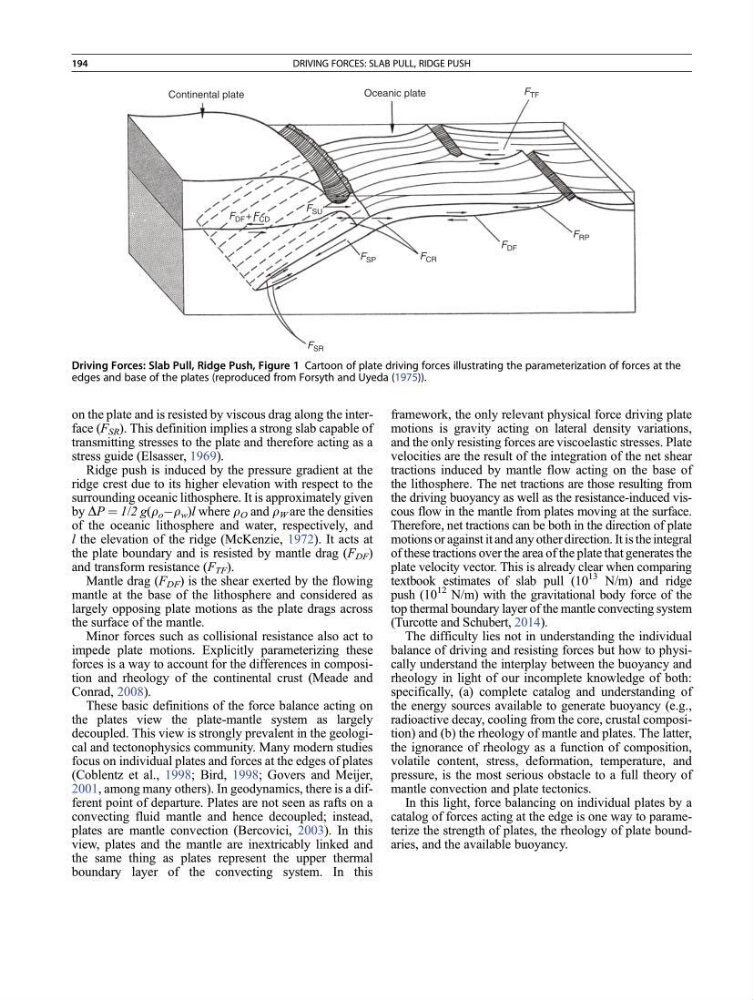
Ridge push is induced by the pressure gradient at the
ridge crest due to its higher elevation with respect to the
surrounding oceanic lithosphere. It is approximately given
by DP ¼ 1/2 g(r o Àr w )l where r O and r W are the densities
of the oceanic lithosphere and water, respectively, and
l the elevation of the ridge (McKenzie, 1972). It acts at
the plate boundary and is resisted by mantle drag (F DF )
and transform resistance (F TF ).
Mantle drag (F DF ) is the shear exerted by the flowing
mantle at the base of the lithosphere and considered as
largely opposing plate motions as the plate drags across
the surface of the mantle.
Minor forces such as collisional resistance also act to
impede plate motions. Explicitly parameterizing these
forces is a way to account for the differences in composition and rheology of the continental crust (Meade and
Conrad, 2008).
These basic definitions of the force balance acting on
the plates view the plate-mantle system as largely
decoupled. This view is strongly prevalent in the geological and tectonophysics community. Many modern studies
focus on individual plates and forces at the edges of plates
(Coblentz et al., 1998; Bird, 1998; Govers and Meijer,
2001, among many others). In geodynamics, there is a different point of departure. Plates are not seen as rafts on a
convecting fluid mantle and hence decoupled; instead,
plates are mantle convection (Bercovici, 2003). In this
view, plates and the mantle are inextricably linked and
the same thing as plates represent the upper thermal
boundary layer of the convecting system. In this
framework, the only relevant physical force driving plate
motions is gravity acting on lateral density variations,
and the only resisting forces are viscoelastic stresses. Plate
velocities are the result of the integration of the net shear
tractions induced by mantle flow acting on the base of
the lithosphere. The net tractions are those resulting from
the driving buoyancy as well as the resistance-induced viscous flow in the mantle from plates moving at the surface.
Therefore, net tractions can be both in the direction of plate
motions or against it and any other direction. It is the integral
of these tractions over the area of the plate that generates the
plate velocity vector. This is already clear when comparing
textbook estimates of slab pull (10
13 N/m) and ridge
push (10
12 N/m) with the gravitational body force of the
top thermal boundary layer of the mantle convecting system
(Turcotte and Schubert, 2014).
The difficulty lies not in understanding the individual
balance of driving and resisting forces but how to physically understand the interplay between the buoyancy and
rheology in light of our incomplete knowledge of both:
specifically, (a) complete catalog and understanding of
the energy sources available to generate buoyancy (e.g.,
radioactive decay, cooling from the core, crustal composition) and (b) the rheology of mantle and plates. The latter,
the ignorance of rheology as a function of composition,
volatile content, stress, deformation, temperature, and
pressure, is the most serious obstacle to a full theory of
mantle convection and plate tectonics.
In this light, force balancing on individual plates by a
catalog of forces acting at the edge is one way to parameterize the strength of plates, the rheology of plate boundaries, and the available buoyancy.
Continental plate
Oceanic plate
F TF
F SP
F DF + F CD
F SU
F SR
F CR
F DF
F RP
Driving Forces: Slab Pull, Ridge Push, Figure 1 Cartoon of plate driving forces illustrating the parameterization of forces at the
edges and base of the plates (reproduced from Forsyth and Uyeda (1975)).
194
DRIVING FORCES: SLAB PULL, RIDGE PUSH
transmitting stresses to the plate and therefore acting as a
stress guide (Elsasser, 1969).
Ridge push is induced by the pressure gradient at the
ridge crest due to its higher elevation with respect to the
surrounding oceanic lithosphere. It is approximately given
by DP ¼ 1/2 g(r o Àr w )l where r O and r W are the densities
of the oceanic lithosphere and water, respectively, and
l the elevation of the ridge (McKenzie, 1972). It acts at
the plate boundary and is resisted by mantle drag (F DF )
and transform resistance (F TF ).
Mantle drag (F DF ) is the shear exerted by the flowing
mantle at the base of the lithosphere and considered as
largely opposing plate motions as the plate drags across
the surface of the mantle.
Minor forces such as collisional resistance also act to
impede plate motions. Explicitly parameterizing these
forces is a way to account for the differences in composition and rheology of the continental crust (Meade and
Conrad, 2008).
These basic definitions of the force balance acting on
the plates view the plate-mantle system as largely
decoupled. This view is strongly prevalent in the geological and tectonophysics community. Many modern studies
focus on individual plates and forces at the edges of plates
(Coblentz et al., 1998; Bird, 1998; Govers and Meijer,
2001, among many others). In geodynamics, there is a different point of departure. Plates are not seen as rafts on a
convecting fluid mantle and hence decoupled; instead,
plates are mantle convection (Bercovici, 2003). In this
view, plates and the mantle are inextricably linked and
the same thing as plates represent the upper thermal
boundary layer of the convecting system. In this
framework, the only relevant physical force driving plate
motions is gravity acting on lateral density variations,
and the only resisting forces are viscoelastic stresses. Plate
velocities are the result of the integration of the net shear
tractions induced by mantle flow acting on the base of
the lithosphere. The net tractions are those resulting from
the driving buoyancy as well as the resistance-induced viscous flow in the mantle from plates moving at the surface.
Therefore, net tractions can be both in the direction of plate
motions or against it and any other direction. It is the integral
of these tractions over the area of the plate that generates the
plate velocity vector. This is already clear when comparing
textbook estimates of slab pull (10
13 N/m) and ridge
push (10
12 N/m) with the gravitational body force of the
top thermal boundary layer of the mantle convecting system
(Turcotte and Schubert, 2014).
The difficulty lies not in understanding the individual
balance of driving and resisting forces but how to physically understand the interplay between the buoyancy and
rheology in light of our incomplete knowledge of both:
specifically, (a) complete catalog and understanding of
the energy sources available to generate buoyancy (e.g.,
radioactive decay, cooling from the core, crustal composition) and (b) the rheology of mantle and plates. The latter,
the ignorance of rheology as a function of composition,
volatile content, stress, deformation, temperature, and
pressure, is the most serious obstacle to a full theory of
mantle convection and plate tectonics.
In this light, force balancing on individual plates by a
catalog of forces acting at the edge is one way to parameterize the strength of plates, the rheology of plate boundaries, and the available buoyancy.
Continental plate
Oceanic plate
F TF
F SP
F DF + F CD
F SU
F SR
F CR
F DF
F RP
Driving Forces: Slab Pull, Ridge Push, Figure 1 Cartoon of plate driving forces illustrating the parameterization of forces at the
edges and base of the plates (reproduced from Forsyth and Uyeda (1975)).
194
DRIVING FORCES: SLAB PULL, RIDGE PUSH