

Authigenic and cosmogenic sediment components
and ferromanganese nodules
A fraction of deep-sea sediments are transition metal-rich
oxyhydroxides precipitated directly from seawater,
referred to as the authigenic or hydrogenous sediment
component (Goldberg, 1954). “Authigenic” has also been
used to refer to aluminosilicate minerals that are formed as
other unstable components dissolve within deep-sea sediments, e.g., authigenic smectite clays (Cole and Shaw,
1983) or authigenic phillipsite (Stonecipher, 1976; Bernat
and Church, 1978). However, this is more properly considered early diagenesis (section “Seafloor Processes
Affecting Deep-Sea Sediment Composition: Dissolution,
Early Diagenesis, and Sediment Movement”).
The authigenic ferromanganese oxyhydroxides are
only a significant sediment component when sedimentation rates are very low, because of the low concentrations
of transition metals in seawater and slow precipitation
rates. Ferromanganese nodules, an authigenic concretion,
typically have growth rates of 1–10 mm/10
6 years, for
example, versus typical sedimentation rates in the surrounding sediments that are ~1,000 times faster (Heath,
1981; Dymond et al., 1984).
Authigenic oxyhydroxides include both ferromanganese
nodules and the dispersed ferromanganese oxyhydroxides
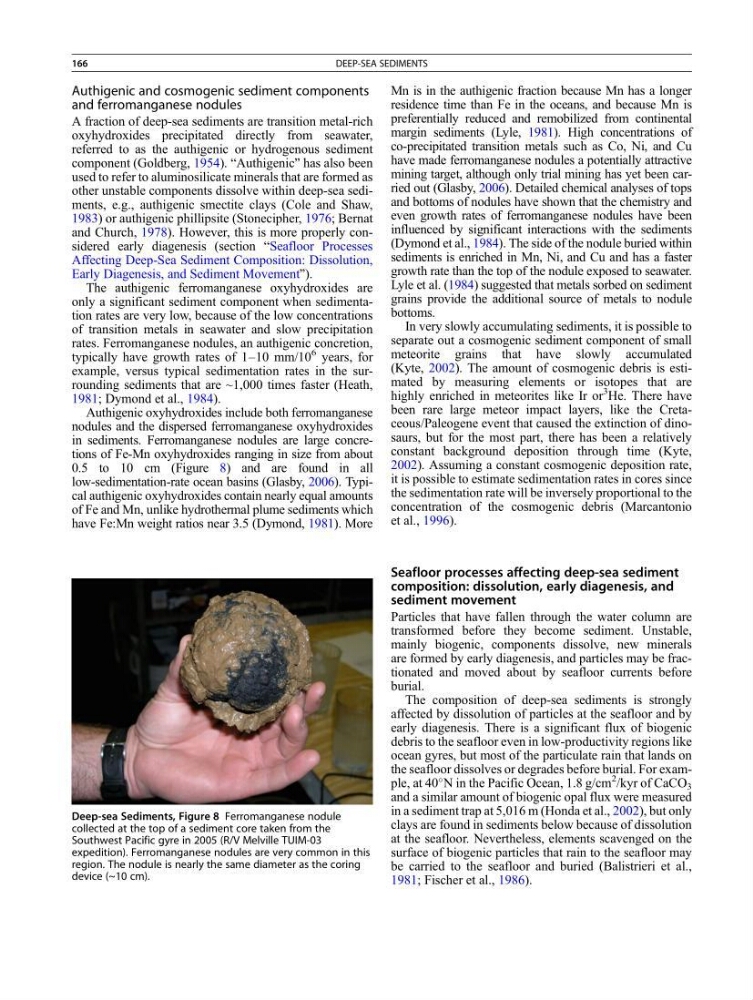
in sediments. Ferromanganese nodules are large concretions of Fe-Mn oxyhydroxides ranging in size from about
0.5 to 10 cm (Figure 8) and are found in all
low-sedimentation-rate ocean basins (Glasby, 2006). Typical authigenic oxyhydroxides contain nearly equal amounts
of Fe and Mn, unlike hydrothermal plume sediments which
have Fe:Mn weight ratios near 3.5 (Dymond, 1981). More
Mn is in the authigenic fraction because Mn has a longer
residence time than Fe in the oceans, and because Mn is
preferentially reduced and remobilized from continental
margin sediments (Lyle, 1981). High concentrations of
co-precipitated transition metals such as Co, Ni, and Cu
have made ferromanganese nodules a potentially attractive
mining target, although only trial mining has yet been carried out (Glasby, 2006). Detailed chemical analyses of tops
and bottoms of nodules have shown that the chemistry and
even growth rates of ferromanganese nodules have been
influenced by significant interactions with the sediments
(Dymond et al., 1984). The side of the nodule buried within
sediments is enriched in Mn, Ni, and Cu and has a faster
growth rate than the top of the nodule exposed to seawater.
Lyle et al. (1984) suggested that metals sorbed on sediment
grains provide the additional source of metals to nodule
bottoms.
In very slowly accumulating sediments, it is possible to
separate out a cosmogenic sediment component of small
meteorite grains that have slowly accumulated
(Kyte, 2002). The amount of cosmogenic debris is estimated by measuring elements or isotopes that are
highly enriched in meteorites like Ir or
3
He. There have
been rare large meteor impact layers, like the Cretaceous/Paleogene event that caused the extinction of dinosaurs, but for the most part, there has been a relatively
constant background deposition through time (Kyte,
2002). Assuming a constant cosmogenic deposition rate,
it is possible to estimate sedimentation rates in cores since
the sedimentation rate will be inversely proportional to the
concentration of the cosmogenic debris (Marcantonio
et al., 1996).
Seafloor processes affecting deep-sea sediment
composition: dissolution, early diagenesis, and
sediment movement
Particles that have fallen through the water column are
transformed before they become sediment. Unstable,
mainly biogenic, components dissolve, new minerals
are formed by early diagenesis, and particles may be fractionated and moved about by seafloor currents before
burial.
The composition of deep-sea sediments is strongly
affected by dissolution of particles at the seafloor and by
early diagenesis. There is a significant flux of biogenic
debris to the seafloor even in low-productivity regions like
ocean gyres, but most of the particulate rain that lands on
the seafloor dissolves or degrades before burial. For example, at 40
N in the Pacific Ocean, 1.8 g/cm
2
/kyr of CaCO 3
and a similar amount of biogenic opal flux were measured
in a sediment trap at 5,016 m (Honda et al., 2002), but only
clays are found in sediments below because of dissolution
at the seafloor. Nevertheless, elements scavenged on the
surface of biogenic particles that rain to the seafloor may
be carried to the seafloor and buried (Balistrieri et al.,
1981; Fischer et al., 1986).
Deep-sea Sediments, Figure 8 Ferromanganese nodule
collected at the top of a sediment core taken from the
Southwest Pacific gyre in 2005 (R/V Melville TUIM-03
expedition). Ferromanganese nodules are very common in this
region. The nodule is nearly the same diameter as the coring
device (~10 cm).
166
DEEP-SEA SEDIMENTS
and ferromanganese nodules
A fraction of deep-sea sediments are transition metal-rich
oxyhydroxides precipitated directly from seawater,
referred to as the authigenic or hydrogenous sediment
component (Goldberg, 1954). “Authigenic” has also been
used to refer to aluminosilicate minerals that are formed as
other unstable components dissolve within deep-sea sediments, e.g., authigenic smectite clays (Cole and Shaw,
1983) or authigenic phillipsite (Stonecipher, 1976; Bernat
and Church, 1978). However, this is more properly considered early diagenesis (section “Seafloor Processes
Affecting Deep-Sea Sediment Composition: Dissolution,
Early Diagenesis, and Sediment Movement”).
The authigenic ferromanganese oxyhydroxides are
only a significant sediment component when sedimentation rates are very low, because of the low concentrations
of transition metals in seawater and slow precipitation
rates. Ferromanganese nodules, an authigenic concretion,
typically have growth rates of 1–10 mm/10
6 years, for
example, versus typical sedimentation rates in the surrounding sediments that are ~1,000 times faster (Heath,
1981; Dymond et al., 1984).
Authigenic oxyhydroxides include both ferromanganese
nodules and the dispersed ferromanganese oxyhydroxides
in sediments. Ferromanganese nodules are large concretions of Fe-Mn oxyhydroxides ranging in size from about
0.5 to 10 cm (Figure 8) and are found in all
low-sedimentation-rate ocean basins (Glasby, 2006). Typical authigenic oxyhydroxides contain nearly equal amounts
of Fe and Mn, unlike hydrothermal plume sediments which
have Fe:Mn weight ratios near 3.5 (Dymond, 1981). More
Mn is in the authigenic fraction because Mn has a longer
residence time than Fe in the oceans, and because Mn is
preferentially reduced and remobilized from continental
margin sediments (Lyle, 1981). High concentrations of
co-precipitated transition metals such as Co, Ni, and Cu
have made ferromanganese nodules a potentially attractive
mining target, although only trial mining has yet been carried out (Glasby, 2006). Detailed chemical analyses of tops
and bottoms of nodules have shown that the chemistry and
even growth rates of ferromanganese nodules have been
influenced by significant interactions with the sediments
(Dymond et al., 1984). The side of the nodule buried within
sediments is enriched in Mn, Ni, and Cu and has a faster
growth rate than the top of the nodule exposed to seawater.
Lyle et al. (1984) suggested that metals sorbed on sediment
grains provide the additional source of metals to nodule
bottoms.
In very slowly accumulating sediments, it is possible to
separate out a cosmogenic sediment component of small
meteorite grains that have slowly accumulated
(Kyte, 2002). The amount of cosmogenic debris is estimated by measuring elements or isotopes that are
highly enriched in meteorites like Ir or
3
He. There have
been rare large meteor impact layers, like the Cretaceous/Paleogene event that caused the extinction of dinosaurs, but for the most part, there has been a relatively
constant background deposition through time (Kyte,
2002). Assuming a constant cosmogenic deposition rate,
it is possible to estimate sedimentation rates in cores since
the sedimentation rate will be inversely proportional to the
concentration of the cosmogenic debris (Marcantonio
et al., 1996).
Seafloor processes affecting deep-sea sediment
composition: dissolution, early diagenesis, and
sediment movement
Particles that have fallen through the water column are
transformed before they become sediment. Unstable,
mainly biogenic, components dissolve, new minerals
are formed by early diagenesis, and particles may be fractionated and moved about by seafloor currents before
burial.
The composition of deep-sea sediments is strongly
affected by dissolution of particles at the seafloor and by
early diagenesis. There is a significant flux of biogenic
debris to the seafloor even in low-productivity regions like
ocean gyres, but most of the particulate rain that lands on
the seafloor dissolves or degrades before burial. For example, at 40
N in the Pacific Ocean, 1.8 g/cm
2
/kyr of CaCO 3
and a similar amount of biogenic opal flux were measured
in a sediment trap at 5,016 m (Honda et al., 2002), but only
clays are found in sediments below because of dissolution
at the seafloor. Nevertheless, elements scavenged on the
surface of biogenic particles that rain to the seafloor may
be carried to the seafloor and buried (Balistrieri et al.,
1981; Fischer et al., 1986).
Deep-sea Sediments, Figure 8 Ferromanganese nodule
collected at the top of a sediment core taken from the
Southwest Pacific gyre in 2005 (R/V Melville TUIM-03
expedition). Ferromanganese nodules are very common in this
region. The nodule is nearly the same diameter as the coring
device (~10 cm).
166
DEEP-SEA SEDIMENTS