

slowly in the abyssal ocean beyond the continental
margins.
What are deep-sea sediments?
Deep-sea sediments typically have sedimentation rates
less than 30 m/10
6 years, and rates as low 0.1 m/10
6 years
have been reported. The slow sedimentation rates and
unusual sediment compositions reflect the low fluxes of
aluminosilicates eroded from continents. The terrigenous
material that does deposit is often windblown dust. Other
solids produced through biological activity, through
hydrothermal leaching of basalts, or even by earth’s bombardment by meteorites can make up large fractions of a
deep-sea sediment deposit.
Not all sediments in the deep ocean are deep-sea sediments depositing slowly. A significant portion of the deep
ocean is filled by turbidites, which are gravity flow
deposits that typically originate from the continental margins. These sediments will be discussed briefly in section
“Turbidites and Hemipelagic Sediment Components” but
are really extensions of continental margin sedimentation.
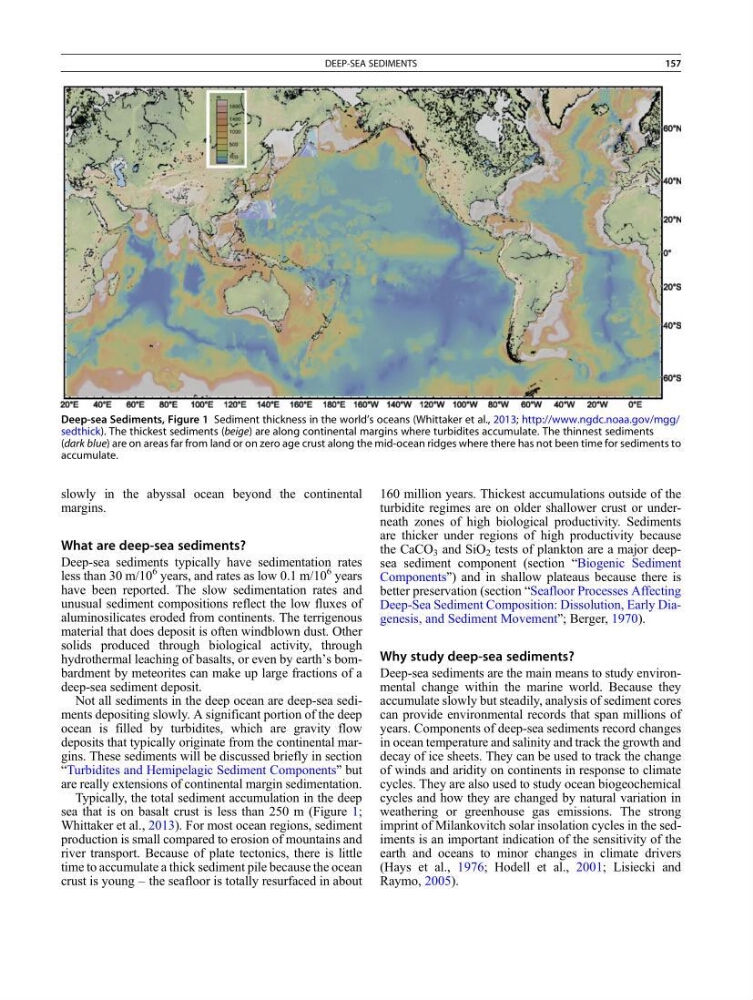
Typically, the total sediment accumulation in the deep
sea that is on basalt crust is less than 250 m (Figure 1;
Whittaker et al., 2013). For most ocean regions, sediment
production is small compared to erosion of mountains and
river transport. Because of plate tectonics, there is little
time to accumulate a thick sediment pile because the ocean
crust is young – the seafloor is totally resurfaced in about
160 million years. Thickest accumulations outside of the
turbidite regimes are on older shallower crust or underneath zones of high biological productivity. Sediments
are thicker under regions of high productivity because
the CaCO 3 and SiO 2 tests of plankton are a major deepsea sediment component (section “Biogenic Sediment
Components”) and in shallow plateaus because there is
better preservation (section “Seafloor Processes Affecting
Deep-Sea Sediment Composition: Dissolution, Early Diagenesis, and Sediment Movement”; Berger, 1970).
Why study deep-sea sediments?
Deep-sea sediments are the main means to study environmental change within the marine world. Because they
accumulate slowly but steadily, analysis of sediment cores
can provide environmental records that span millions of
years. Components of deep-sea sediments record changes
in ocean temperature and salinity and track the growth and
decay of ice sheets. They can be used to track the change
of winds and aridity on continents in response to climate
cycles. They are also used to study ocean biogeochemical
cycles and how they are changed by natural variation in
weathering or greenhouse gas emissions. The strong
imprint of Milankovitch solar insolation cycles in the sediments is an important indication of the sensitivity of the
earth and oceans to minor changes in climate drivers
(Hays et al., 1976; Hodell et al., 2001; Lisiecki and
Raymo, 2005).
Deep-sea Sediments, Figure 1 Sediment thickness in the world’s oceans (Whittaker et al., 2013; http://www.ngdc.noaa.gov/mgg/
sedthick). The thickest sediments (beige) are along continental margins where turbidites accumulate. The thinnest sediments
(dark blue) are on areas far from land or on zero age crust along the mid-ocean ridges where there has not been time for sediments to
accumulate.
DEEP-SEA SEDIMENTS
157
margins.
What are deep-sea sediments?
Deep-sea sediments typically have sedimentation rates
less than 30 m/10
6 years, and rates as low 0.1 m/10
6 years
have been reported. The slow sedimentation rates and
unusual sediment compositions reflect the low fluxes of
aluminosilicates eroded from continents. The terrigenous
material that does deposit is often windblown dust. Other
solids produced through biological activity, through
hydrothermal leaching of basalts, or even by earth’s bombardment by meteorites can make up large fractions of a
deep-sea sediment deposit.
Not all sediments in the deep ocean are deep-sea sediments depositing slowly. A significant portion of the deep
ocean is filled by turbidites, which are gravity flow
deposits that typically originate from the continental margins. These sediments will be discussed briefly in section
“Turbidites and Hemipelagic Sediment Components” but
are really extensions of continental margin sedimentation.
Typically, the total sediment accumulation in the deep
sea that is on basalt crust is less than 250 m (Figure 1;
Whittaker et al., 2013). For most ocean regions, sediment
production is small compared to erosion of mountains and
river transport. Because of plate tectonics, there is little
time to accumulate a thick sediment pile because the ocean
crust is young – the seafloor is totally resurfaced in about
160 million years. Thickest accumulations outside of the
turbidite regimes are on older shallower crust or underneath zones of high biological productivity. Sediments
are thicker under regions of high productivity because
the CaCO 3 and SiO 2 tests of plankton are a major deepsea sediment component (section “Biogenic Sediment
Components”) and in shallow plateaus because there is
better preservation (section “Seafloor Processes Affecting
Deep-Sea Sediment Composition: Dissolution, Early Diagenesis, and Sediment Movement”; Berger, 1970).
Why study deep-sea sediments?
Deep-sea sediments are the main means to study environmental change within the marine world. Because they
accumulate slowly but steadily, analysis of sediment cores
can provide environmental records that span millions of
years. Components of deep-sea sediments record changes
in ocean temperature and salinity and track the growth and
decay of ice sheets. They can be used to track the change
of winds and aridity on continents in response to climate
cycles. They are also used to study ocean biogeochemical
cycles and how they are changed by natural variation in
weathering or greenhouse gas emissions. The strong
imprint of Milankovitch solar insolation cycles in the sediments is an important indication of the sensitivity of the
earth and oceans to minor changes in climate drivers
(Hays et al., 1976; Hodell et al., 2001; Lisiecki and
Raymo, 2005).
Deep-sea Sediments, Figure 1 Sediment thickness in the world’s oceans (Whittaker et al., 2013; http://www.ngdc.noaa.gov/mgg/
sedthick). The thickest sediments (beige) are along continental margins where turbidites accumulate. The thinnest sediments
(dark blue) are on areas far from land or on zero age crust along the mid-ocean ridges where there has not been time for sediments to
accumulate.
DEEP-SEA SEDIMENTS
157