

In the coastal areas, near-shore currents, including the
tidal streams, can be well detected by modern coastal maritime radars with advanced signal processing algorithms.
Further details of current observing methods can be
found in the books by Emery and Thomson (2001) and
Talley et al. (2011).
Basic theoretical concepts
Motions of seawater follow the laws of hydrodynamics
written in partial differential equations. The flows are generated mainly by the pressure gradients, forming due to the
gravity and acting through the whole water column, and
by the frictional forces acting on the sea surface due to
the wind stress. The balance of forces (momentum) follows Newton’s Second Law for the continuum fluid in
the system of partial differential equations: the sum of
forces due to the gravity, pressure gradients, and friction
per unit mass is equal to the acceleration of the water parcel. Acceleration consists from local time rate of momentum velocity change (absent for stationary flows),
nonlinear momentum advection per unit mass (can be
omitted for small flow speeds and/or curvature), and
Coriolis acceleration (can be omitted for short-period
motions).
Coriolis acceleration appears due to the rotation of the
Earth and deflects in the Northern (Southern) Hemisphere
the currents to the right (left) from the original direction.
Its magnitude is described by the product of Coriolis
parameter with the current speed in rotated, perpendicular
direction. Coriolis parameter is zero at the equator and
reaches twice the Earth’s angular speed on the poles.
In an idealized case of boundless ocean and vanishing
horizontal flow variations, the wind stress acting on the
sea surface and frictional drag of the underlying layers
are balanced by the Coriolis force. This flow is called
“Ekman spiral,” according to the theoretical work by Vagn
Walfrid Ekman published in 1905. In such conditions, the
surface drift currents are deflected by 45
to the right (left)
from the wind direction in the Northern (Southern) Hemisphere. When going deeper from the surface, the flow
speed decays exponentially, but the direction deflects further in linear dependence from the depth. At the Ekman
depth (depends on the turbulent viscosity and Coriolis
parameter), usually from a few tens of meters to hundred
meter, the drift currents become negligibly small. Total
water transport in the upper layer (Ekman transport) is perpendicular to the wind direction.
Besides the momentum equations, the flow must follow
also the continuity equation. In a simple explanation,
when the currents are converging in horizontal direction
relative to the bottom, then isopycnals (surfaces of constant water density) and sea-level will rise; in case of
diverging currents, the vertical motion is of opposite direction. When the wind blows parallel to the coast, then
Ekman transport is offshore or onshore, depending on
the wind direction. Ocean waters are usually stratified;
warm surface waters are separated from deeper colder
waters by a thermocline where temperature drops rapidly.
By the continuity arguments, offshore Ekman transport
causes upwelling of cold and nutrient-rich deeper waters
to the sea surface; downwelling occurs in case of onshore
Ekman transport.
The pressure gradients are formed by sea surface topography and spatial variations in water density; the pressure
at actual point can be usually calculated by hydrostatic
relation. Ocean currents are quite well described by the
geostrophic relations where the pressure gradient force is
balanced by the Coriolis force. Geostrophic flow is
directed along the lines of constant pressure (isobars) in
a direction that looking from the higher pressure toward
lower pressure, the flow is directed perpendicularly to
the right (left) on the Northern (Southern) Hemisphere.
Tilting of sea surface and isopycnals is easily formed by
horizontally diverging or converging flows due to the continuity; pressure gradients formed by the flow in such a
way have feedback to the flow itself in the momentum
equations. As a result, different wave motions are created.
In the time scale of days to months, planetary and/or topographic Rossby waves appear. These waves are nearly in
the geostrophic balance like are also the mesoscale eddies
which have typical size of the order of baroclinic Rossby
Westerlies
Trade Winds
Western Boundary Currents
Mesoscale Eddies
Filaments
Gyre Circulation
Surface Waves
Turbulence
Ekman Currents
Local Winds
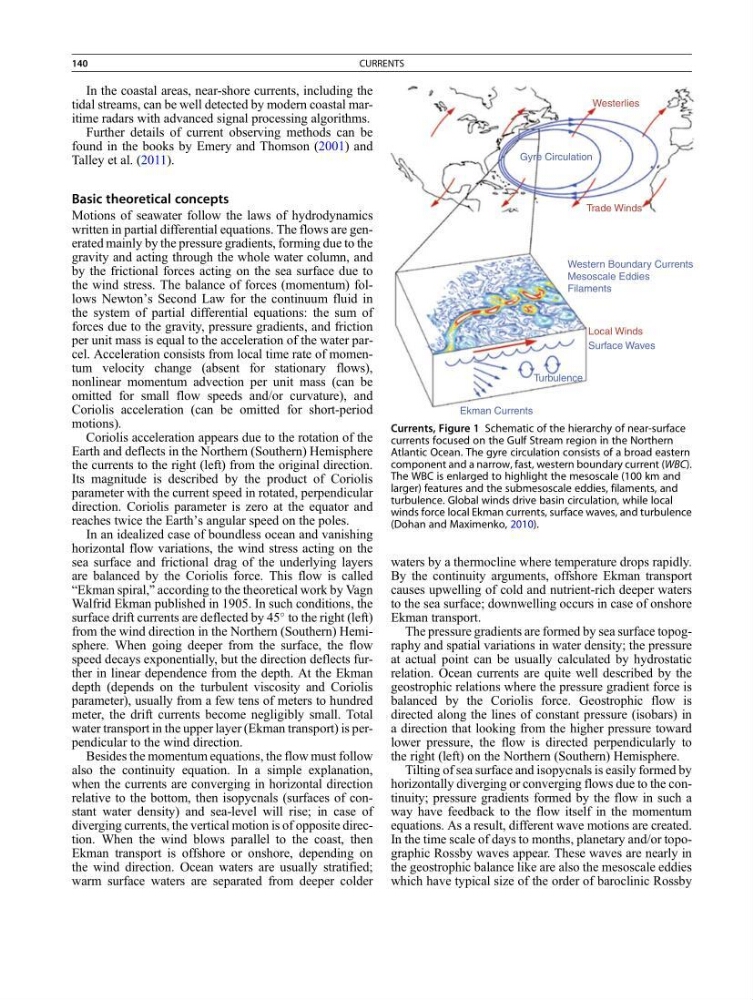
Currents, Figure 1 Schematic of the hierarchy of near-surface
currents focused on the Gulf Stream region in the Northern
Atlantic Ocean. The gyre circulation consists of a broad eastern
component and a narrow, fast, western boundary current (WBC).
The WBC is enlarged to highlight the mesoscale (100 km and
larger) features and the submesoscale eddies, filaments, and
turbulence. Global winds drive basin circulation, while local
winds force local Ekman currents, surface waves, and turbulence
(Dohan and Maximenko, 2010).
140
CURRENTS
tidal streams, can be well detected by modern coastal maritime radars with advanced signal processing algorithms.
Further details of current observing methods can be
found in the books by Emery and Thomson (2001) and
Talley et al. (2011).
Basic theoretical concepts
Motions of seawater follow the laws of hydrodynamics
written in partial differential equations. The flows are generated mainly by the pressure gradients, forming due to the
gravity and acting through the whole water column, and
by the frictional forces acting on the sea surface due to
the wind stress. The balance of forces (momentum) follows Newton’s Second Law for the continuum fluid in
the system of partial differential equations: the sum of
forces due to the gravity, pressure gradients, and friction
per unit mass is equal to the acceleration of the water parcel. Acceleration consists from local time rate of momentum velocity change (absent for stationary flows),
nonlinear momentum advection per unit mass (can be
omitted for small flow speeds and/or curvature), and
Coriolis acceleration (can be omitted for short-period
motions).
Coriolis acceleration appears due to the rotation of the
Earth and deflects in the Northern (Southern) Hemisphere
the currents to the right (left) from the original direction.
Its magnitude is described by the product of Coriolis
parameter with the current speed in rotated, perpendicular
direction. Coriolis parameter is zero at the equator and
reaches twice the Earth’s angular speed on the poles.
In an idealized case of boundless ocean and vanishing
horizontal flow variations, the wind stress acting on the
sea surface and frictional drag of the underlying layers
are balanced by the Coriolis force. This flow is called
“Ekman spiral,” according to the theoretical work by Vagn
Walfrid Ekman published in 1905. In such conditions, the
surface drift currents are deflected by 45
to the right (left)
from the wind direction in the Northern (Southern) Hemisphere. When going deeper from the surface, the flow
speed decays exponentially, but the direction deflects further in linear dependence from the depth. At the Ekman
depth (depends on the turbulent viscosity and Coriolis
parameter), usually from a few tens of meters to hundred
meter, the drift currents become negligibly small. Total
water transport in the upper layer (Ekman transport) is perpendicular to the wind direction.
Besides the momentum equations, the flow must follow
also the continuity equation. In a simple explanation,
when the currents are converging in horizontal direction
relative to the bottom, then isopycnals (surfaces of constant water density) and sea-level will rise; in case of
diverging currents, the vertical motion is of opposite direction. When the wind blows parallel to the coast, then
Ekman transport is offshore or onshore, depending on
the wind direction. Ocean waters are usually stratified;
warm surface waters are separated from deeper colder
waters by a thermocline where temperature drops rapidly.
By the continuity arguments, offshore Ekman transport
causes upwelling of cold and nutrient-rich deeper waters
to the sea surface; downwelling occurs in case of onshore
Ekman transport.
The pressure gradients are formed by sea surface topography and spatial variations in water density; the pressure
at actual point can be usually calculated by hydrostatic
relation. Ocean currents are quite well described by the
geostrophic relations where the pressure gradient force is
balanced by the Coriolis force. Geostrophic flow is
directed along the lines of constant pressure (isobars) in
a direction that looking from the higher pressure toward
lower pressure, the flow is directed perpendicularly to
the right (left) on the Northern (Southern) Hemisphere.
Tilting of sea surface and isopycnals is easily formed by
horizontally diverging or converging flows due to the continuity; pressure gradients formed by the flow in such a
way have feedback to the flow itself in the momentum
equations. As a result, different wave motions are created.
In the time scale of days to months, planetary and/or topographic Rossby waves appear. These waves are nearly in
the geostrophic balance like are also the mesoscale eddies
which have typical size of the order of baroclinic Rossby
Westerlies
Trade Winds
Western Boundary Currents
Mesoscale Eddies
Filaments
Gyre Circulation
Surface Waves
Turbulence
Ekman Currents
Local Winds
Currents, Figure 1 Schematic of the hierarchy of near-surface
currents focused on the Gulf Stream region in the Northern
Atlantic Ocean. The gyre circulation consists of a broad eastern
component and a narrow, fast, western boundary current (WBC).
The WBC is enlarged to highlight the mesoscale (100 km and
larger) features and the submesoscale eddies, filaments, and
turbulence. Global winds drive basin circulation, while local
winds force local Ekman currents, surface waves, and turbulence
(Dohan and Maximenko, 2010).
140
CURRENTS