

Shelly, D., 1993. Igneous and Metamorphic Rocks Under the
Microscope. London: Chapman and Hall. 445 p.
Wager, L. R., Brown, G. M., and Wadsworth, W. J., 1960. Types of
igneous cumulate. Journal of Petrology, 1, 73–85.
Cross-references
Crustal Accretion
Gabbro
Mid-ocean Ridge Magmatism and Volcanism
CURIE TEMPERATURE
Hans-Jürgen Götze
Institute of Geosciences, Christian-Albrechts-University
Kiel, Kiel, Germany
In a physical sense the Curie temperature (CT or T c ) is
defined as the temperature that marks the reversible phase
crossing of ferromagnetic or ferrimagnetic materials in its
high paramagnetic temperature form:
• Above the CT, spontaneous or directed magnetization
disappears from crystal domains.
• Below the CT, magnetic materials get magnetic behavior back, i.e., the spontaneous magnetization and magnetic domains without any effect of an external
magnetic field.
Therefore, CT is a material-specific temperature, above
which magnetic properties of matter, solids, or rocks will
change. Also remanence of magnetized ferromagnets is
removed above CT (Blakely, 1995).
“CT” is named in honor of the eminent French Physicist
Pierre Curie (1859–1906), who was a pioneer in crystallography, magnetism, piezoelectricity, and radioactivity
and won the Nobel Prize in Physics in 1903.
A certain level in the Earth’s crust is called “Curie
depth” in which temperatures are so high that the Curie
temperature is reached. In the continental crust this temperature is usually achieved at about 20 km depth, while
in the oceanic crust, the Curie temperature lies, depending
on temperature, pressure, and rock properties, at greater
depths.
When rocks are in a ferromagnetic state, exposure to a
magnetic field can align their atoms and create an attraction. If the field is taken away, the magnetism remains,
as the material has a form of “memory.” This can be used
to make permanent magnets and demonstrate a variety of
interesting physical phenomena. Paramagnetic materials,
however, require the maintenance of an external magnetic
field to remain magnetized. At the Curie temperature, the
heat agitates the atoms inside the material so much that
they cannot align, and it loses its magnetism. At Curie
temperature rocks lose their spontaneous magnetization
(e.g., 580
C for magnetite; 769
C for iron (Fe);
1,400
C for Cobalt (Co); 631
C for Nickel (Ni); e.g.,
Buschow, 2001; Bouligand et al., 2009).
This can have important implications. In geology, for
example, high temperatures can occur in lightning strikes
and volcanic eruptions and are capable of causing the
properties of minerals in the Earth’s crust to change.
Observers looking at magnetic minerals need to consider
their history and what may have influenced them. One
can map the depth to the Curie temperature isotherm from
magnetic anomalies in an attempt to provide a measure of
crustal temperatures. Such methods are based on the estimation of the depth to the bottom of magnetic sources,
which is assumed to correspond to the temperature at
which rocks lose their spontaneous magnetization (see
above). Therefore, depths to the bottom of magnetic
sources show several features correlated well with prominent heat-flow anomalies. Bouligand et al. (2009) used a
method based on the spectral analysis of magnetic anomalies. It incorporates a representation where magnetization
has a fractal distribution defined by three independent
parameters: the depths to the top and bottom of magnetic
sources and a fractal parameter related to the geology.
The Curie temperature has also practical implications in
marine geosciences. For instance, the oceanic crust can
be altered by high-temperature fluids related to hydrothermal processes, thereby losing its magnetization. The
resulting magnetic lows in basaltic crust can be used to
detect fossil zones of hydrothermal upflow and associated
volcanogenic massive sulfides (Zhu et al., 2010).
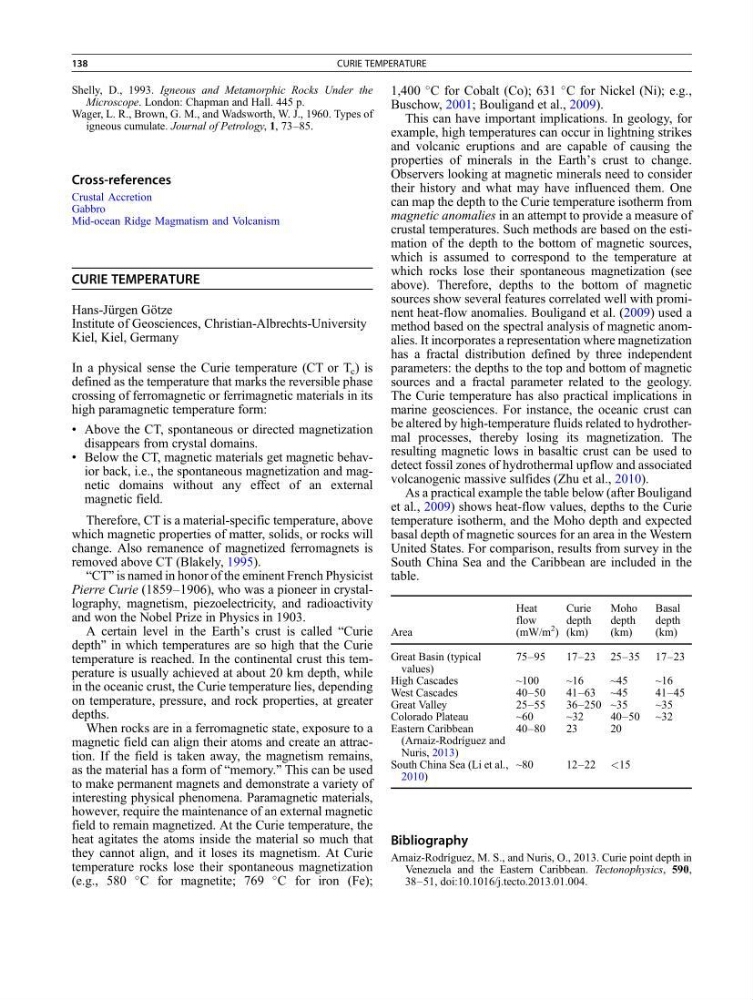
As a practical example the table below (after Bouligand
et al., 2009) shows heat-flow values, depths to the Curie
temperature isotherm, and the Moho depth and expected
basal depth of magnetic sources for an area in the Western
United States. For comparison, results from survey in the
South China Sea and the Caribbean are included in the
table.
Area
Heat
flow
(mW/m
2 )
Curie
depth
(km)
Moho
depth
(km)
Basal
depth
(km)
Great Basin (typical
values)
75–95
17–23 25–35 17–23
High Cascades
~100
~16
~45
~16
West Cascades
40–50
41–63 ~45
41–45
Great Valley
25–55
36–250 ~35
~35
Colorado Plateau
~60
~32
40–50 ~32
Eastern Caribbean
(Arnaiz-Rodríguez and
Nuris, 2013)
40–80
23
20
South China Sea (Li et al.,
2010)
~80
12–22 <15
Bibliography
Arnaiz-Rodríguez, M. S., and Nuris, O., 2013. Curie point depth in
Venezuela and the Eastern Caribbean. Tectonophysics, 590,
38–51, doi:10.1016/j.tecto.2013.01.004.
138
CURIE TEMPERATURE
Microscope. London: Chapman and Hall. 445 p.
Wager, L. R., Brown, G. M., and Wadsworth, W. J., 1960. Types of
igneous cumulate. Journal of Petrology, 1, 73–85.
Cross-references
Crustal Accretion
Gabbro
Mid-ocean Ridge Magmatism and Volcanism
CURIE TEMPERATURE
Hans-Jürgen Götze
Institute of Geosciences, Christian-Albrechts-University
Kiel, Kiel, Germany
In a physical sense the Curie temperature (CT or T c ) is
defined as the temperature that marks the reversible phase
crossing of ferromagnetic or ferrimagnetic materials in its
high paramagnetic temperature form:
• Above the CT, spontaneous or directed magnetization
disappears from crystal domains.
• Below the CT, magnetic materials get magnetic behavior back, i.e., the spontaneous magnetization and magnetic domains without any effect of an external
magnetic field.
Therefore, CT is a material-specific temperature, above
which magnetic properties of matter, solids, or rocks will
change. Also remanence of magnetized ferromagnets is
removed above CT (Blakely, 1995).
“CT” is named in honor of the eminent French Physicist
Pierre Curie (1859–1906), who was a pioneer in crystallography, magnetism, piezoelectricity, and radioactivity
and won the Nobel Prize in Physics in 1903.
A certain level in the Earth’s crust is called “Curie
depth” in which temperatures are so high that the Curie
temperature is reached. In the continental crust this temperature is usually achieved at about 20 km depth, while
in the oceanic crust, the Curie temperature lies, depending
on temperature, pressure, and rock properties, at greater
depths.
When rocks are in a ferromagnetic state, exposure to a
magnetic field can align their atoms and create an attraction. If the field is taken away, the magnetism remains,
as the material has a form of “memory.” This can be used
to make permanent magnets and demonstrate a variety of
interesting physical phenomena. Paramagnetic materials,
however, require the maintenance of an external magnetic
field to remain magnetized. At the Curie temperature, the
heat agitates the atoms inside the material so much that
they cannot align, and it loses its magnetism. At Curie
temperature rocks lose their spontaneous magnetization
(e.g., 580
C for magnetite; 769
C for iron (Fe);
1,400
C for Cobalt (Co); 631
C for Nickel (Ni); e.g.,
Buschow, 2001; Bouligand et al., 2009).
This can have important implications. In geology, for
example, high temperatures can occur in lightning strikes
and volcanic eruptions and are capable of causing the
properties of minerals in the Earth’s crust to change.
Observers looking at magnetic minerals need to consider
their history and what may have influenced them. One
can map the depth to the Curie temperature isotherm from
magnetic anomalies in an attempt to provide a measure of
crustal temperatures. Such methods are based on the estimation of the depth to the bottom of magnetic sources,
which is assumed to correspond to the temperature at
which rocks lose their spontaneous magnetization (see
above). Therefore, depths to the bottom of magnetic
sources show several features correlated well with prominent heat-flow anomalies. Bouligand et al. (2009) used a
method based on the spectral analysis of magnetic anomalies. It incorporates a representation where magnetization
has a fractal distribution defined by three independent
parameters: the depths to the top and bottom of magnetic
sources and a fractal parameter related to the geology.
The Curie temperature has also practical implications in
marine geosciences. For instance, the oceanic crust can
be altered by high-temperature fluids related to hydrothermal processes, thereby losing its magnetization. The
resulting magnetic lows in basaltic crust can be used to
detect fossil zones of hydrothermal upflow and associated
volcanogenic massive sulfides (Zhu et al., 2010).
As a practical example the table below (after Bouligand
et al., 2009) shows heat-flow values, depths to the Curie
temperature isotherm, and the Moho depth and expected
basal depth of magnetic sources for an area in the Western
United States. For comparison, results from survey in the
South China Sea and the Caribbean are included in the
table.
Area
Heat
flow
(mW/m
2 )
Curie
depth
(km)
Moho
depth
(km)
Basal
depth
(km)
Great Basin (typical
values)
75–95
17–23 25–35 17–23
High Cascades
~100
~16
~45
~16
West Cascades
40–50
41–63 ~45
41–45
Great Valley
25–55
36–250 ~35
~35
Colorado Plateau
~60
~32
40–50 ~32
Eastern Caribbean
(Arnaiz-Rodríguez and
Nuris, 2013)
40–80
23
20
South China Sea (Li et al.,
2010)
~80
12–22 <15
Bibliography
Arnaiz-Rodríguez, M. S., and Nuris, O., 2013. Curie point depth in
Venezuela and the Eastern Caribbean. Tectonophysics, 590,
38–51, doi:10.1016/j.tecto.2013.01.004.
138
CURIE TEMPERATURE