

Stow, D. A. V., Hunter, S., Wilkinson, D., and Hernández-Molina,
F. J., 2008. Contourite facies and the facies model. In Rebesco,
M., and Camerlenghi, A. (eds.), Contourites. Amsterdam:
Elsevier, pp. 143–156.
Viana, A. R., and Rebesco, M. (eds.), 2007. Economic and
Palaeoceanographic Significance of Contourite Deposits. London: Geological Society. Geological Society Special Publication, Vol. 276, pp. 1–350.
Wetzel, A., Werner, F., and Stow, D. A. V., 2008. Bioturbation and
biogenic sedimentary structures in contourites. In Rebesco, M.,
and Camerlenghi, A. (eds.), Contourites. Amsterdam: Elsevier,
pp. 183–202.
Cross-references
Continental Rise
Continental Slope
Deep-sea Sediments
CONVERGENCE TEXTURE OF SEISMIC REFLECTORS
Christopher George St. Clement Kendall
Earth and Ocean Sciences, University of South Carolina,
Columbia, SC, USA
Depositional and erosional bounding surfaces define sedimentary sequences, systems tracts, and parasequences
(see section on the topics of Sedimentary Sequence in
the encyclopedia). They match surfaces that coincide with
the convergence and termination of seismic reflectors but
are best displayed in outcrops and are often easily identified in well logs and cores.
In seismic reflection data the convergence and termination patterns and their continuity are used to identify
sequence stratigraphic surfaces. On seismic data the most
prominent of these surfaces are subaerial unconformities
marking sequence boundaries (SB) eroded during
sea-level fall (Sloss et al., 1949) and time-equivalent submarine correlative conformities (SB-CC) (Hunt and
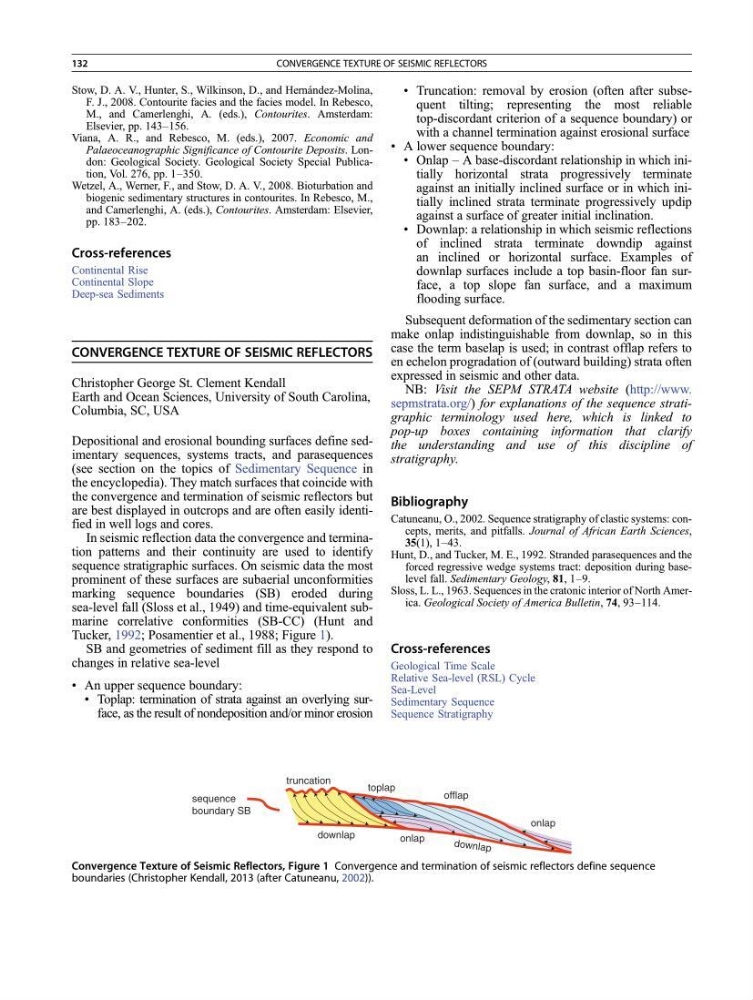
Tucker, 1992; Posamentier et al., 1988; Figure 1).
SB and geometries of sediment fill as they respond to
changes in relative sea-level
• An upper sequence boundary:
• Toplap: termination of strata against an overlying surface, as the result of nondeposition and/or minor erosion
• Truncation: removal by erosion (often after subsequent tilting; representing the most reliable
top-discordant criterion of a sequence boundary) or
with a channel termination against erosional surface
• A lower sequence boundary:
• Onlap – A base-discordant relationship in which initially horizontal strata progressively terminate
against an initially inclined surface or in which initially inclined strata terminate progressively updip
against a surface of greater initial inclination.
• Downlap: a relationship in which seismic reflections
of inclined strata terminate downdip against
an inclined or horizontal surface. Examples of
downlap surfaces include a top basin-floor fan surface, a top slope fan surface, and a maximum
flooding surface.
Subsequent deformation of the sedimentary section can
make onlap indistinguishable from downlap, so in this
case the term baselap is used; in contrast offlap refers to
en echelon progradation of (outward building) strata often
expressed in seismic and other data.
NB: Visit the SEPM STRATA website (http://www.
sepmstrata.org/) for explanations of the sequence stratigraphic terminology used here, which is linked to
pop-up boxes containing information that clarify
the understanding and use of this discipline of
stratigraphy.
Bibliography
Catuneanu, O., 2002. Sequence stratigraphy of clastic systems: concepts, merits, and pitfalls. Journal of African Earth Sciences,
35(1), 1–43.
Hunt, D., and Tucker, M. E., 1992. Stranded parasequences and the
forced regressive wedge systems tract: deposition during baselevel fall. Sedimentary Geology, 81, 1–9.
Sloss, L. L., 1963. Sequences in the cratonic interior of North America. Geological Society of America Bulletin, 74, 93–114.
Cross-references
Geological Time Scale
Relative Sea-level (RSL) Cycle
Sea-Level
Sedimentary Sequence
Sequence Stratigraphy
sequence
boundary SB
truncation
toplap
offlap
onlap
onlap
downlap
do wn lap
Convergence Texture of Seismic Reflectors, Figure 1 Convergence and termination of seismic reflectors define sequence
boundaries (Christopher Kendall, 2013 (after Catuneanu, 2002)).
132
CONVERGENCE TEXTURE OF SEISMIC REFLECTORS
F. J., 2008. Contourite facies and the facies model. In Rebesco,
M., and Camerlenghi, A. (eds.), Contourites. Amsterdam:
Elsevier, pp. 143–156.
Viana, A. R., and Rebesco, M. (eds.), 2007. Economic and
Palaeoceanographic Significance of Contourite Deposits. London: Geological Society. Geological Society Special Publication, Vol. 276, pp. 1–350.
Wetzel, A., Werner, F., and Stow, D. A. V., 2008. Bioturbation and
biogenic sedimentary structures in contourites. In Rebesco, M.,
and Camerlenghi, A. (eds.), Contourites. Amsterdam: Elsevier,
pp. 183–202.
Cross-references
Continental Rise
Continental Slope
Deep-sea Sediments
CONVERGENCE TEXTURE OF SEISMIC REFLECTORS
Christopher George St. Clement Kendall
Earth and Ocean Sciences, University of South Carolina,
Columbia, SC, USA
Depositional and erosional bounding surfaces define sedimentary sequences, systems tracts, and parasequences
(see section on the topics of Sedimentary Sequence in
the encyclopedia). They match surfaces that coincide with
the convergence and termination of seismic reflectors but
are best displayed in outcrops and are often easily identified in well logs and cores.
In seismic reflection data the convergence and termination patterns and their continuity are used to identify
sequence stratigraphic surfaces. On seismic data the most
prominent of these surfaces are subaerial unconformities
marking sequence boundaries (SB) eroded during
sea-level fall (Sloss et al., 1949) and time-equivalent submarine correlative conformities (SB-CC) (Hunt and
Tucker, 1992; Posamentier et al., 1988; Figure 1).
SB and geometries of sediment fill as they respond to
changes in relative sea-level
• An upper sequence boundary:
• Toplap: termination of strata against an overlying surface, as the result of nondeposition and/or minor erosion
• Truncation: removal by erosion (often after subsequent tilting; representing the most reliable
top-discordant criterion of a sequence boundary) or
with a channel termination against erosional surface
• A lower sequence boundary:
• Onlap – A base-discordant relationship in which initially horizontal strata progressively terminate
against an initially inclined surface or in which initially inclined strata terminate progressively updip
against a surface of greater initial inclination.
• Downlap: a relationship in which seismic reflections
of inclined strata terminate downdip against
an inclined or horizontal surface. Examples of
downlap surfaces include a top basin-floor fan surface, a top slope fan surface, and a maximum
flooding surface.
Subsequent deformation of the sedimentary section can
make onlap indistinguishable from downlap, so in this
case the term baselap is used; in contrast offlap refers to
en echelon progradation of (outward building) strata often
expressed in seismic and other data.
NB: Visit the SEPM STRATA website (http://www.
sepmstrata.org/) for explanations of the sequence stratigraphic terminology used here, which is linked to
pop-up boxes containing information that clarify
the understanding and use of this discipline of
stratigraphy.
Bibliography
Catuneanu, O., 2002. Sequence stratigraphy of clastic systems: concepts, merits, and pitfalls. Journal of African Earth Sciences,
35(1), 1–43.
Hunt, D., and Tucker, M. E., 1992. Stranded parasequences and the
forced regressive wedge systems tract: deposition during baselevel fall. Sedimentary Geology, 81, 1–9.
Sloss, L. L., 1963. Sequences in the cratonic interior of North America. Geological Society of America Bulletin, 74, 93–114.
Cross-references
Geological Time Scale
Relative Sea-level (RSL) Cycle
Sea-Level
Sedimentary Sequence
Sequence Stratigraphy
sequence
boundary SB
truncation
toplap
offlap
onlap
onlap
downlap
do wn lap
Convergence Texture of Seismic Reflectors, Figure 1 Convergence and termination of seismic reflectors define sequence
boundaries (Christopher Kendall, 2013 (after Catuneanu, 2002)).
132
CONVERGENCE TEXTURE OF SEISMIC REFLECTORS