

drifts are well recognizable as being of contourite origin, and they are the most spectacular because of their
size (dimensions ranging from a few tens of kilometers to over 1,000 km). They are characterized by
length–width ratios varying from 2:1 to 10:1 and
thicknesses reaching several hundreds of meters.
Elongate-mounded drifts have been documented anywhere from the outer shelf and upper slope down to
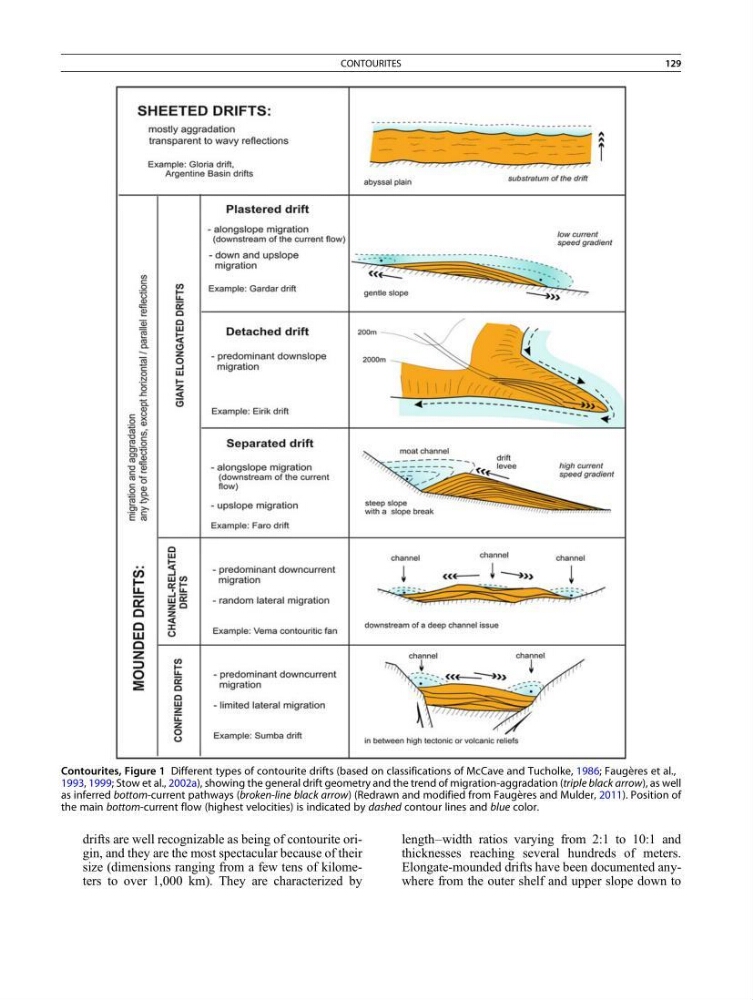
Contourites, Figure 1 Different types of contourite drifts (based on classifications of McCave and Tucholke, 1986; Fauge `res et al.,
1993, 1999; Stow et al., 2002a), showing the general drift geometry and the trend of migration-aggradation (triple black arrow), as well
as inferred bottom-current pathways (broken-line black arrow) (Redrawn and modified from Fauge `res and Mulder, 2011). Position of
the main bottom-current flow (highest velocities) is indicated by dashed contour lines and blue color.
CONTOURITES
129
size (dimensions ranging from a few tens of kilometers to over 1,000 km). They are characterized by
length–width ratios varying from 2:1 to 10:1 and
thicknesses reaching several hundreds of meters.
Elongate-mounded drifts have been documented anywhere from the outer shelf and upper slope down to
Contourites, Figure 1 Different types of contourite drifts (based on classifications of McCave and Tucholke, 1986; Fauge `res et al.,
1993, 1999; Stow et al., 2002a), showing the general drift geometry and the trend of migration-aggradation (triple black arrow), as well
as inferred bottom-current pathways (broken-line black arrow) (Redrawn and modified from Fauge `res and Mulder, 2011). Position of
the main bottom-current flow (highest velocities) is indicated by dashed contour lines and blue color.
CONTOURITES
129