

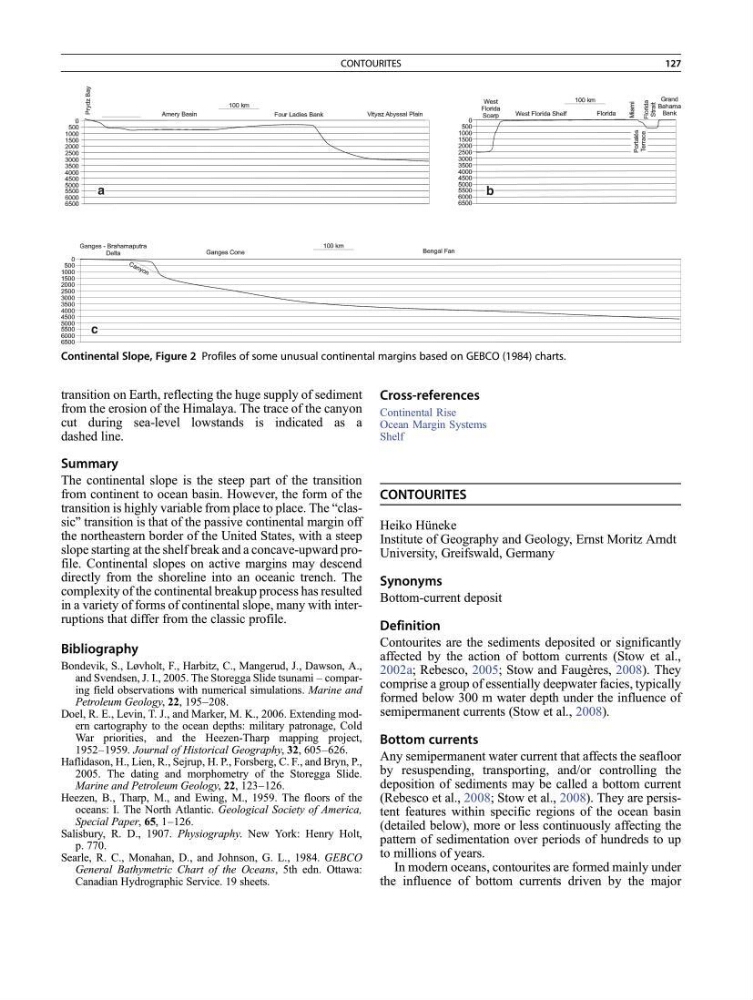
transition on Earth, reflecting the huge supply of sediment
from the erosion of the Himalaya. The trace of the canyon
cut during sea-level lowstands is indicated as a
dashed line.
Summary
The continental slope is the steep part of the transition
from continent to ocean basin. However, the form of the
transition is highly variable from place to place. The “classic” transition is that of the passive continental margin off
the northeastern border of the United States, with a steep
slope starting at the shelf break and a concave-upward profile. Continental slopes on active margins may descend
directly from the shoreline into an oceanic trench. The
complexity of the continental breakup process has resulted
in a variety of forms of continental slope, many with interruptions that differ from the classic profile.
Bibliography
Bondevik, S., Løvholt, F., Harbitz, C., Mangerud, J., Dawson, A.,
and Svendsen, J. I., 2005. The Storegga Slide tsunami – comparing field observations with numerical simulations. Marine and
Petroleum Geology, 22, 195–208.
Doel, R. E., Levin, T. J., and Marker, M. K., 2006. Extending modern cartography to the ocean depths: military patronage, Cold
War priorities, and the Heezen-Tharp mapping project,
1952–1959. Journal of Historical Geography, 32, 605–626.
Haflidason, H., Lien, R., Sejrup, H. P., Forsberg, C. F., and Bryn, P.,
2005. The dating and morphometry of the Storegga Slide.
Marine and Petroleum Geology, 22, 123–126.
Heezen, B., Tharp, M., and Ewing, M., 1959. The floors of the
oceans: I. The North Atlantic. Geological Society of America,
Special Paper, 65, 1–126.
Salisbury, R. D., 1907. Physiography. New York: Henry Holt,
p. 770.
Searle, R. C., Monahan, D., and Johnson, G. L., 1984. GEBCO
General Bathymetric Chart of the Oceans, 5th edn. Ottawa:
Canadian Hydrographic Service. 19 sheets.
Cross-references
Continental Rise
Ocean Margin Systems
Shelf
CONTOURITES
Heiko Hüneke
Institute of Geography and Geology, Ernst Moritz Arndt
University, Greifswald, Germany
Synonyms
Bottom-current deposit
Definition
Contourites are the sediments deposited or significantly
affected by the action of bottom currents (Stow et al.,
2002a; Rebesco, 2005; Stow and Faugères, 2008). They
comprise a group of essentially deepwater facies, typically
formed below 300 m water depth under the influence of
semipermanent currents (Stow et al., 2008).
Bottom currents
Any semipermanent water current that affects the seafloor
by resuspending, transporting, and/or controlling the
deposition of sediments may be called a bottom current
(Rebesco et al., 2008; Stow et al., 2008). They are persistent features within specific regions of the ocean basin
(detailed below), more or less continuously affecting the
pattern of sedimentation over periods of hundreds to up
to millions of years.
In modern oceans, contourites are formed mainly under
the influence of bottom currents driven by the major
a
b
c
Continental Slope, Figure 2 Profiles of some unusual continental margins based on GEBCO (1984) charts.
CONTOURITES
127
from the erosion of the Himalaya. The trace of the canyon
cut during sea-level lowstands is indicated as a
dashed line.
Summary
The continental slope is the steep part of the transition
from continent to ocean basin. However, the form of the
transition is highly variable from place to place. The “classic” transition is that of the passive continental margin off
the northeastern border of the United States, with a steep
slope starting at the shelf break and a concave-upward profile. Continental slopes on active margins may descend
directly from the shoreline into an oceanic trench. The
complexity of the continental breakup process has resulted
in a variety of forms of continental slope, many with interruptions that differ from the classic profile.
Bibliography
Bondevik, S., Løvholt, F., Harbitz, C., Mangerud, J., Dawson, A.,
and Svendsen, J. I., 2005. The Storegga Slide tsunami – comparing field observations with numerical simulations. Marine and
Petroleum Geology, 22, 195–208.
Doel, R. E., Levin, T. J., and Marker, M. K., 2006. Extending modern cartography to the ocean depths: military patronage, Cold
War priorities, and the Heezen-Tharp mapping project,
1952–1959. Journal of Historical Geography, 32, 605–626.
Haflidason, H., Lien, R., Sejrup, H. P., Forsberg, C. F., and Bryn, P.,
2005. The dating and morphometry of the Storegga Slide.
Marine and Petroleum Geology, 22, 123–126.
Heezen, B., Tharp, M., and Ewing, M., 1959. The floors of the
oceans: I. The North Atlantic. Geological Society of America,
Special Paper, 65, 1–126.
Salisbury, R. D., 1907. Physiography. New York: Henry Holt,
p. 770.
Searle, R. C., Monahan, D., and Johnson, G. L., 1984. GEBCO
General Bathymetric Chart of the Oceans, 5th edn. Ottawa:
Canadian Hydrographic Service. 19 sheets.
Cross-references
Continental Rise
Ocean Margin Systems
Shelf
CONTOURITES
Heiko Hüneke
Institute of Geography and Geology, Ernst Moritz Arndt
University, Greifswald, Germany
Synonyms
Bottom-current deposit
Definition
Contourites are the sediments deposited or significantly
affected by the action of bottom currents (Stow et al.,
2002a; Rebesco, 2005; Stow and Faugères, 2008). They
comprise a group of essentially deepwater facies, typically
formed below 300 m water depth under the influence of
semipermanent currents (Stow et al., 2008).
Bottom currents
Any semipermanent water current that affects the seafloor
by resuspending, transporting, and/or controlling the
deposition of sediments may be called a bottom current
(Rebesco et al., 2008; Stow et al., 2008). They are persistent features within specific regions of the ocean basin
(detailed below), more or less continuously affecting the
pattern of sedimentation over periods of hundreds to up
to millions of years.
In modern oceans, contourites are formed mainly under
the influence of bottom currents driven by the major
a
b
c
Continental Slope, Figure 2 Profiles of some unusual continental margins based on GEBCO (1984) charts.
CONTOURITES
127