

70
,, R.H. ' Chartier and Clar. P. De Meyer
Generally, the application of mathematical models for estuarine and coastal
problems requires a schematization on a macro-scale (limited computer facilities)
applying a horizontal grid size much larger than the bedform length.
Consequently, a detailed representation of the concentration profiles and also the
velocity profiles is not feasible. The effect of the dunes on the flow field is,
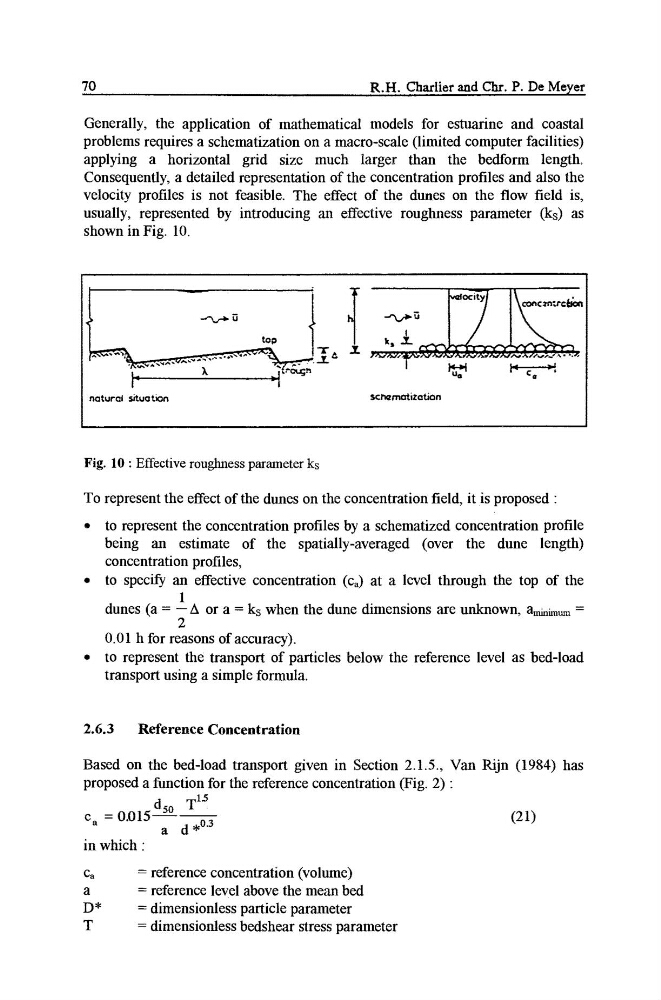
usually, represented by introducing an effective roughness parameter (ks) as
shown in Fig. 10.
T
,
T
top
l"
r!
natural situation
ra:r~motization
Fig. 10 : Effective roughness parameter ks
To represent the effect of the dunes on the concentration field, it is proposed :
- to represent the concentration profiles by a schematized concentration profile
being an estimate of the spatially-averaged (over the dune length)
concentration profiles,
• to specify an effective concentration (co) at a level through the top of the
1
dunes (a = --A or a = ks when the dune dimensions are unknown, ami~ =
2
0.01 h for reasons of accuracy).
• to represent the transport of particles below the reference level as bed-load
transport using a simple formula.
2.6.3
Reference Concentration
Based on the bed-load transport given in Section 2.1.5., Van Rijn (1984) has
proposed a function for the reference concentration 0?ig. 2) :
e a = 0.015 dS° TI~
a d .o.3
(21)
in which :
ca
= reference concentration (volume)
a
= reference level above the mean bed
D*
= dimensionless particle parameter
T
= dimensionless bedshear stress parameter
,, R.H. ' Chartier and Clar. P. De Meyer
Generally, the application of mathematical models for estuarine and coastal
problems requires a schematization on a macro-scale (limited computer facilities)
applying a horizontal grid size much larger than the bedform length.
Consequently, a detailed representation of the concentration profiles and also the
velocity profiles is not feasible. The effect of the dunes on the flow field is,
usually, represented by introducing an effective roughness parameter (ks) as
shown in Fig. 10.
T
,
T
top
l"
r!
natural situation
ra:r~motization
Fig. 10 : Effective roughness parameter ks
To represent the effect of the dunes on the concentration field, it is proposed :
- to represent the concentration profiles by a schematized concentration profile
being an estimate of the spatially-averaged (over the dune length)
concentration profiles,
• to specify an effective concentration (co) at a level through the top of the
1
dunes (a = --A or a = ks when the dune dimensions are unknown, ami~ =
2
0.01 h for reasons of accuracy).
• to represent the transport of particles below the reference level as bed-load
transport using a simple formula.
2.6.3
Reference Concentration
Based on the bed-load transport given in Section 2.1.5., Van Rijn (1984) has
proposed a function for the reference concentration 0?ig. 2) :
e a = 0.015 dS° TI~
a d .o.3
(21)
in which :
ca
= reference concentration (volume)
a
= reference level above the mean bed
D*
= dimensionless particle parameter
T
= dimensionless bedshear stress parameter