

I~. Sediment Transport
1.5
Prediction Method of Van Rijn (1984)
55
Van Rijn followed the approach of Bagnold (1954) assuming that the motion of
the bed load particles is dominated by particle saltations under the influence of
hydrodynamic fluid forces and gravity forces. Van Rijn (1984) computed that the
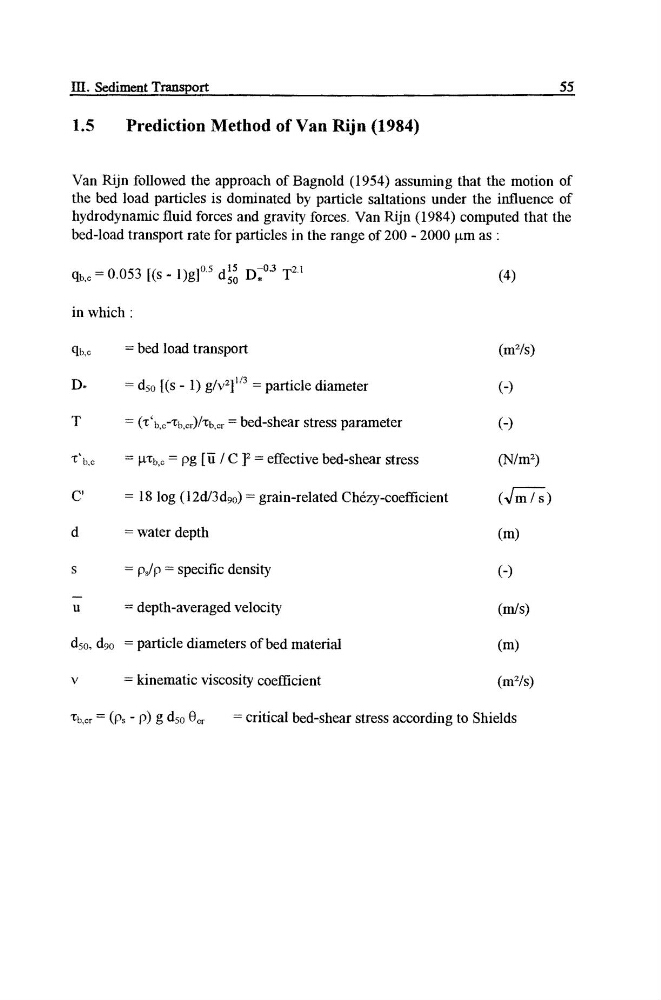
bed-load transport rate for particles in the range of 200 - 2000 p.m as :
t5 D.O.3 TzA
qb.c = 0.053 [(S - l)g] °5 dso
in which :
%,°
= bed load transport
D.
= also [(s - 1) g/v2] I/3 = particle diameter
T
= (Z'b.o-zb.cr)/~b.~ = bed-shear stress parameter
"Cb.o
= g'Cb,o = Pg [U / C ]2 = effective bed-shear stress
C'
= 18 log (12d/3dgo) = grain-related Ch6zy-coefficient
d
= water depth
s
= 9~/9 = specific density
u
= depth-averaged velocity
dso, dgo = particle diameters of bed material
v
= kinematic viscosity coefficient
%,o~ = (O~ - P) g dso Oor
(4)
(mVs)
(-)
(-)
(N/m 2)
(m4~-~)
(m)
(-)
(m/s)
(m)
(m2/s)
= critical bed-shear stress according to Shields
1.5
Prediction Method of Van Rijn (1984)
55
Van Rijn followed the approach of Bagnold (1954) assuming that the motion of
the bed load particles is dominated by particle saltations under the influence of
hydrodynamic fluid forces and gravity forces. Van Rijn (1984) computed that the
bed-load transport rate for particles in the range of 200 - 2000 p.m as :
t5 D.O.3 TzA
qb.c = 0.053 [(S - l)g] °5 dso
in which :
%,°
= bed load transport
D.
= also [(s - 1) g/v2] I/3 = particle diameter
T
= (Z'b.o-zb.cr)/~b.~ = bed-shear stress parameter
"Cb.o
= g'Cb,o = Pg [U / C ]2 = effective bed-shear stress
C'
= 18 log (12d/3dgo) = grain-related Ch6zy-coefficient
d
= water depth
s
= 9~/9 = specific density
u
= depth-averaged velocity
dso, dgo = particle diameters of bed material
v
= kinematic viscosity coefficient
%,o~ = (O~ - P) g dso Oor
(4)
(mVs)
(-)
(-)
(N/m 2)
(m4~-~)
(m)
(-)
(m/s)
(m)
(m2/s)
= critical bed-shear stress according to Shields