

52
R.H. Charlier and Chr. P. De Meyer
Frijlinck's (1952) very practical approach made a simple fit of the Meyer-PeterMtiller and Einstein formulas. Bagnold (1966) introduced an energy concept and
related the sediment transport rate to the work done by the fluid. Van Rijn (1984)
solved the equations of motion of an individual bed-load particle and computed
the saltation characteristics and the particle velocity as a function of the flow
conditions and particle diameter.
1.2
Meyer-Peter and Miiller (1948) Prediction Method
Extensive experimental work has been carried out by Meyer-Peter and Miiller at
the "EidgenOssische Technische Hochschule" (ETH) in Switzerland. The
experiments were performed in a laboratory flume with a cross-section of 2 x 2
m 2 (2 x 21.5 sq. ft.) and a length of 50 m (164 ft.). Uniform bed material as well
as particle mixtures were used in the experiments.
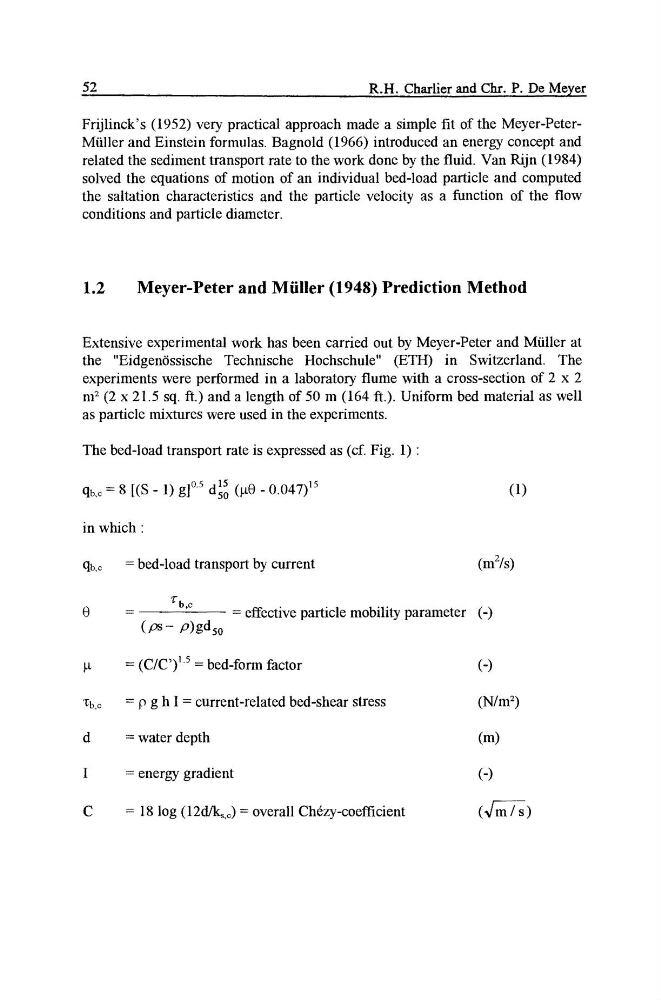
The bed-load transport rate is expressed as (cf. Fig. 1) :
15
%° = 8 [(S - 1) g]O.5 d5 ° (~t0 - 0.047) 15
in which :
qb,c
= bed-load transport by current
(1)
Tb,c
(ps - p)gdso
~t
= (C/C,)I,5 = bed-form factor
%,°
= p g h I = current-related bed-shear stress
d
= water depth
I
= energy gradient
C
= 18 log (12d/ks,o) = overall Ch6zy-coefficient
(me/s)
= effective particle mobility parameter (-)
(-)
(N/m:)
(m)
(-)
(4-mm/s)
R.H. Charlier and Chr. P. De Meyer
Frijlinck's (1952) very practical approach made a simple fit of the Meyer-PeterMtiller and Einstein formulas. Bagnold (1966) introduced an energy concept and
related the sediment transport rate to the work done by the fluid. Van Rijn (1984)
solved the equations of motion of an individual bed-load particle and computed
the saltation characteristics and the particle velocity as a function of the flow
conditions and particle diameter.
1.2
Meyer-Peter and Miiller (1948) Prediction Method
Extensive experimental work has been carried out by Meyer-Peter and Miiller at
the "EidgenOssische Technische Hochschule" (ETH) in Switzerland. The
experiments were performed in a laboratory flume with a cross-section of 2 x 2
m 2 (2 x 21.5 sq. ft.) and a length of 50 m (164 ft.). Uniform bed material as well
as particle mixtures were used in the experiments.
The bed-load transport rate is expressed as (cf. Fig. 1) :
15
%° = 8 [(S - 1) g]O.5 d5 ° (~t0 - 0.047) 15
in which :
qb,c
= bed-load transport by current
(1)
Tb,c
(ps - p)gdso
~t
= (C/C,)I,5 = bed-form factor
%,°
= p g h I = current-related bed-shear stress
d
= water depth
I
= energy gradient
C
= 18 log (12d/ks,o) = overall Ch6zy-coefficient
(me/s)
= effective particle mobility parameter (-)
(-)
(N/m:)
(m)
(-)
(4-mm/s)