

312
R.H. Charlier and Chr. P. De Meyer
Some relationship may be calculated using mean energy per ocean area unit and
mean sediment characteristics. Several authors have stressed that 'In computing
such average, some statistical value may have to be used for the energy
fluctuations throughout the year, e.g. the average of the highest third of the peak
energies" Same energy level or not, data relating to sections of an enclosed sea
cannot be used for an ocean coast. Wave length (X) or period (T) are to be
included in the 'relationship" as they vary from storm to swell conditions (see
below).
1.2
Swell to storm profile
Long-term erosion and/or accretion trends must be taken into account to assess
beach encroachment safe limit for construction, and thus establishment of an
authorized construction limit, and to advise pipelines positioning depths.
1.3
Theoretical analysis
The Sitarz equations proposed a relationship for surf zone width for swell and
storm-waves profiles, plus zonal water cross-sectional area. Average depth can
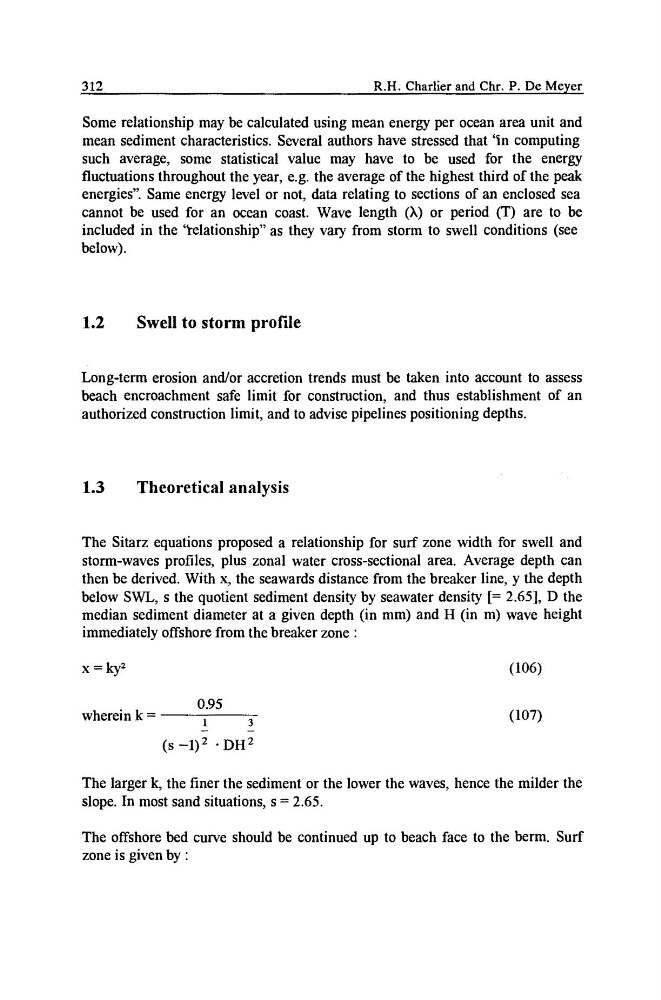
then be derived. With x, the seawards distance from the breaker line, y the depth
below SWL, s the quotient sediment density by seawater density [= 2.65], D the
median sediment diameter at a given depth (in mm) and H (in m) wave height
immediately offshore from the breaker zone :
x = ky 2
(106)
0.95
wherein k =
l
3
(107)
(s -1) 2 . DH 2
The larger k, the finer the sediment or the lower the waves, hence the milder the
slope. In most sand situations, s = 2.65.
The offshore bed curve should be continued up to beach face to the berm. Surf
zone is given by"
R.H. Charlier and Chr. P. De Meyer
Some relationship may be calculated using mean energy per ocean area unit and
mean sediment characteristics. Several authors have stressed that 'In computing
such average, some statistical value may have to be used for the energy
fluctuations throughout the year, e.g. the average of the highest third of the peak
energies" Same energy level or not, data relating to sections of an enclosed sea
cannot be used for an ocean coast. Wave length (X) or period (T) are to be
included in the 'relationship" as they vary from storm to swell conditions (see
below).
1.2
Swell to storm profile
Long-term erosion and/or accretion trends must be taken into account to assess
beach encroachment safe limit for construction, and thus establishment of an
authorized construction limit, and to advise pipelines positioning depths.
1.3
Theoretical analysis
The Sitarz equations proposed a relationship for surf zone width for swell and
storm-waves profiles, plus zonal water cross-sectional area. Average depth can
then be derived. With x, the seawards distance from the breaker line, y the depth
below SWL, s the quotient sediment density by seawater density [= 2.65], D the
median sediment diameter at a given depth (in mm) and H (in m) wave height
immediately offshore from the breaker zone :
x = ky 2
(106)
0.95
wherein k =
l
3
(107)
(s -1) 2 . DH 2
The larger k, the finer the sediment or the lower the waves, hence the milder the
slope. In most sand situations, s = 2.65.
The offshore bed curve should be continued up to beach face to the berm. Surf
zone is given by"