

IV. Retreating Shorelines
267
The concept of critical erosion has found its way in the literature ; areas of
critical erosion are defined as those where erosion presents a serious problem
because the rate of erosion considered in conjunction with economic, industrial,
recreational, agricultural, navigation, demographic, ecological and other relevant
factors, indicated that action to halt such erosion may be justified.
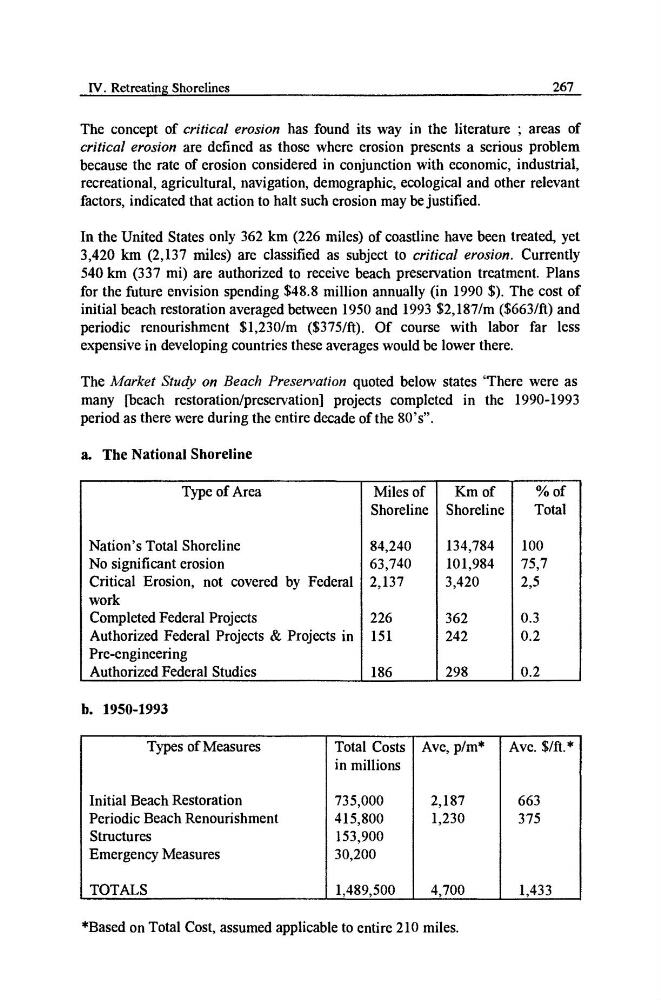
In the United States only 362 km (226 miles) of coastline have been treated, yet
3,420 km (2,137 miles) are classified as subject to critical erosion. Currently
540 km (337 mi) are authorized to receive beach preservation treatment. Plans
for the future envision spending $48.8 million annually (in 1990 $). The cost of
initial beach restoration averaged between 1950 and 1993 $2,187/m ($663/fl) and
periodic renourishment $1,230/m ($375/fl). Of course with labor far less
expensive in developing countries these averages would be lower there.
The Market Study on Beach Preservation quoted below states 'There were as
many [beach restoration/preservation] projects completed in the 1990-1993
period as there were during the entire decade of the 80's".
a. The National Shoreline
Type of Area
Nation's Total Shoreline
No significant erosion
Critical Erosion, not covered by Federal
work
Completed Federal Projects
Authorized Federal Projects & Projects in
Pre-engineering
Authorized Federal Studies
Miles of
Shoreline
84,240
63,740
2,137
226
151
186
Km of
Shoreline
134,784
101,984
3,420
362
242
298
%of
Total
100
75,7
2,5
0.3
0.2
0.2
b. 1950-1993
Types of Measures
Initial Beach Restoration
Periodic Beach Renourishment
Structures
Emergency Measures
TOTALS
Total Costs
in millions
735,000
415,800
153,900
30,200
1,489,500
Ave, p/m*
2,187
1,230
4,700
*Based on Total Cost, assumed applicable to entire 210 miles.
Ave. S/ft.*
663
375
1,433
267
The concept of critical erosion has found its way in the literature ; areas of
critical erosion are defined as those where erosion presents a serious problem
because the rate of erosion considered in conjunction with economic, industrial,
recreational, agricultural, navigation, demographic, ecological and other relevant
factors, indicated that action to halt such erosion may be justified.
In the United States only 362 km (226 miles) of coastline have been treated, yet
3,420 km (2,137 miles) are classified as subject to critical erosion. Currently
540 km (337 mi) are authorized to receive beach preservation treatment. Plans
for the future envision spending $48.8 million annually (in 1990 $). The cost of
initial beach restoration averaged between 1950 and 1993 $2,187/m ($663/fl) and
periodic renourishment $1,230/m ($375/fl). Of course with labor far less
expensive in developing countries these averages would be lower there.
The Market Study on Beach Preservation quoted below states 'There were as
many [beach restoration/preservation] projects completed in the 1990-1993
period as there were during the entire decade of the 80's".
a. The National Shoreline
Type of Area
Nation's Total Shoreline
No significant erosion
Critical Erosion, not covered by Federal
work
Completed Federal Projects
Authorized Federal Projects & Projects in
Pre-engineering
Authorized Federal Studies
Miles of
Shoreline
84,240
63,740
2,137
226
151
186
Km of
Shoreline
134,784
101,984
3,420
362
242
298
%of
Total
100
75,7
2,5
0.3
0.2
0.2
b. 1950-1993
Types of Measures
Initial Beach Restoration
Periodic Beach Renourishment
Structures
Emergency Measures
TOTALS
Total Costs
in millions
735,000
415,800
153,900
30,200
1,489,500
Ave, p/m*
2,187
1,230
4,700
*Based on Total Cost, assumed applicable to entire 210 miles.
Ave. S/ft.*
663
375
1,433