

234
R.H. Charlier and Chr. P. De Meyer
.
.
.
.
.
.
,,,,,,,,, ,,,,,
I ARTIRCIAL BEACH RE-NOURI SHMENT I
ON THE BELSAN EAST LT)AST
I,,, ,,,,,,,,,,,,,,PREUMINARY STUmES I
I EXECUTION OF BEAO-I NOURISHMENT I
FOLLOW-UP PROGRAMME
- FIELD SURVEYS
- DEFINITIONS
-PROCESSING SURVEY DATA
DI SCUSSI ON OF SURVEY RESULTS
-AERIAL PHOIT)GRAIv~E' IIRY AND
BATHYMETRIC SOUNDINGS
-TERRESTRIAL BEACH SURVEYS
[ FUTURE TRENDS, ]
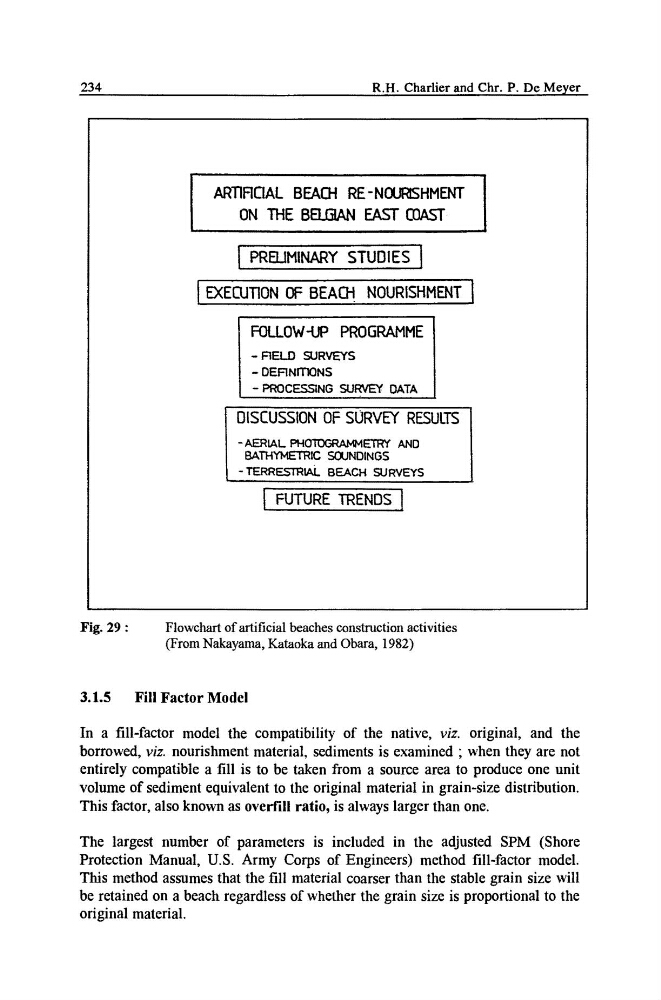
Fig. 29 :
Flowchart of artificial beaches construction activities
(From Nakayama, Kataoka and Obara, 1982)
3.1.5
Fill Factor Model
In a fill-factor model the compatibility of the native, viz. original, and the
borrowed, viz. nourishment material, sediments is examined ; when they are not
entirely compatible a fill is to be taken from a source area to produce one unit
volume of sediment equivalent to the original material in grain-size distribution.
This factor, also known as overfill ratio, is always larger than one.
The largest number of parameters is included in the adjusted SPM (Shore
Protection Manual, U.S. Army Corps of Engineers) method fill-factor model.
This method assumes that the fill material coarser than the stable grain size will
be retained on a beach regardless of whether the grain size is proportional to the
original material.
R.H. Charlier and Chr. P. De Meyer
.
.
.
.
.
.
,,,,,,,,, ,,,,,
I ARTIRCIAL BEACH RE-NOURI SHMENT I
ON THE BELSAN EAST LT)AST
I,,, ,,,,,,,,,,,,,,PREUMINARY STUmES I
I EXECUTION OF BEAO-I NOURISHMENT I
FOLLOW-UP PROGRAMME
- FIELD SURVEYS
- DEFINITIONS
-PROCESSING SURVEY DATA
DI SCUSSI ON OF SURVEY RESULTS
-AERIAL PHOIT)GRAIv~E' IIRY AND
BATHYMETRIC SOUNDINGS
-TERRESTRIAL BEACH SURVEYS
[ FUTURE TRENDS, ]
Fig. 29 :
Flowchart of artificial beaches construction activities
(From Nakayama, Kataoka and Obara, 1982)
3.1.5
Fill Factor Model
In a fill-factor model the compatibility of the native, viz. original, and the
borrowed, viz. nourishment material, sediments is examined ; when they are not
entirely compatible a fill is to be taken from a source area to produce one unit
volume of sediment equivalent to the original material in grain-size distribution.
This factor, also known as overfill ratio, is always larger than one.
The largest number of parameters is included in the adjusted SPM (Shore
Protection Manual, U.S. Army Corps of Engineers) method fill-factor model.
This method assumes that the fill material coarser than the stable grain size will
be retained on a beach regardless of whether the grain size is proportional to the
original material.