

202
R.H. Charlier and Chr. P. De Meyer
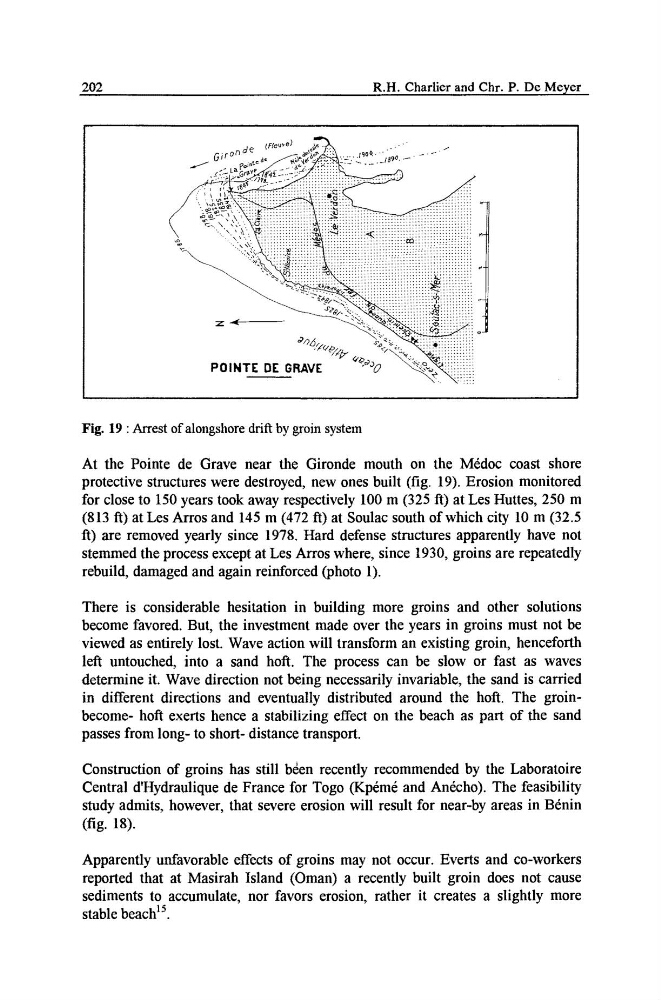
Fig. 19 : Arrest of alongshore drift by groin system
At the Pointe de Grave near the Gironde mouth on the M6doc coast shore
protective structures were destroyed, new ones built (fig. 19). Erosion monitored
for close to 150 years took away respectively 100 m (325 ft) at Les Huttes, 250 m
(813 ft) at Les Arros and 145 m (472 ft) at Soulac south of which city 10 m (32.5
ft) are removed yearly since 1978. Hard defense structures apparently have not
stemmed the process except at Les Arros where, since 1930, groins are repeatedly
rebuild, damaged and again reinforced (photo 1).
There is considerable hesitation in building more groins and other solutions
become favored. But, the investment made over the years in groins must not be
viewed as entirely lost. Wave action will transform an existing groin, henceforth
left untouched, into a sand hoft. The process can be slow or fast as waves
determine it. Wave direction not being necessarily invariable, the sand is carried
in different directions and eventually distributed around the hoft. The groinbecome- hoft exerts hence a stabilizing effect on the beach as part of the sand
passes from long- to short- distance transport.
Construction of groins has still b6en recently recommended by the Laboratoire
Central d'Hydraulique de France for Togo (Kp6m6 and An6cho). The feasibility
study admits, however, that severe erosion will result for near-by areas in B6nin
(fig. 18).
Apparently unfavorable effects of groins may not occur. Everts and co-workers
reported that at Masirah Island (Oman) a recently built groin does not cause
sediments to accumulate, nor favors erosion, rather it creates a slightly more
stable beach 13.
R.H. Charlier and Chr. P. De Meyer
Fig. 19 : Arrest of alongshore drift by groin system
At the Pointe de Grave near the Gironde mouth on the M6doc coast shore
protective structures were destroyed, new ones built (fig. 19). Erosion monitored
for close to 150 years took away respectively 100 m (325 ft) at Les Huttes, 250 m
(813 ft) at Les Arros and 145 m (472 ft) at Soulac south of which city 10 m (32.5
ft) are removed yearly since 1978. Hard defense structures apparently have not
stemmed the process except at Les Arros where, since 1930, groins are repeatedly
rebuild, damaged and again reinforced (photo 1).
There is considerable hesitation in building more groins and other solutions
become favored. But, the investment made over the years in groins must not be
viewed as entirely lost. Wave action will transform an existing groin, henceforth
left untouched, into a sand hoft. The process can be slow or fast as waves
determine it. Wave direction not being necessarily invariable, the sand is carried
in different directions and eventually distributed around the hoft. The groinbecome- hoft exerts hence a stabilizing effect on the beach as part of the sand
passes from long- to short- distance transport.
Construction of groins has still b6en recently recommended by the Laboratoire
Central d'Hydraulique de France for Togo (Kp6m6 and An6cho). The feasibility
study admits, however, that severe erosion will result for near-by areas in B6nin
(fig. 18).
Apparently unfavorable effects of groins may not occur. Everts and co-workers
reported that at Masirah Island (Oman) a recently built groin does not cause
sediments to accumulate, nor favors erosion, rather it creates a slightly more
stable beach 13.