

180
R.H. Charlier and Chr. P. De Meyer
If in cases of mild erosion the best action is to take none, human action or
ignorance of shoreline processes often necessitates decisive measures, particularly
where economic values are at stake. Which erosion control measures have to be
taken depends on the type of shore and land-use. Alternatives include
construction of hard structures, artificial and induced natural beach
replenishment, traffic restriction, vegetation protection, retreat and outright
human occupancy abandon.
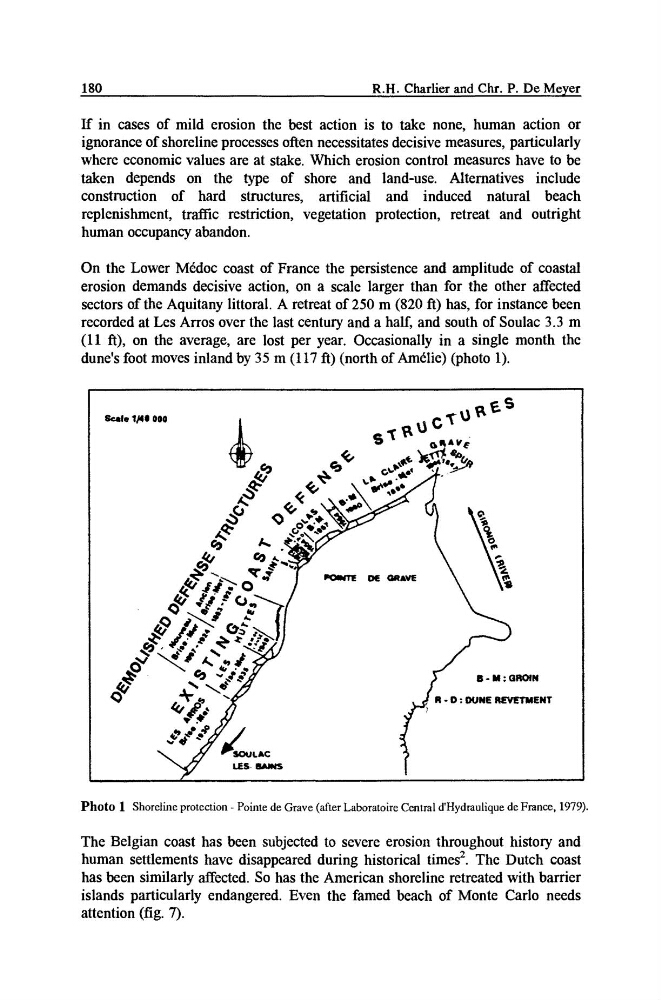
On the Lower M6doc coast of France the persistence and amplitude of coastal
erosion demands decisive action, on a scale larger than for the other affected
sectors of the Aquitany littoral. A retreat of 250 m (820 ft) has, for instance been
recorded at Les Arros over the last century and a half, and south of Soulac 3.3 m
(11 ft), on the average, are lost per year. Occasionally in a single month the
dune's foot moves inland by 35 m (117 ft) (north of Amdlie) (photo 1).
Scale 1/4e 000
/.,.
rn
POWl"E 04[ GRAVE
,~
B - M : GROIN
R - D : OUNE REVETMENT
Photo 1 Shoreline protection - Pointe de Grave (after Laboratoire Central d'Hydraulique de France, 1979).
The Belgian coast has been subjected to severe erosion throughout history and
human settlements have disappeared during historical times 2. The Dutch coast
has been similarly affected. So has the American shoreline retreated with barrier
islands particularly endangered. Even the famed beach of Monte Carlo needs
attention (fig. 7).
R.H. Charlier and Chr. P. De Meyer
If in cases of mild erosion the best action is to take none, human action or
ignorance of shoreline processes often necessitates decisive measures, particularly
where economic values are at stake. Which erosion control measures have to be
taken depends on the type of shore and land-use. Alternatives include
construction of hard structures, artificial and induced natural beach
replenishment, traffic restriction, vegetation protection, retreat and outright
human occupancy abandon.
On the Lower M6doc coast of France the persistence and amplitude of coastal
erosion demands decisive action, on a scale larger than for the other affected
sectors of the Aquitany littoral. A retreat of 250 m (820 ft) has, for instance been
recorded at Les Arros over the last century and a half, and south of Soulac 3.3 m
(11 ft), on the average, are lost per year. Occasionally in a single month the
dune's foot moves inland by 35 m (117 ft) (north of Amdlie) (photo 1).
Scale 1/4e 000
/.,.
rn
POWl"E 04[ GRAVE
,~
B - M : GROIN
R - D : OUNE REVETMENT
Photo 1 Shoreline protection - Pointe de Grave (after Laboratoire Central d'Hydraulique de France, 1979).
The Belgian coast has been subjected to severe erosion throughout history and
human settlements have disappeared during historical times 2. The Dutch coast
has been similarly affected. So has the American shoreline retreated with barrier
islands particularly endangered. Even the famed beach of Monte Carlo needs
attention (fig. 7).