

170
3.2
The Equilibrium Profile
R.H. Charlier and Chr. P. De Meyer
The equilibrium profile being produced by a specific wave climate and the type of
coastal sediment, the construction of a structure on-shore or across a river will
affect wave height, sedimentation and if beach nourishment is carried out,
sediment nature. A "probable" equilibrium profile will help determine fill volume
needed to achieve stability.
The equilibrium beach profile, an idealized condition, practically never attained,
is a useful interpretation tool.
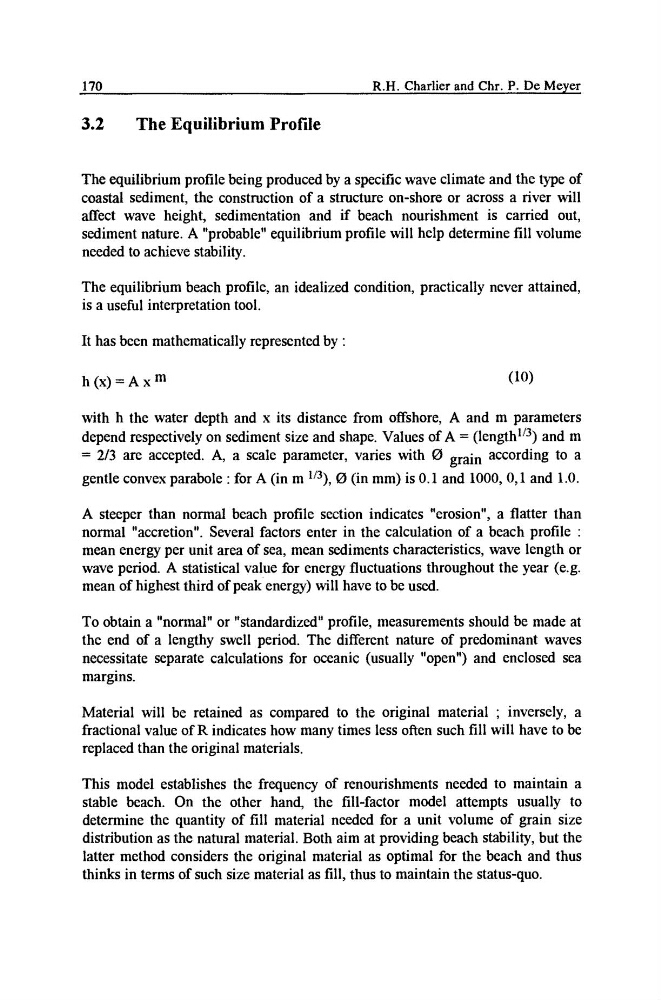
It has been mathematically represented by :
h(x)=Ax m
(10)
with h the water depth and x its distance from offshore, A and m parameters
depend respectively on sediment size and shape. Values of A = (lengt hv3) and m
= 2/3 are accepted. A, a scale parameter, varies with O grain according to a
gentle convex parabole : for A (in m v3), O (in mm) is 0.1 and 1000, 0,1 and 1.0.
A steeper than normal beach profile section indicates "erosion", a flatter than
normal "accretion". Several factors enter in the calculation of a beach profile :
mean energy per unit area of sea, mean sediments characteristics, wave length or
wave period. A statistical value for energy fluctuations throughout the year (e.g.
mean of highest third of peak energy) will have to be used.
To obtain a "normal" or "standardized" profile, measurements should be made at
the end of a lengthy swell period. The different nature of predominant waves
necessitate separate calculations for oceanic (usually "open") and enclosed sea
margins.
Material will be retained as compared to the original material ; inversely, a
fractional value of R indicates how many times less often such fill will have to be
replaced than the original materials.
This model establishes the frequency of renourishments needed to maintain a
stable beach. On the other hand, the fill-factor model attempts usually to
determine the quantity of fill material needed for a unit volume of grain size
distribution as the natural material. Both aim at providing beach stability, but the
latter method considers the original material as optimal for the beach and thus
thinks in terms of such size material as fill, thus to maintain the status-quo.
3.2
The Equilibrium Profile
R.H. Charlier and Chr. P. De Meyer
The equilibrium profile being produced by a specific wave climate and the type of
coastal sediment, the construction of a structure on-shore or across a river will
affect wave height, sedimentation and if beach nourishment is carried out,
sediment nature. A "probable" equilibrium profile will help determine fill volume
needed to achieve stability.
The equilibrium beach profile, an idealized condition, practically never attained,
is a useful interpretation tool.
It has been mathematically represented by :
h(x)=Ax m
(10)
with h the water depth and x its distance from offshore, A and m parameters
depend respectively on sediment size and shape. Values of A = (lengt hv3) and m
= 2/3 are accepted. A, a scale parameter, varies with O grain according to a
gentle convex parabole : for A (in m v3), O (in mm) is 0.1 and 1000, 0,1 and 1.0.
A steeper than normal beach profile section indicates "erosion", a flatter than
normal "accretion". Several factors enter in the calculation of a beach profile :
mean energy per unit area of sea, mean sediments characteristics, wave length or
wave period. A statistical value for energy fluctuations throughout the year (e.g.
mean of highest third of peak energy) will have to be used.
To obtain a "normal" or "standardized" profile, measurements should be made at
the end of a lengthy swell period. The different nature of predominant waves
necessitate separate calculations for oceanic (usually "open") and enclosed sea
margins.
Material will be retained as compared to the original material ; inversely, a
fractional value of R indicates how many times less often such fill will have to be
replaced than the original materials.
This model establishes the frequency of renourishments needed to maintain a
stable beach. On the other hand, the fill-factor model attempts usually to
determine the quantity of fill material needed for a unit volume of grain size
distribution as the natural material. Both aim at providing beach stability, but the
latter method considers the original material as optimal for the beach and thus
thinks in terms of such size material as fill, thus to maintain the status-quo.