

IV. Retreating Shorelines
165
2.4.1
Edge Waves
Reflective beaches are associated with beach cusps and subharmonic (having
twice the period of the incident waves) edge waves. Shallow beaches are
associated with wide surf zones of turbulent dissipation.
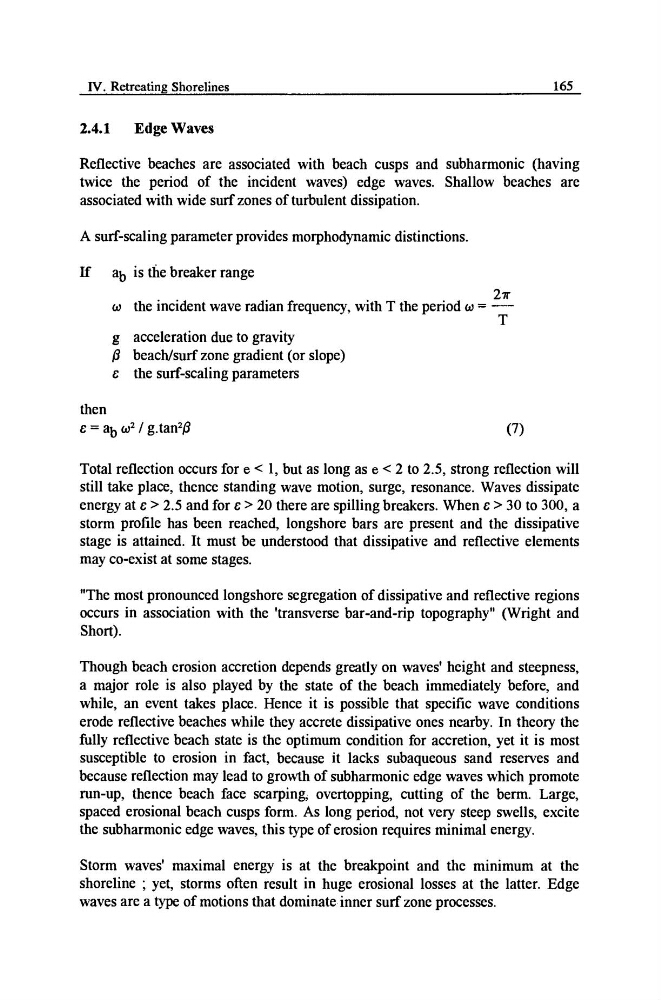
A surf-scaling parameter provides morphodynamic distinctions.
If
a b is the breaker range
o~ the incident wave radian frequency, with T the period o: = -g acceleration due to gravity
fl beach/surf zone gradient (or slope)
e the surf-scaling parameters
271"
T
then
e = a b oJ 2 / g.tan213
(7)
Total reflection occurs for e < 1, but as long as e < 2 to 2.5, strong reflection will
still take place, thence standing wave motion, surge, resonance. Waves dissipate
energy at e > 2.5 and for e > 20 there are spilling breakers. When e > 30 to 300, a
storm profile has been reached, longshore bars are present and the dissipative
stage is attained. It must be understood that dissipative and reflective elements
may co-exist at some stages.
"The most pronounced longshore segregation of dissipative and reflective regions
occurs in association with the 'transverse bar-and-rip topography" (Wright and
Short).
Though beach erosion accretion depends greatly on waves' height and steepness,
a major role is also played by the state of the beach immediately before, and
while, an event takes place. Hence it is possible that specific wave conditions
erode reflective beaches while they accrete dissipative ones nearby. In theory the
fully reflective beach state is the optimum condition for accretion, yet it is most
susceptible to erosion in fact, because it lacks subaqueous sand reserves and
because reflection may lead to growth of subharmonic edge waves which promote
run-up, thence beach face scarping, overtopping, cutting of the berm. Large,
spaced erosional beach cusps form. As long period, not very steep swells, excite
the subharmonic edge waves, this type of erosion requires minimal energy.
Storm waves' maximal energy is at the breakpoint and the minimum at the
shoreline ; yet, storms often result in huge erosional losses at the latter. Edge
waves are a type of motions that dominate inner surf zone processes.
165
2.4.1
Edge Waves
Reflective beaches are associated with beach cusps and subharmonic (having
twice the period of the incident waves) edge waves. Shallow beaches are
associated with wide surf zones of turbulent dissipation.
A surf-scaling parameter provides morphodynamic distinctions.
If
a b is the breaker range
o~ the incident wave radian frequency, with T the period o: = -g acceleration due to gravity
fl beach/surf zone gradient (or slope)
e the surf-scaling parameters
271"
T
then
e = a b oJ 2 / g.tan213
(7)
Total reflection occurs for e < 1, but as long as e < 2 to 2.5, strong reflection will
still take place, thence standing wave motion, surge, resonance. Waves dissipate
energy at e > 2.5 and for e > 20 there are spilling breakers. When e > 30 to 300, a
storm profile has been reached, longshore bars are present and the dissipative
stage is attained. It must be understood that dissipative and reflective elements
may co-exist at some stages.
"The most pronounced longshore segregation of dissipative and reflective regions
occurs in association with the 'transverse bar-and-rip topography" (Wright and
Short).
Though beach erosion accretion depends greatly on waves' height and steepness,
a major role is also played by the state of the beach immediately before, and
while, an event takes place. Hence it is possible that specific wave conditions
erode reflective beaches while they accrete dissipative ones nearby. In theory the
fully reflective beach state is the optimum condition for accretion, yet it is most
susceptible to erosion in fact, because it lacks subaqueous sand reserves and
because reflection may lead to growth of subharmonic edge waves which promote
run-up, thence beach face scarping, overtopping, cutting of the berm. Large,
spaced erosional beach cusps form. As long period, not very steep swells, excite
the subharmonic edge waves, this type of erosion requires minimal energy.
Storm waves' maximal energy is at the breakpoint and the minimum at the
shoreline ; yet, storms often result in huge erosional losses at the latter. Edge
waves are a type of motions that dominate inner surf zone processes.