

111. Sediment TransEort
. . . . . . . . .
147
Both possibilities satisfy Q2 = QI, at the beginning of this second stage and Q2 =
0 at the end of it.
The numerical method for this stage is based on equation (100), (102) and either
(103) or (105). The ~erential s equation can be solved using a finite-difference
numerical method.
stole lm*del~
//
"-,~->,.
o
~ ~,
• .~//
"%¢'>..
L! , , , !
?//
"%,,'z-..
_
S~itl w~er eleoth [ mode~l
"~ii:~
,,n
..
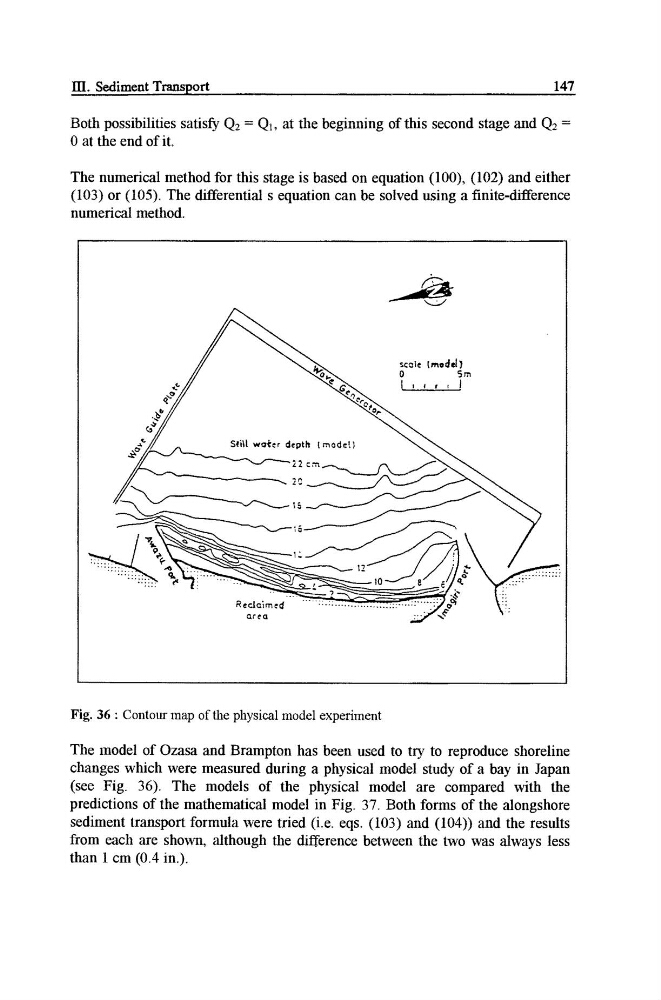
Fig. 36 : Contour map of the physical model experiment
The model of Ozasa and Brampton has been used to try to reproduce shoreline
changes which were measured during a physical model study of a bay in Japan
(see Fig. 36). The models of the physical model are compared with the
predictions of the mathematical model in Fig. 37. Both forms of the alongshore
sediment transport formula were tried (i.e. eqs. (103) and (104)) and the results
from each are shown, although the difference between the two was always less
than 1 cm (0.4 in.).
. . . . . . . . .
147
Both possibilities satisfy Q2 = QI, at the beginning of this second stage and Q2 =
0 at the end of it.
The numerical method for this stage is based on equation (100), (102) and either
(103) or (105). The ~erential s equation can be solved using a finite-difference
numerical method.
stole lm*del~
//
"-,~->,.
o
~ ~,
• .~//
"%¢'>..
L! , , , !
?//
"%,,'z-..
_
S~itl w~er eleoth [ mode~l
"~ii:~
,,n
..
Fig. 36 : Contour map of the physical model experiment
The model of Ozasa and Brampton has been used to try to reproduce shoreline
changes which were measured during a physical model study of a bay in Japan
(see Fig. 36). The models of the physical model are compared with the
predictions of the mathematical model in Fig. 37. Both forms of the alongshore
sediment transport formula were tried (i.e. eqs. (103) and (104)) and the results
from each are shown, although the difference between the two was always less
than 1 cm (0.4 in.).