

ILl. Sediment,Transport
145
= the specific of beach material in place and where subscripts b refers to
breaking wave conditions.
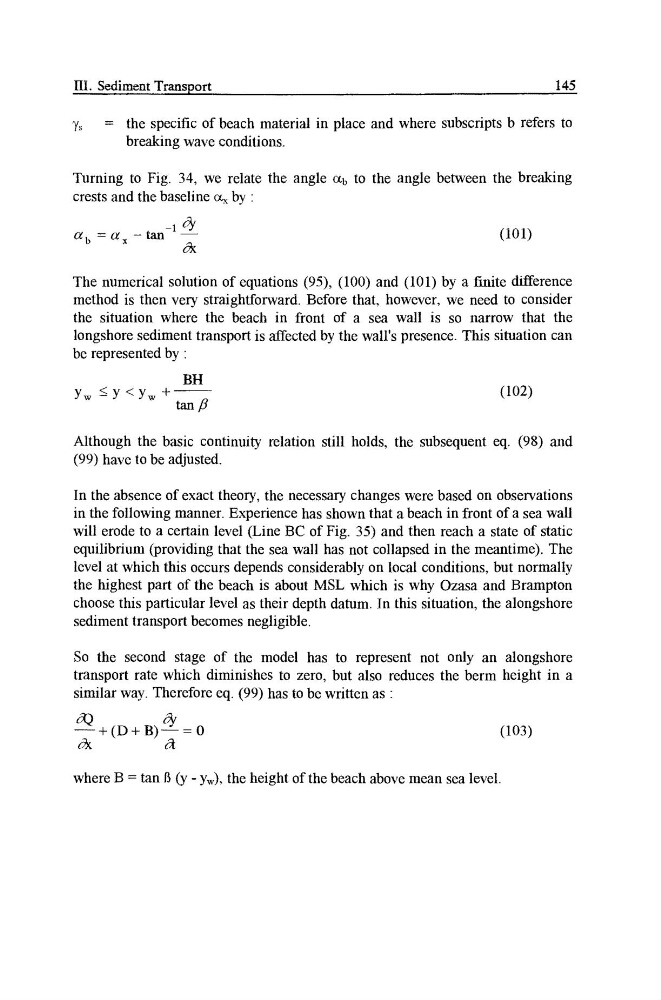
Turning to Fig. 34, we relate the angle O~b to the angle between the breaking
crests and the baseline ~xx by :
ab = ax -- tall- 1 t~
(101)
c~
The numerical solution of equations (95), (I00) and (101) by a finite difference
method is then very straightforward. Before that, however, we need to consider
the situation where the beach in front of a sea wall is so narrow that the
longshore sediment transport is affected by the wall's presence. This situation can
be represented by :
BH
Yw -< Y < Yw + -(102)
tan p
Although the basic continuity relation still holds, the subsequent eq. (98) and
(99) have to be adjusted.
In the absence of exact theory, the necessary changes were based on observations
in the following manner. Experience has shown that a beach in front of a sea wall
will erode to a certain level (Line BC of Fig. 35) and then reach a state of static
equilibrium (providing that the sea wall has not collapsed in the meantime). The
level at which this occurs depends considerably on local conditions, but normally
the highest part of the beach is about MSL which is why Ozasa and Brampton
choose this particular level as their depth datum. In this situation, the alongshore
sediment transport becomes negligible.
So the second stage of the model has to represent not only an alongshore
transport rate which diminishes to zero, but also reduces the berm height in a
similar way. Therefore eq. (99) has to be written as :
-- + (D + B)
= 0
(103)
3x
where B = tan fi (y - Yw), the height of the beach above mean sea level.
145
= the specific of beach material in place and where subscripts b refers to
breaking wave conditions.
Turning to Fig. 34, we relate the angle O~b to the angle between the breaking
crests and the baseline ~xx by :
ab = ax -- tall- 1 t~
(101)
c~
The numerical solution of equations (95), (I00) and (101) by a finite difference
method is then very straightforward. Before that, however, we need to consider
the situation where the beach in front of a sea wall is so narrow that the
longshore sediment transport is affected by the wall's presence. This situation can
be represented by :
BH
Yw -< Y < Yw + -(102)
tan p
Although the basic continuity relation still holds, the subsequent eq. (98) and
(99) have to be adjusted.
In the absence of exact theory, the necessary changes were based on observations
in the following manner. Experience has shown that a beach in front of a sea wall
will erode to a certain level (Line BC of Fig. 35) and then reach a state of static
equilibrium (providing that the sea wall has not collapsed in the meantime). The
level at which this occurs depends considerably on local conditions, but normally
the highest part of the beach is about MSL which is why Ozasa and Brampton
choose this particular level as their depth datum. In this situation, the alongshore
sediment transport becomes negligible.
So the second stage of the model has to represent not only an alongshore
transport rate which diminishes to zero, but also reduces the berm height in a
similar way. Therefore eq. (99) has to be written as :
-- + (D + B)
= 0
(103)
3x
where B = tan fi (y - Yw), the height of the beach above mean sea level.