

HI. Sediment Transport
.............
123
~t~ t~it
b~,mg fmmt
L
Xu
-
'
-
46
swt
X t~
' ,
bar profil~
step profiJe
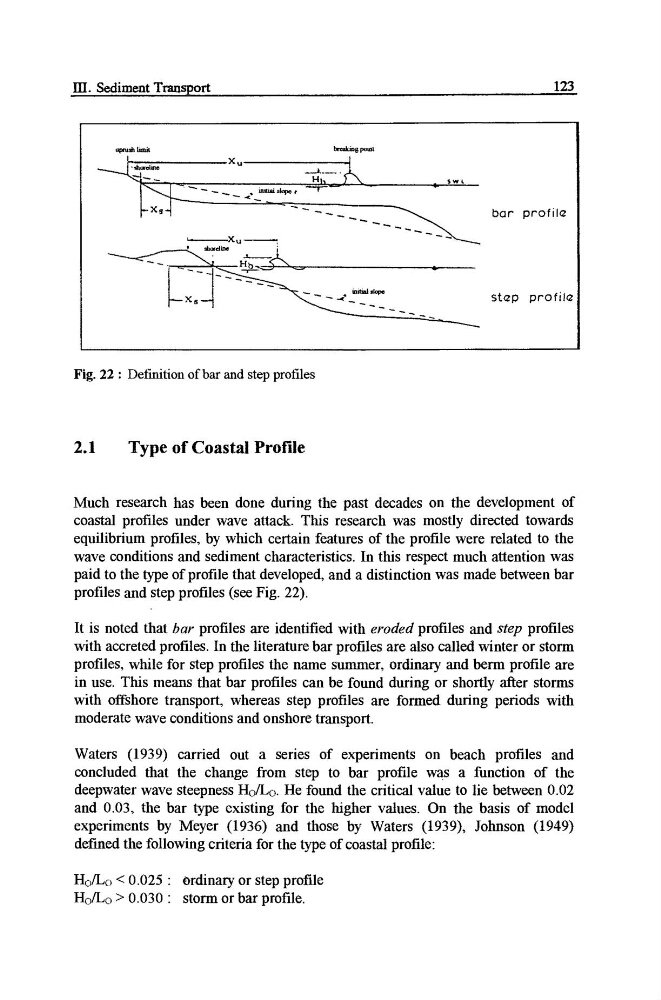
Fig. 22 : Definition of bar and step profiles
2.1
Type of Coastal Profile
Much research has been done during the past decades on the development of
coastal profiles under wave attack. This research was mostly directed towards
equilibrium profiles, by which certain features of the profile were related to the
wave conditions and sediment characteristics. In this respect much attention was
paid to the type of profile that developed, and a distinction was made between bar
profiles and step profiles (see Fig. 22).
It is noted that bar profiles are identified with eroded profiles and step profiles
with accreted profiles. In the literature bar profiles are also called winter or storm
profiles, while for step profiles the name summer, ordinary and berm profile are
in use. This means that bar profiles can be found during or shortly after storms
with offshore transport, whereas step profiles are formed during periods with
moderate wave conditions and onshore transport.
Waters (1939) carried out a series of experiments on beach profiles and
concluded that the change from step to bar profile was a function of the
deepwater wave steepness Ho/Lo. He found the critical value to lie between 0.02
and 0.03, the bar type existing for the higher values. On the basis of model
experiments by Meyer (1936) and those by Waters (1939), Johnson (1949)
defined the following criteria for the type of coastal profile:
HJLo < 0.025 • ordinary or step profile
HcJLo > 0.030 • storm or bar profile.
.............
123
~t~ t~it
b~,mg fmmt
L
Xu
-
'
-
46
swt
X t~
' ,
bar profil~
step profiJe
Fig. 22 : Definition of bar and step profiles
2.1
Type of Coastal Profile
Much research has been done during the past decades on the development of
coastal profiles under wave attack. This research was mostly directed towards
equilibrium profiles, by which certain features of the profile were related to the
wave conditions and sediment characteristics. In this respect much attention was
paid to the type of profile that developed, and a distinction was made between bar
profiles and step profiles (see Fig. 22).
It is noted that bar profiles are identified with eroded profiles and step profiles
with accreted profiles. In the literature bar profiles are also called winter or storm
profiles, while for step profiles the name summer, ordinary and berm profile are
in use. This means that bar profiles can be found during or shortly after storms
with offshore transport, whereas step profiles are formed during periods with
moderate wave conditions and onshore transport.
Waters (1939) carried out a series of experiments on beach profiles and
concluded that the change from step to bar profile was a function of the
deepwater wave steepness Ho/Lo. He found the critical value to lie between 0.02
and 0.03, the bar type existing for the higher values. On the basis of model
experiments by Meyer (1936) and those by Waters (1939), Johnson (1949)
defined the following criteria for the type of coastal profile:
HJLo < 0.025 • ordinary or step profile
HcJLo > 0.030 • storm or bar profile.