

HI. Sediment Transport
..........
121
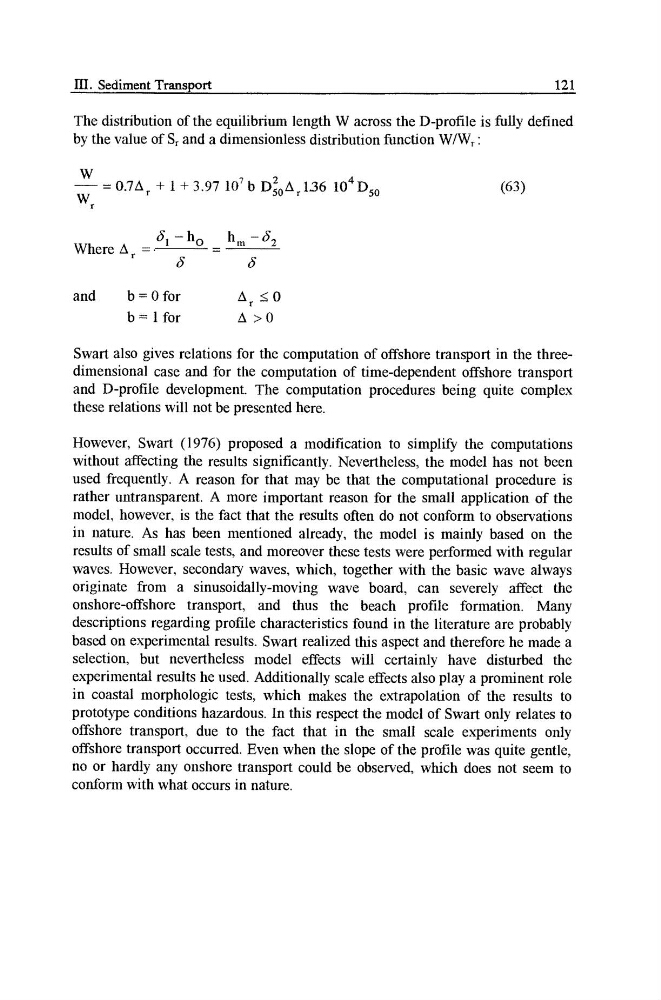
The distribution of the equilibrium length W across the D-profile is fully defined
by the value of Sr and a dimensionless distribution function W/Wr"
W
2 A
-0.7A r + 1 + 3.97 107b Ds0 r136 104D5o
(63)
W~
di - ho
hm - d2
Where A r -'-- -and
b = 0 for
A r -< 0
b= 1 for
A >0
Swart also gives relations for the computation of offshore transport in the threedimensional case and for the computation of time-dependent offshore transport
and D-profile development. The computation procedures being quite complex
these relations will not be presented here.
However, Swart (1976) proposed a modification to simplify the computations
without affecting the results significantly° Nevertheless, the model has not been
used frequently. A reason for that may be that the computational procedure is
rather untransparent. A more important reason for the small application of the
model, however, is the fact that the results often do not conform to observations
in nature. As has been mentioned already, the model is mainly based on the
results of small scale tests, and moreover these tests were performed with regular
waves. However, secondary waves, which, together with the basic wave always
originate from a sinusoidally-moving wave board, can severely affect the
onshore-offshore transport, and thus the beach profile formation. Many
descriptions regarding profile characteristics found in the literature are probably
based on experimental results. Swart realized this aspect and therefore he made a
selection, but nevertheless model effects will certainly have disturbed the
experimental results he used. Additionally scale effects also play a pronrinent role
in coastal morphologic tests, which makes the extrapolation of the results to
prototype conditions hazardous. In this respect the model of Swart only relates to
offshore transport, due to the fact that in the small scale experiments only
offshore transport occurred. Even when the slope of the profile was quite gentle,
no or hardly ally onshore transport could be observed, which does not seem to
conform with what occurs in nature.
..........
121
The distribution of the equilibrium length W across the D-profile is fully defined
by the value of Sr and a dimensionless distribution function W/Wr"
W
2 A
-0.7A r + 1 + 3.97 107b Ds0 r136 104D5o
(63)
W~
di - ho
hm - d2
Where A r -'-- -and
b = 0 for
A r -< 0
b= 1 for
A >0
Swart also gives relations for the computation of offshore transport in the threedimensional case and for the computation of time-dependent offshore transport
and D-profile development. The computation procedures being quite complex
these relations will not be presented here.
However, Swart (1976) proposed a modification to simplify the computations
without affecting the results significantly° Nevertheless, the model has not been
used frequently. A reason for that may be that the computational procedure is
rather untransparent. A more important reason for the small application of the
model, however, is the fact that the results often do not conform to observations
in nature. As has been mentioned already, the model is mainly based on the
results of small scale tests, and moreover these tests were performed with regular
waves. However, secondary waves, which, together with the basic wave always
originate from a sinusoidally-moving wave board, can severely affect the
onshore-offshore transport, and thus the beach profile formation. Many
descriptions regarding profile characteristics found in the literature are probably
based on experimental results. Swart realized this aspect and therefore he made a
selection, but nevertheless model effects will certainly have disturbed the
experimental results he used. Additionally scale effects also play a pronrinent role
in coastal morphologic tests, which makes the extrapolation of the results to
prototype conditions hazardous. In this respect the model of Swart only relates to
offshore transport, due to the fact that in the small scale experiments only
offshore transport occurred. Even when the slope of the profile was quite gentle,
no or hardly ally onshore transport could be observed, which does not seem to
conform with what occurs in nature.