

ffl. Sediment Transport
119
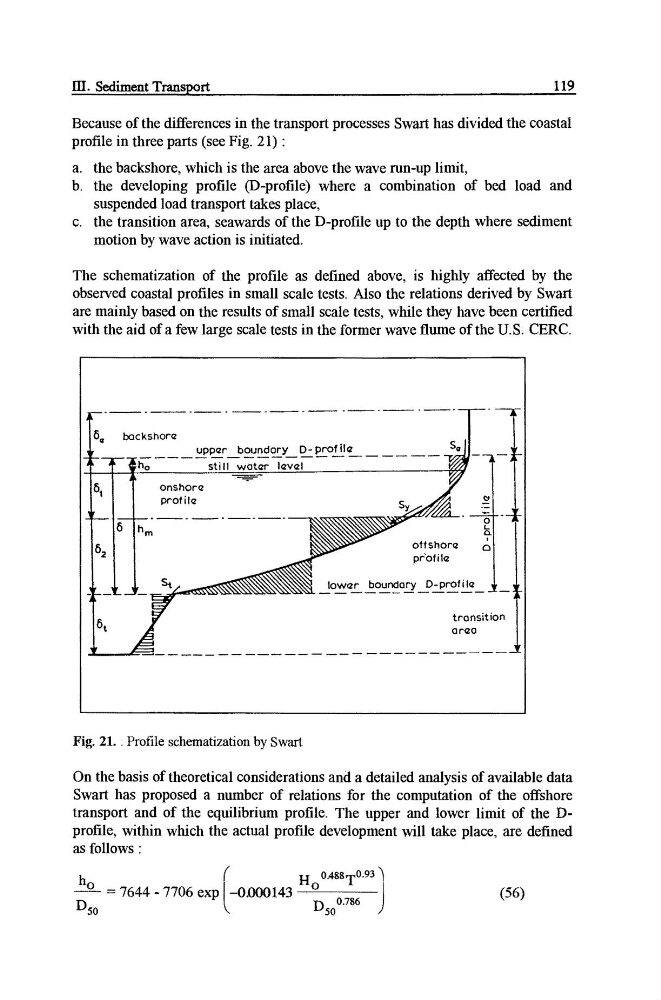
Because of the differences in the transport processes Swart has divided the coastal
profile in three parts (see Fig. 21) :
a. the backshore, which is the area above the wave rim-up limit,
b. the developing profile (D-profile) where a combination of bed load and
suspended load transport takes place,
c. the transition area, seawards of the D-profile up to the depth where sediment
motion by wave action is initiated.
The schematization of the profile as defined above, is highly affected by the
observed coastal profiles in small scale tests° Also the relations derived by Swart
are mainly based on the results of small scale tests, while they have been certified
with the aid of a few large scale tests in the former wave flume of the U.S. CERC.
'
L
~a bockshore
~
t
upper__bound 0ry__ D__ 2 p rof i le
still wot~'f level
i
--w~J
onshore
~
]
protile
S ~
--~
!
~ o H s h o r e
c~
~
pr"ofile
lower boundo~
tronsition
QreQ
Fig. 21. Profile schematization by Swart
On the basis of theoretical considerations and a detailed analysis of available data
Swart has proposed a number of relations for the computation of the offshore
transport and of the equilibrium profile. The upper and lower limit of the Dprofile, within which the actual profile development will take place, are defined
as follows :
(
I-I o o .488 T O .93
h-~° = 7644- 7706 exp I-0.000143
|
(56)
DsO
\
Dso
0.786
)
119
Because of the differences in the transport processes Swart has divided the coastal
profile in three parts (see Fig. 21) :
a. the backshore, which is the area above the wave rim-up limit,
b. the developing profile (D-profile) where a combination of bed load and
suspended load transport takes place,
c. the transition area, seawards of the D-profile up to the depth where sediment
motion by wave action is initiated.
The schematization of the profile as defined above, is highly affected by the
observed coastal profiles in small scale tests° Also the relations derived by Swart
are mainly based on the results of small scale tests, while they have been certified
with the aid of a few large scale tests in the former wave flume of the U.S. CERC.
'
L
~a bockshore
~
t
upper__bound 0ry__ D__ 2 p rof i le
still wot~'f level
i
--w~J
onshore
~
]
protile
S ~
--~
!
~ o H s h o r e
c~
~
pr"ofile
lower boundo~
tronsition
QreQ
Fig. 21. Profile schematization by Swart
On the basis of theoretical considerations and a detailed analysis of available data
Swart has proposed a number of relations for the computation of the offshore
transport and of the equilibrium profile. The upper and lower limit of the Dprofile, within which the actual profile development will take place, are defined
as follows :
(
I-I o o .488 T O .93
h-~° = 7644- 7706 exp I-0.000143
|
(56)
DsO
\
Dso
0.786
)