

2 Topography, Hydrography, Circulation and Modelling of the Baltic Sea
51
The solution is q = i∇p/(ρf ), thus the flow direction is perpendicular to the pressure gradient (i.e., parallel with the isobars) with higher pressure on the right when
facing the direction of the motion in the northern hemisphere. In the barotropic case
the geostrophic flow is depth-independent, whereas in the baroclinic case the flow
varies with depth. The geostrophic solution is horizontally non-divergent and therefore w = 0 everywhere. Consequently, the flow conserves its forcing, the pressure
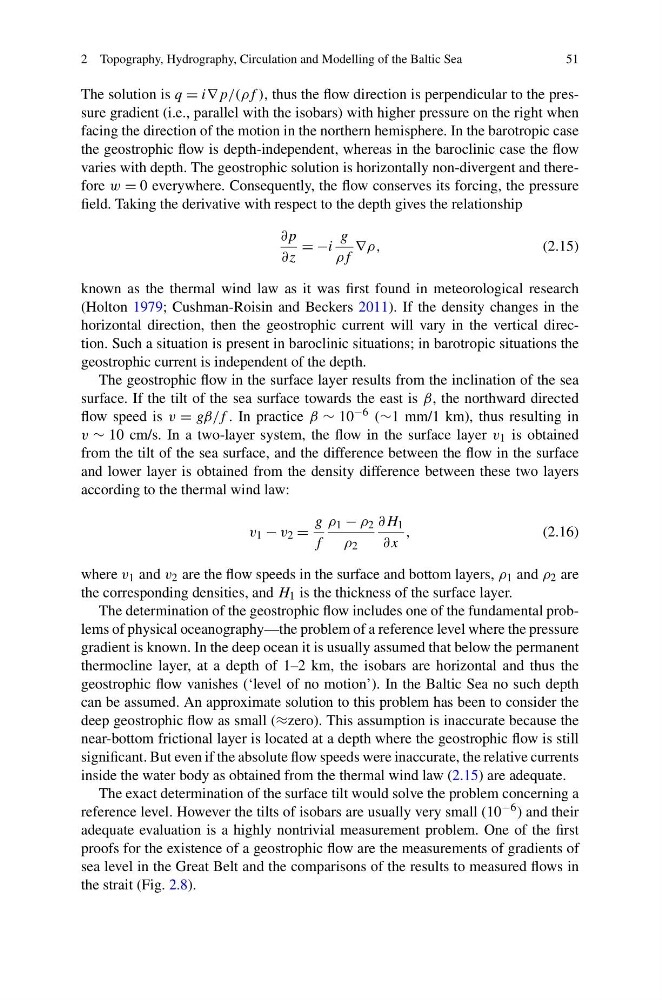
field. Taking the derivative with respect to the depth gives the relationship
∂p
∂z
= −i
g
ρf
∇ρ,
(2.15)
known as the thermal wind law as it was first found in meteorological research
(Holton 1979; Cushman-Roisin and Beckers 2011). If the density changes in the
horizontal direction, then the geostrophic current will vary in the vertical direction. Such a situation is present in baroclinic situations; in barotropic situations the
geostrophic current is independent of the depth.
The geostrophic flow in the surface layer results from the inclination of the sea
surface. If the tilt of the sea surface towards the east is β, the northward directed
flow speed is v = gβ/f . In practice β ∼ 10 −6 (∼1 mm/1 km), thus resulting in
v ∼ 10 cm/s. In a two-layer system, the flow in the surface layer v 1 is obtained
from the tilt of the sea surface, and the difference between the flow in the surface
and lower layer is obtained from the density difference between these two layers
according to the thermal wind law:
v 1 − v 2 =
g
f
ρ 1 − ρ 2
ρ 2
∂H 1
∂x
,
(2.16)
where v 1 and v 2 are the flow speeds in the surface and bottom layers, ρ 1 and ρ 2 are
the corresponding densities, and H 1 is the thickness of the surface layer.
The determination of the geostrophic flow includes one of the fundamental problems of physical oceanography—the problem of a reference level where the pressure
gradient is known. In the deep ocean it is usually assumed that below the permanent
thermocline layer, at a depth of 1–2 km, the isobars are horizontal and thus the
geostrophic flow vanishes (‘level of no motion’). In the Baltic Sea no such depth
can be assumed. An approximate solution to this problem has been to consider the
deep geostrophic flow as small (≈zero). This assumption is inaccurate because the
near-bottom frictional layer is located at a depth where the geostrophic flow is still
significant. But even if the absolute flow speeds were inaccurate, the relative currents
inside the water body as obtained from the thermal wind law (2.15) are adequate.
The exact determination of the surface tilt would solve the problem concerning a
reference level. However the tilts of isobars are usually very small (10 −6 ) and their
adequate evaluation is a highly nontrivial measurement problem. One of the first
proofs for the existence of a geostrophic flow are the measurements of gradients of
sea level in the Great Belt and the comparisons of the results to measured flows in
the strait (Fig. 2.8).
51
The solution is q = i∇p/(ρf ), thus the flow direction is perpendicular to the pressure gradient (i.e., parallel with the isobars) with higher pressure on the right when
facing the direction of the motion in the northern hemisphere. In the barotropic case
the geostrophic flow is depth-independent, whereas in the baroclinic case the flow
varies with depth. The geostrophic solution is horizontally non-divergent and therefore w = 0 everywhere. Consequently, the flow conserves its forcing, the pressure
field. Taking the derivative with respect to the depth gives the relationship
∂p
∂z
= −i
g
ρf
∇ρ,
(2.15)
known as the thermal wind law as it was first found in meteorological research
(Holton 1979; Cushman-Roisin and Beckers 2011). If the density changes in the
horizontal direction, then the geostrophic current will vary in the vertical direction. Such a situation is present in baroclinic situations; in barotropic situations the
geostrophic current is independent of the depth.
The geostrophic flow in the surface layer results from the inclination of the sea
surface. If the tilt of the sea surface towards the east is β, the northward directed
flow speed is v = gβ/f . In practice β ∼ 10 −6 (∼1 mm/1 km), thus resulting in
v ∼ 10 cm/s. In a two-layer system, the flow in the surface layer v 1 is obtained
from the tilt of the sea surface, and the difference between the flow in the surface
and lower layer is obtained from the density difference between these two layers
according to the thermal wind law:
v 1 − v 2 =
g
f
ρ 1 − ρ 2
ρ 2
∂H 1
∂x
,
(2.16)
where v 1 and v 2 are the flow speeds in the surface and bottom layers, ρ 1 and ρ 2 are
the corresponding densities, and H 1 is the thickness of the surface layer.
The determination of the geostrophic flow includes one of the fundamental problems of physical oceanography—the problem of a reference level where the pressure
gradient is known. In the deep ocean it is usually assumed that below the permanent
thermocline layer, at a depth of 1–2 km, the isobars are horizontal and thus the
geostrophic flow vanishes (‘level of no motion’). In the Baltic Sea no such depth
can be assumed. An approximate solution to this problem has been to consider the
deep geostrophic flow as small (≈zero). This assumption is inaccurate because the
near-bottom frictional layer is located at a depth where the geostrophic flow is still
significant. But even if the absolute flow speeds were inaccurate, the relative currents
inside the water body as obtained from the thermal wind law (2.15) are adequate.
The exact determination of the surface tilt would solve the problem concerning a
reference level. However the tilts of isobars are usually very small (10 −6 ) and their
adequate evaluation is a highly nontrivial measurement problem. One of the first
proofs for the existence of a geostrophic flow are the measurements of gradients of
sea level in the Great Belt and the comparisons of the results to measured flows in
the strait (Fig. 2.8).