

42
K. Myrberg and A. Lehmann
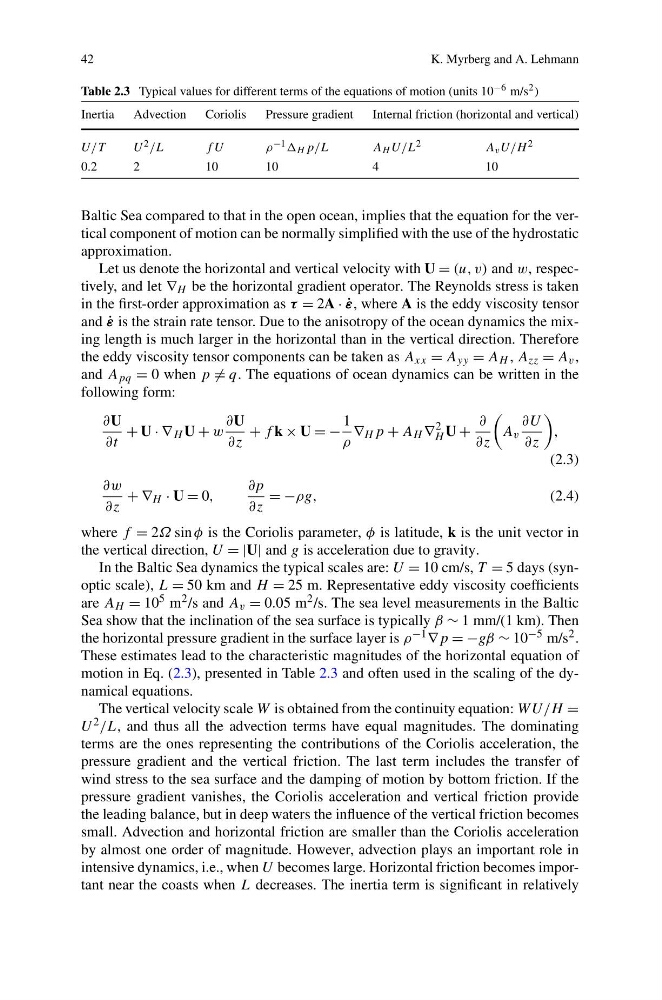
Table 2.3 Typical values for different terms of the equations of motion (units 10 −6 m/s 2 )
Inertia
Advection
Coriolis
Pressure gradient
Internal friction (horizontal and vertical)
U/T
U 2 /L
f U
ρ −1 H p/L
A H U/L 2
A v U/H 2
0.2
2
10
10
4
10
Baltic Sea compared to that in the open ocean, implies that the equation for the vertical component of motion can be normally simplified with the use of the hydrostatic
approximation.
Let us denote the horizontal and vertical velocity with U = (u, v) and w, respectively, and let ∇ H be the horizontal gradient operator. The Reynolds stress is taken
in the first-order approximation as τ = 2A · ˙
ε, where A is the eddy viscosity tensor
and ˙
ε is the strain rate tensor. Due to the anisotropy of the ocean dynamics the mixing length is much larger in the horizontal than in the vertical direction. Therefore
the eddy viscosity tensor components can be taken as A xx = A yy = A H , A zz = A v ,
and A pq = 0 when p = q. The equations of ocean dynamics can be written in the
following form:
∂U
∂t
+ U · ∇ H U + w
∂U
∂z
+ f k × U = −
1
ρ
∇ H p + A H ∇
2
H U +
∂
∂z
A v
∂U
∂z
,
(2.3)
∂w
∂z
+ ∇ H · U = 0,
∂p
∂z
= −ρg,
(2.4)
where f = 2Ω sin φ is the Coriolis parameter, φ is latitude, k is the unit vector in
the vertical direction, U = |U| and g is acceleration due to gravity.
In the Baltic Sea dynamics the typical scales are: U = 10 cm/s, T = 5 days (synoptic scale), L = 50 km and H = 25 m. Representative eddy viscosity coefficients
are A H = 10 5 m 2 /s and A v = 0.05 m 2 /s. The sea level measurements in the Baltic
Sea show that the inclination of the sea surface is typically β ∼ 1 mm/(1 km). Then
the horizontal pressure gradient in the surface layer is ρ −1 ∇p = −gβ ∼ 10 −5 m/s 2 .
These estimates lead to the characteristic magnitudes of the horizontal equation of
motion in Eq. (2.3), presented in Table 2.3 and often used in the scaling of the dynamical equations.
The vertical velocity scale W is obtained from the continuity equation: W U/H =
U 2 /L, and thus all the advection terms have equal magnitudes. The dominating
terms are the ones representing the contributions of the Coriolis acceleration, the
pressure gradient and the vertical friction. The last term includes the transfer of
wind stress to the sea surface and the damping of motion by bottom friction. If the
pressure gradient vanishes, the Coriolis acceleration and vertical friction provide
the leading balance, but in deep waters the influence of the vertical friction becomes
small. Advection and horizontal friction are smaller than the Coriolis acceleration
by almost one order of magnitude. However, advection plays an important role in
intensive dynamics, i.e., when U becomes large. Horizontal friction becomes important near the coasts when L decreases. The inertia term is significant in relatively
K. Myrberg and A. Lehmann
Table 2.3 Typical values for different terms of the equations of motion (units 10 −6 m/s 2 )
Inertia
Advection
Coriolis
Pressure gradient
Internal friction (horizontal and vertical)
U/T
U 2 /L
f U
ρ −1 H p/L
A H U/L 2
A v U/H 2
0.2
2
10
10
4
10
Baltic Sea compared to that in the open ocean, implies that the equation for the vertical component of motion can be normally simplified with the use of the hydrostatic
approximation.
Let us denote the horizontal and vertical velocity with U = (u, v) and w, respectively, and let ∇ H be the horizontal gradient operator. The Reynolds stress is taken
in the first-order approximation as τ = 2A · ˙
ε, where A is the eddy viscosity tensor
and ˙
ε is the strain rate tensor. Due to the anisotropy of the ocean dynamics the mixing length is much larger in the horizontal than in the vertical direction. Therefore
the eddy viscosity tensor components can be taken as A xx = A yy = A H , A zz = A v ,
and A pq = 0 when p = q. The equations of ocean dynamics can be written in the
following form:
∂U
∂t
+ U · ∇ H U + w
∂U
∂z
+ f k × U = −
1
ρ
∇ H p + A H ∇
2
H U +
∂
∂z
A v
∂U
∂z
,
(2.3)
∂w
∂z
+ ∇ H · U = 0,
∂p
∂z
= −ρg,
(2.4)
where f = 2Ω sin φ is the Coriolis parameter, φ is latitude, k is the unit vector in
the vertical direction, U = |U| and g is acceleration due to gravity.
In the Baltic Sea dynamics the typical scales are: U = 10 cm/s, T = 5 days (synoptic scale), L = 50 km and H = 25 m. Representative eddy viscosity coefficients
are A H = 10 5 m 2 /s and A v = 0.05 m 2 /s. The sea level measurements in the Baltic
Sea show that the inclination of the sea surface is typically β ∼ 1 mm/(1 km). Then
the horizontal pressure gradient in the surface layer is ρ −1 ∇p = −gβ ∼ 10 −5 m/s 2 .
These estimates lead to the characteristic magnitudes of the horizontal equation of
motion in Eq. (2.3), presented in Table 2.3 and often used in the scaling of the dynamical equations.
The vertical velocity scale W is obtained from the continuity equation: W U/H =
U 2 /L, and thus all the advection terms have equal magnitudes. The dominating
terms are the ones representing the contributions of the Coriolis acceleration, the
pressure gradient and the vertical friction. The last term includes the transfer of
wind stress to the sea surface and the damping of motion by bottom friction. If the
pressure gradient vanishes, the Coriolis acceleration and vertical friction provide
the leading balance, but in deep waters the influence of the vertical friction becomes
small. Advection and horizontal friction are smaller than the Coriolis acceleration
by almost one order of magnitude. However, advection plays an important role in
intensive dynamics, i.e., when U becomes large. Horizontal friction becomes important near the coasts when L decreases. The inertia term is significant in relatively