

384
J. Murawski and J. Woge Nielsen
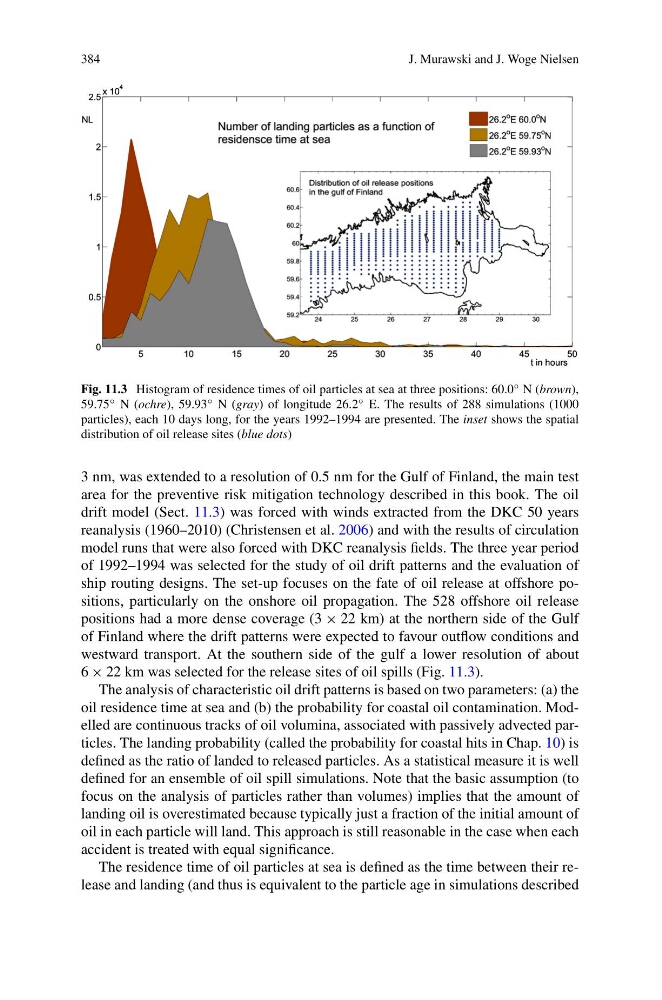
Fig. 11.3 Histogram of residence times of oil particles at sea at three positions: 60.0 ◦ N (brown),
59.75 ◦ N (ochre), 59.93 ◦ N (gray) of longitude 26.2 ◦ E. The results of 288 simulations (1000
particles), each 10 days long, for the years 1992–1994 are presented. The inset shows the spatial
distribution of oil release sites (blue dots)
3 nm, was extended to a resolution of 0.5 nm for the Gulf of Finland, the main test
area for the preventive risk mitigation technology described in this book. The oil
drift model (Sect. 11.3) was forced with winds extracted from the DKC 50 years
reanalysis (1960–2010) (Christensen et al. 2006) and with the results of circulation
model runs that were also forced with DKC reanalysis fields. The three year period
of 1992–1994 was selected for the study of oil drift patterns and the evaluation of
ship routing designs. The set-up focuses on the fate of oil release at offshore positions, particularly on the onshore oil propagation. The 528 offshore oil release
positions had a more dense coverage (3 × 22 km) at the northern side of the Gulf
of Finland where the drift patterns were expected to favour outflow conditions and
westward transport. At the southern side of the gulf a lower resolution of about
6 × 22 km was selected for the release sites of oil spills (Fig. 11.3).
The analysis of characteristic oil drift patterns is based on two parameters: (a) the
oil residence time at sea and (b) the probability for coastal oil contamination. Modelled are continuous tracks of oil volumina, associated with passively advected particles. The landing probability (called the probability for coastal hits in Chap. 10) is
defined as the ratio of landed to released particles. As a statistical measure it is well
defined for an ensemble of oil spill simulations. Note that the basic assumption (to
focus on the analysis of particles rather than volumes) implies that the amount of
landing oil is overestimated because typically just a fraction of the initial amount of
oil in each particle will land. This approach is still reasonable in the case when each
accident is treated with equal significance.
The residence time of oil particles at sea is defined as the time between their release and landing (and thus is equivalent to the particle age in simulations described
J. Murawski and J. Woge Nielsen
Fig. 11.3 Histogram of residence times of oil particles at sea at three positions: 60.0 ◦ N (brown),
59.75 ◦ N (ochre), 59.93 ◦ N (gray) of longitude 26.2 ◦ E. The results of 288 simulations (1000
particles), each 10 days long, for the years 1992–1994 are presented. The inset shows the spatial
distribution of oil release sites (blue dots)
3 nm, was extended to a resolution of 0.5 nm for the Gulf of Finland, the main test
area for the preventive risk mitigation technology described in this book. The oil
drift model (Sect. 11.3) was forced with winds extracted from the DKC 50 years
reanalysis (1960–2010) (Christensen et al. 2006) and with the results of circulation
model runs that were also forced with DKC reanalysis fields. The three year period
of 1992–1994 was selected for the study of oil drift patterns and the evaluation of
ship routing designs. The set-up focuses on the fate of oil release at offshore positions, particularly on the onshore oil propagation. The 528 offshore oil release
positions had a more dense coverage (3 × 22 km) at the northern side of the Gulf
of Finland where the drift patterns were expected to favour outflow conditions and
westward transport. At the southern side of the gulf a lower resolution of about
6 × 22 km was selected for the release sites of oil spills (Fig. 11.3).
The analysis of characteristic oil drift patterns is based on two parameters: (a) the
oil residence time at sea and (b) the probability for coastal oil contamination. Modelled are continuous tracks of oil volumina, associated with passively advected particles. The landing probability (called the probability for coastal hits in Chap. 10) is
defined as the ratio of landed to released particles. As a statistical measure it is well
defined for an ensemble of oil spill simulations. Note that the basic assumption (to
focus on the analysis of particles rather than volumes) implies that the amount of
landing oil is overestimated because typically just a fraction of the initial amount of
oil in each particle will land. This approach is still reasonable in the case when each
accident is treated with equal significance.
The residence time of oil particles at sea is defined as the time between their release and landing (and thus is equivalent to the particle age in simulations described