

372
J. Murawski and J. Woge Nielsen
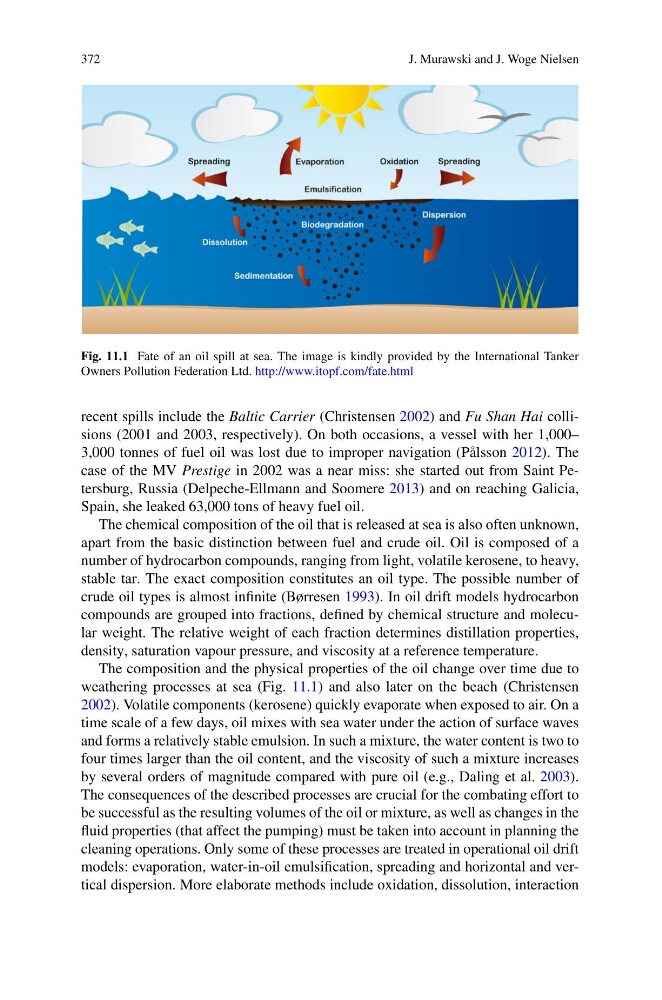
Fig. 11.1 Fate of an oil spill at sea. The image is kindly provided by the International Tanker
Owners Pollution Federation Ltd. http://www.itopf.com/fate.html
recent spills include the Baltic Carrier (Christensen 2002) and Fu Shan Hai collisions (2001 and 2003, respectively). On both occasions, a vessel with her 1,000–
3,000 tonnes of fuel oil was lost due to improper navigation (Pålsson 2012). The
case of the MV Prestige in 2002 was a near miss: she started out from Saint Petersburg, Russia (Delpeche-Ellmann and Soomere 2013) and on reaching Galicia,
Spain, she leaked 63,000 tons of heavy fuel oil.
The chemical composition of the oil that is released at sea is also often unknown,
apart from the basic distinction between fuel and crude oil. Oil is composed of a
number of hydrocarbon compounds, ranging from light, volatile kerosene, to heavy,
stable tar. The exact composition constitutes an oil type. The possible number of
crude oil types is almost infinite (Børresen 1993). In oil drift models hydrocarbon
compounds are grouped into fractions, defined by chemical structure and molecular weight. The relative weight of each fraction determines distillation properties,
density, saturation vapour pressure, and viscosity at a reference temperature.
The composition and the physical properties of the oil change over time due to
weathering processes at sea (Fig. 11.1) and also later on the beach (Christensen
2002). Volatile components (kerosene) quickly evaporate when exposed to air. On a
time scale of a few days, oil mixes with sea water under the action of surface waves
and forms a relatively stable emulsion. In such a mixture, the water content is two to
four times larger than the oil content, and the viscosity of such a mixture increases
by several orders of magnitude compared with pure oil (e.g., Daling et al. 2003).
The consequences of the described processes are crucial for the combating effort to
be successful as the resulting volumes of the oil or mixture, as well as changes in the
fluid properties (that affect the pumping) must be taken into account in planning the
cleaning operations. Only some of these processes are treated in operational oil drift
models: evaporation, water-in-oil emulsification, spreading and horizontal and vertical dispersion. More elaborate methods include oxidation, dissolution, interaction
J. Murawski and J. Woge Nielsen
Fig. 11.1 Fate of an oil spill at sea. The image is kindly provided by the International Tanker
Owners Pollution Federation Ltd. http://www.itopf.com/fate.html
recent spills include the Baltic Carrier (Christensen 2002) and Fu Shan Hai collisions (2001 and 2003, respectively). On both occasions, a vessel with her 1,000–
3,000 tonnes of fuel oil was lost due to improper navigation (Pålsson 2012). The
case of the MV Prestige in 2002 was a near miss: she started out from Saint Petersburg, Russia (Delpeche-Ellmann and Soomere 2013) and on reaching Galicia,
Spain, she leaked 63,000 tons of heavy fuel oil.
The chemical composition of the oil that is released at sea is also often unknown,
apart from the basic distinction between fuel and crude oil. Oil is composed of a
number of hydrocarbon compounds, ranging from light, volatile kerosene, to heavy,
stable tar. The exact composition constitutes an oil type. The possible number of
crude oil types is almost infinite (Børresen 1993). In oil drift models hydrocarbon
compounds are grouped into fractions, defined by chemical structure and molecular weight. The relative weight of each fraction determines distillation properties,
density, saturation vapour pressure, and viscosity at a reference temperature.
The composition and the physical properties of the oil change over time due to
weathering processes at sea (Fig. 11.1) and also later on the beach (Christensen
2002). Volatile components (kerosene) quickly evaporate when exposed to air. On a
time scale of a few days, oil mixes with sea water under the action of surface waves
and forms a relatively stable emulsion. In such a mixture, the water content is two to
four times larger than the oil content, and the viscosity of such a mixture increases
by several orders of magnitude compared with pure oil (e.g., Daling et al. 2003).
The consequences of the described processes are crucial for the combating effort to
be successful as the resulting volumes of the oil or mixture, as well as changes in the
fluid properties (that affect the pumping) must be taken into account in planning the
cleaning operations. Only some of these processes are treated in operational oil drift
models: evaporation, water-in-oil emulsification, spreading and horizontal and vertical dispersion. More elaborate methods include oxidation, dissolution, interaction