

360
T. Soomere
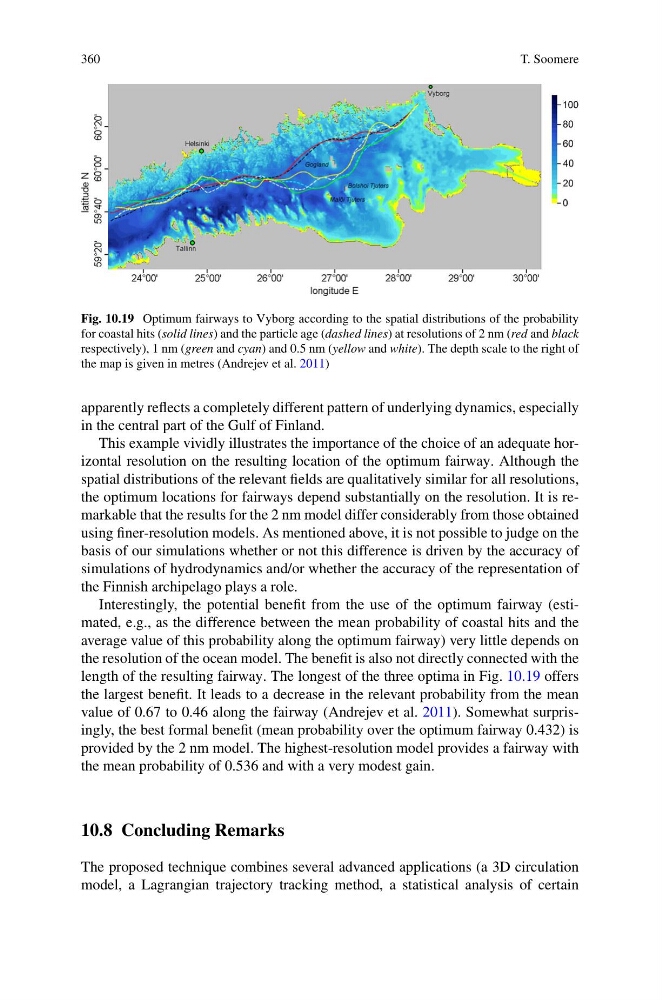
Fig. 10.19 Optimum fairways to Vyborg according to the spatial distributions of the probability
for coastal hits (solid lines) and the particle age (dashed lines) at resolutions of 2 nm (red and black
respectively), 1 nm (green and cyan) and 0.5 nm (yellow and white). The depth scale to the right of
the map is given in metres (Andrejev et al. 2011)
apparently reflects a completely different pattern of underlying dynamics, especially
in the central part of the Gulf of Finland.
This example vividly illustrates the importance of the choice of an adequate horizontal resolution on the resulting location of the optimum fairway. Although the
spatial distributions of the relevant fields are qualitatively similar for all resolutions,
the optimum locations for fairways depend substantially on the resolution. It is remarkable that the results for the 2 nm model differ considerably from those obtained
using finer-resolution models. As mentioned above, it is not possible to judge on the
basis of our simulations whether or not this difference is driven by the accuracy of
simulations of hydrodynamics and/or whether the accuracy of the representation of
the Finnish archipelago plays a role.
Interestingly, the potential benefit from the use of the optimum fairway (estimated, e.g., as the difference between the mean probability of coastal hits and the
average value of this probability along the optimum fairway) very little depends on
the resolution of the ocean model. The benefit is also not directly connected with the
length of the resulting fairway. The longest of the three optima in Fig. 10.19 offers
the largest benefit. It leads to a decrease in the relevant probability from the mean
value of 0.67 to 0.46 along the fairway (Andrejev et al. 2011). Somewhat surprisingly, the best formal benefit (mean probability over the optimum fairway 0.432) is
provided by the 2 nm model. The highest-resolution model provides a fairway with
the mean probability of 0.536 and with a very modest gain.
10.8 Concluding Remarks
The proposed technique combines several advanced applications (a 3D circulation
model, a Lagrangian trajectory tracking method, a statistical analysis of certain
T. Soomere
Fig. 10.19 Optimum fairways to Vyborg according to the spatial distributions of the probability
for coastal hits (solid lines) and the particle age (dashed lines) at resolutions of 2 nm (red and black
respectively), 1 nm (green and cyan) and 0.5 nm (yellow and white). The depth scale to the right of
the map is given in metres (Andrejev et al. 2011)
apparently reflects a completely different pattern of underlying dynamics, especially
in the central part of the Gulf of Finland.
This example vividly illustrates the importance of the choice of an adequate horizontal resolution on the resulting location of the optimum fairway. Although the
spatial distributions of the relevant fields are qualitatively similar for all resolutions,
the optimum locations for fairways depend substantially on the resolution. It is remarkable that the results for the 2 nm model differ considerably from those obtained
using finer-resolution models. As mentioned above, it is not possible to judge on the
basis of our simulations whether or not this difference is driven by the accuracy of
simulations of hydrodynamics and/or whether the accuracy of the representation of
the Finnish archipelago plays a role.
Interestingly, the potential benefit from the use of the optimum fairway (estimated, e.g., as the difference between the mean probability of coastal hits and the
average value of this probability along the optimum fairway) very little depends on
the resolution of the ocean model. The benefit is also not directly connected with the
length of the resulting fairway. The longest of the three optima in Fig. 10.19 offers
the largest benefit. It leads to a decrease in the relevant probability from the mean
value of 0.67 to 0.46 along the fairway (Andrejev et al. 2011). Somewhat surprisingly, the best formal benefit (mean probability over the optimum fairway 0.432) is
provided by the 2 nm model. The highest-resolution model provides a fairway with
the mean probability of 0.536 and with a very modest gain.
10.8 Concluding Remarks
The proposed technique combines several advanced applications (a 3D circulation
model, a Lagrangian trajectory tracking method, a statistical analysis of certain