

10 Applications of the Inverse Problem of Pollution Propagation
339
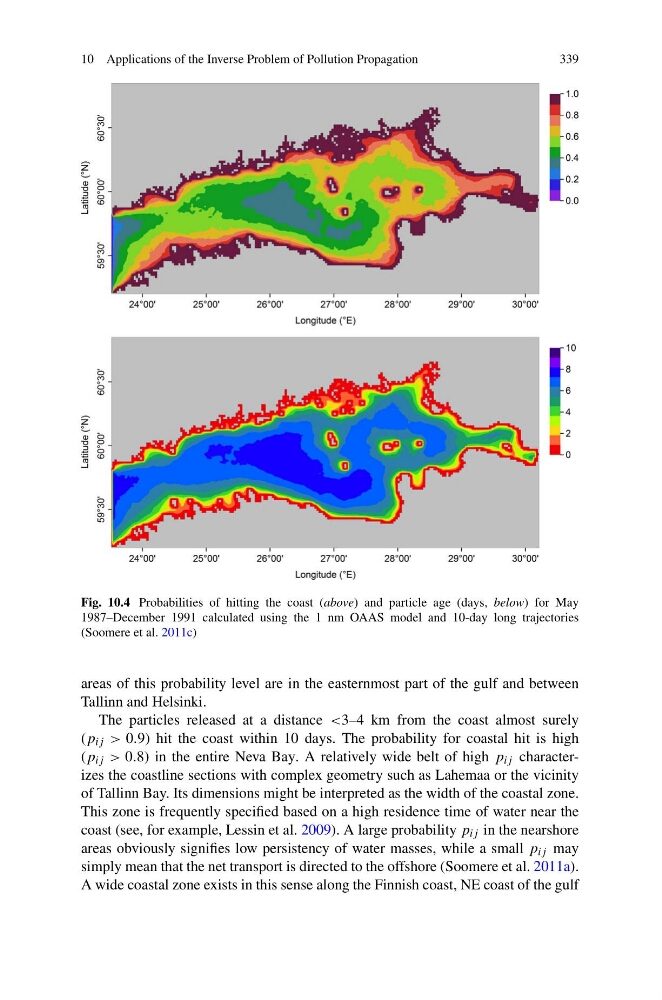
Fig. 10.4 Probabilities of hitting the coast (above) and particle age (days, below) for May
1987–December 1991 calculated using the 1 nm OAAS model and 10-day long trajectories
(Soomere et al. 2011c)
areas of this probability level are in the easternmost part of the gulf and between
Tallinn and Helsinki.
The particles released at a distance <3–4 km from the coast almost surely
(p ij > 0.9) hit the coast within 10 days. The probability for coastal hit is high
(p ij > 0.8) in the entire Neva Bay. A relatively wide belt of high p ij characterizes the coastline sections with complex geometry such as Lahemaa or the vicinity
of Tallinn Bay. Its dimensions might be interpreted as the width of the coastal zone.
This zone is frequently specified based on a high residence time of water near the
coast (see, for example, Lessin et al. 2009). A large probability p ij in the nearshore
areas obviously signifies low persistency of water masses, while a small p ij may
simply mean that the net transport is directed to the offshore (Soomere et al. 2011a).
A wide coastal zone exists in this sense along the Finnish coast, NE coast of the gulf
339
Fig. 10.4 Probabilities of hitting the coast (above) and particle age (days, below) for May
1987–December 1991 calculated using the 1 nm OAAS model and 10-day long trajectories
(Soomere et al. 2011c)
areas of this probability level are in the easternmost part of the gulf and between
Tallinn and Helsinki.
The particles released at a distance <3–4 km from the coast almost surely
(p ij > 0.9) hit the coast within 10 days. The probability for coastal hit is high
(p ij > 0.8) in the entire Neva Bay. A relatively wide belt of high p ij characterizes the coastline sections with complex geometry such as Lahemaa or the vicinity
of Tallinn Bay. Its dimensions might be interpreted as the width of the coastal zone.
This zone is frequently specified based on a high residence time of water near the
coast (see, for example, Lessin et al. 2009). A large probability p ij in the nearshore
areas obviously signifies low persistency of water masses, while a small p ij may
simply mean that the net transport is directed to the offshore (Soomere et al. 2011a).
A wide coastal zone exists in this sense along the Finnish coast, NE coast of the gulf